
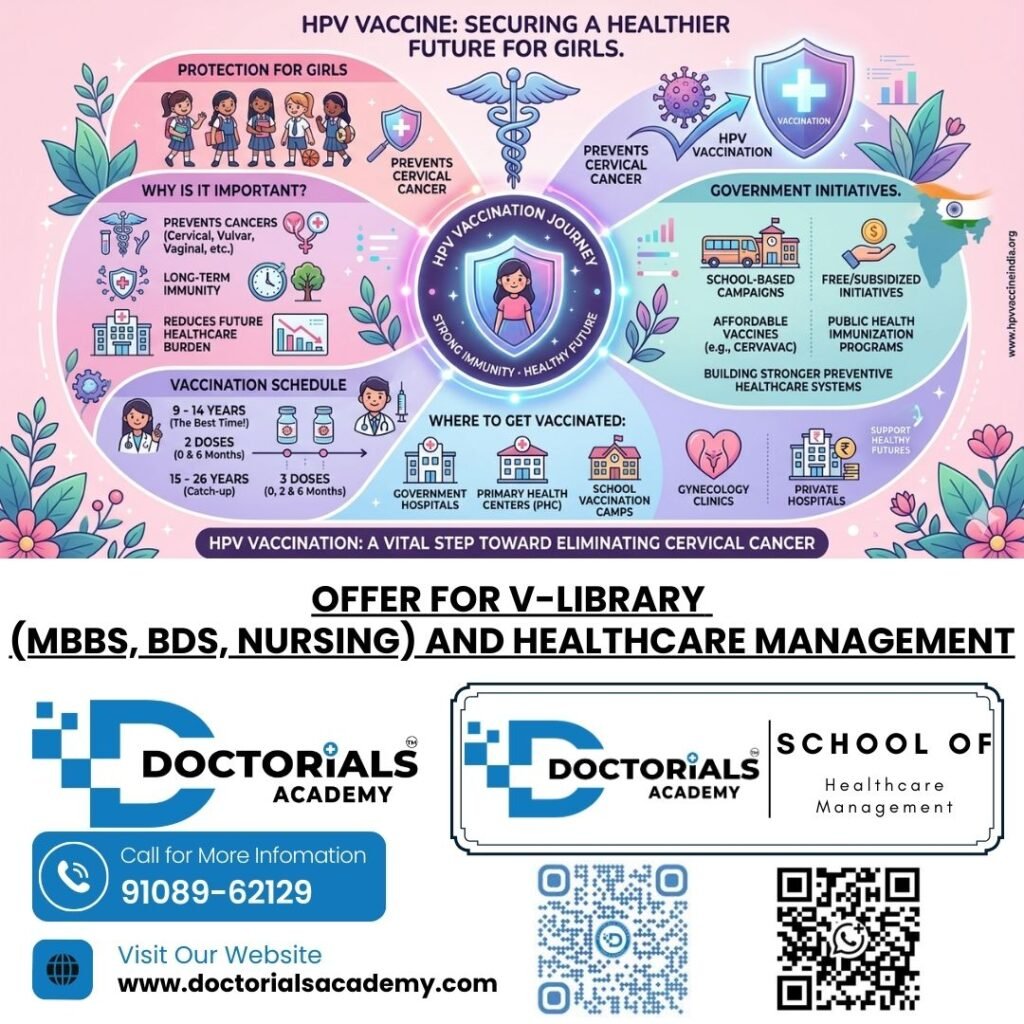
In recent years, awareness about preventive healthcare for women and girls has grown significantly. One of the most important medical breakthroughs in women’s health is the Human Papillomavirus (HPV) vaccine, which protects girls and women from cervical cancer and other HPV-related diseases.
Cervical cancer remains one of the most common cancers among women worldwide. In India alone, more than 1.25 lakh women are diagnosed with cervical cancer every year, and around 75,000 deaths occur annually due to this disease. Fortunately, this cancer is largely preventable, and HPV vaccination plays a crucial role in protecting future generations of women.
This article explains what HPV is, why the HPV vaccine is important for girls, the recommended age group, vaccine schedule, government initiatives, and where girls can get vaccinated.
What is HPV?
Human Papillomavirus (HPV) is a very common virus that spreads through skin-to-skin contact, including sexual contact. There are over 100 types of HPV, and some high-risk strains can lead to serious health problems, including:
- Cervical cancer
- Vaginal cancer
- Vulvar cancer
- Anal cancer
- Throat cancer
- Genital warts
In many cases, HPV infections disappear on their own within a couple of years. However, persistent infections with certain high-risk HPV types can lead to cancer later in life.
The HPV vaccine helps prevent these infections before they occur, which is why it is recommended for girls at an early age.
Why HPV Vaccination is Important for Girls
The HPV vaccine is considered one of the most effective cancer-prevention vaccines available today.
1. Prevents Cervical Cancer
Almost 99% of cervical cancer cases are caused by HPV infection. Vaccination protects against the most dangerous strains responsible for this cancer.
2. Protection Before Exposure
Doctors recommend vaccination before a person becomes exposed to HPV, which is why it is given during preteen years.
3. Long-Term Immunity
Studies show that HPV vaccines provide long-lasting protection against HPV infection and related cancers.
4. Reduces Future Healthcare Burden
By preventing infection early, HPV vaccination reduces the risk of cancer treatment, hospitalizations, and complications later in life.
5. Protects Against Multiple HPV Types
Modern vaccines protect against several HPV strains responsible for the majority of cervical cancer cases and genital warts.
Ideal Age for HPV Vaccination
Medical experts recommend that girls receive the HPV vaccine before they are exposed to the virus.
Recommended Age Groups
| Age Group | Vaccine Schedule |
|---|---|
| 9 – 14 years | 2 doses (0 and 6 months) |
| 15 – 26 years | 3 doses (0, 2, and 6 months) |
| 27 – 45 years | Can be taken after consulting a doctor |
The best and most effective age to get vaccinated is between 9 and 14 years, as the immune response is stronger in younger adolescents.
Doctors usually recommend vaccination at 11–12 years, although it can start as early as 9 years of age.
Types of HPV Vaccines Available
Several HPV vaccines are available globally and in India.
Common HPV Vaccines
- Cervarix – Protects against HPV types 16 and 18 (major cancer-causing strains).
- Gardasil – Protects against HPV types 6, 11, 16, and 18.
- Gardasil 9 – Protects against nine HPV strains.
- Cervavac – India’s affordable HPV vaccine developed by the Serum Institute of India.
Quadrivalent and nonavalent vaccines can prevent over 80–98% of cervical cancer cases, depending on the strain coverage.
Government Support for HPV Vaccination in India
Recognizing the importance of preventing cervical cancer, the Government of India has started initiatives to expand HPV vaccination programs for girls.
National Vaccination Initiative
The Indian government plans to vaccinate girls aged 9 to 14 years through school-based and health center vaccination programs.
Key highlights include:
- Free vaccination at government hospitals and health centers
- School-based vaccination campaigns
- Awareness programs for parents and students
- Collaboration between Health, Education, and Women & Child Development ministries
In many states, HPV vaccination has already started through free immunization programs for adolescent girls.
Recent health campaigns in several Indian cities aim to vaccinate girls aged 14–15 years through public health facilities.
The introduction of Cervavac, an affordable Indian vaccine, has significantly reduced costs and made nationwide vaccination programs possible.
Where Girls Can Get HPV Vaccination
HPV vaccines are available through both government and private healthcare systems.
Government Facilities
Girls can receive the vaccine for free or at subsidized cost at:
- Government hospitals
- Primary Health Centers (PHC)
- Community Health Centers
- School vaccination camps
- Public health immunization programs
Private Healthcare Facilities
Vaccination is also available at:
- Private hospitals
- Gynecology clinics
- Pediatric clinics
- Vaccination centers
In private hospitals, the vaccine may cost ₹2,000 to ₹5,000 per dose, depending on the type of vaccine used.
Is the HPV Vaccine Safe?
Yes. The HPV vaccine has been extensively tested and proven to be safe and effective worldwide.
Common side effects are mild and may include:
- Pain or redness at the injection site
- Mild fever
- Fatigue
- Headache
These side effects usually disappear within a day or two.
Millions of doses have been administered globally, and health organizations including the WHO and CDC strongly recommend HPV vaccination for adolescents.
HPV Vaccination and the Future of Women’s Health
The HPV vaccine is a powerful step toward eliminating cervical cancer worldwide. Public health experts believe that widespread vaccination could significantly reduce cervical cancer cases in the coming decades.
By vaccinating girls early, families and healthcare systems can ensure:
- Healthier future generations
- Reduced cancer burden
- Increased awareness of women’s health
- Stronger preventive healthcare systems
Conclusion
HPV vaccination is not just another vaccine — it is a life-saving preventive measure that protects girls from cervical cancer and other HPV-related diseases.
Parents, healthcare providers, and educational institutions must work together to spread awareness about the importance of HPV vaccination. With strong government support and improved access to vaccines, India has the opportunity to protect millions of young girls from cancer in the future.
Ensuring that girls receive the HPV vaccine at the right age (9–14 years) can make a significant difference in women’s health outcomes for generations to come.
Sources & References
- HPV Vaccination – CDC Overview
- HPV Vaccine Information Statement – CDC
- HPV Vaccine: Who Needs It and How It Works – Mayo Clinic
- WHO Information on Human Papillomavirus Vaccines
- https://atgfoundation.org/understanding-the-importance-of-hpv-vaccination-in-preventing-cervical-cancer/
- https://www.google.com/search?q=details+about+hpv+vaccine

For any of the course please go through the links below.
📞 Call / WhatsApp: 9108962129
📩 Email: sh****@***************my.comDoctors, there is a discount offer
“MBBS, BDS” click here: https://rzp.io/rzp/doctorialsacademyP6wFG9j4
For a limited time
Just for 2500 per year
Website:- https://doctorialsacademy.com/
PGDHM:- https://doctorialsacademy.com/pgdhm/
LinkedIn:- https://in.linkedin.com/company/doctorials-academy
PGDHM LinkedIn: https://www.linkedin.com/company/doctorials-academ-pgdhm/
Abroad LinkedIn: https://www.linkedin.com/company/mbbs-pg-and-pg-abroad-admission/
Facebook:- https://www.facebook.com/people/Doctorials-Academy/61558183675530/
YouTube:- https://www.youtube.com/channel/UCEukyOB7riOSdUhz68tdLzA
Instagram:- https://www.instagram.com/doctorialsacademy/
Android app:- https://play.google.com/store/apps/details?id=com.edmingle.doctorialsacademy&hl=en
LMS:- https://www.doctorialsacademy.in/