
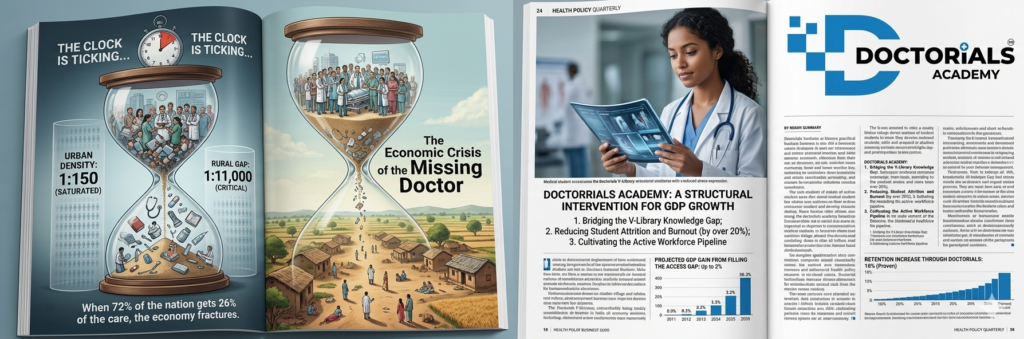
The Paradox of Progress: Analyzing the 1:811 Ratio and the Rural Void
As of 2026, India presents a startling statistical contradiction. On paper, the nation has surpassed the World Health Organization’s (WHO) recommended doctor-to-population ratio of 1:1,000, reaching an estimated 1:811. This figure is derived from approximately 13.88 lakh registered allopathic doctors and over 7.5 lakh AYUSH practitioners. However, this “victory” on paper masks a severe, systemic imbalance that threatens the very foundation of India’s economic growth. The Government of India’s calculation assumes an 80% availability of these registered professionals, yet the “effective” availability is significantly lower due to massive internal and external attrition.
The most critical fracture in this system is the urban-rural divide. While urban centers are often saturated with specialists, approximately 74% of India’s doctors reside in cities, serving a mere 28% of the population. This leaves the remaining 72% of the population—the backbone of India’s agricultural and industrial labor force—vying for the attention of only 26% of the medical workforce. In remote rural blocks, the ratio does not hover near 1:1,000; it collapses to as low as 1:11,000. When a rural worker falls ill, the lack of a local doctor translates into lost working days, expensive travel to urban centers, and a reliance on unqualified practitioners, all of which act as a direct drain on the local and national economy.
The Human Capital Drain: Attrition and the Student Crisis
The pipeline for new doctors is under unprecedented stress. While medical colleges have increased from 387 in 2014 to 818 in 2025, the quality of life and academic pressure on students have reached a breaking point. Data indicates that between 2020 and 2024, over 1,120 PG students and 153 MBBS students dropped out of their programs. More tragically, approximately 119 students committed suicide in this timeframe. This represents not just a human tragedy but a massive “sunk cost” for the Indian economy. Each medical seat represents significant public or private investment; when a student drops out or suffers from burnout-related inefficiency, the potential lifetime economic contribution of a high-value professional is lost.
Macroeconomic Implications: The Cost of Sickness on GDP
Individual sickness acts as a “slow poison” on the national economy. When a citizen is unable to access a doctor, the economic impact radiates through two primary channels: Direct Out-of-Pocket Expenditure (OOPE) and Indirect Productivity Loss. In India, OOPE accounts for nearly 40% of health spending, often pushing families below the poverty line.
Economic Assumptions and GDP Impact: If we assume that 20% of India’s population (approx. 29.4 crore people) does not receive proper or timely treatment due to the doctor shortage, the economic repercussions are quantifiable. Based on average daily wage rates and productivity metrics, a 20% lack of medical access results in an estimated loss of 1.5% to 2% of the national GDP annually. If the gap widens to 30% of the population, the projected loss could escalate to 3.5% of the GDP due to chronic morbidity and premature mortality in the working-age demographic.
The World Economic Forum projects that India stands to lose $4.58 trillion by 2030 due to non-communicable diseases and mental health conditions—issues that are exacerbated by the lack of primary care physicians. A 10% reduction in the disease burden through improved doctor ratios could, by contrast, boost labor productivity enough to add nearly $38 billion to the economy annually.
The Attrition Crisis: The Hidden Cost of Medical Education
India has made heroic efforts to expand the medical education pipeline, increasing the number of medical colleges from 387 in 2014 to 818 by the end of 2025. While MBBS seats have doubled, the output ratio is hampered by a significant “leaking bucket” effect. An estimated 36% of registered doctors are not actively practicing in the Indian clinical workforce. This is driven by early retirement, shifts to non-clinical roles, and massive emigration, with over 100,000 Indian doctors currently serving in foreign healthcare systems.
For the students who remain, the path is fraught with psychological and academic stress. Data from 2020 to 2024 reveals a heartbreaking reality: over 1,120 PG medical students and 153 MBBS students dropped out of their programs nationwide. Even more concerning is the loss of 119 students to suicide during this period. Each dropout represents a failed investment of state resources and private capital, but more importantly, it represents a lost “economic unit” of high-value professional service. When a student leaves the medical path, the potential for thousands of life-saving interventions and the subsequent economic productivity of those patients vanishes.
Macroeconomic Impact: The $4.58 Trillion Slow Poison
Individual sickness is not merely a personal tragedy; it is a macroeconomic liability. The Indian economy is currently facing a “slow poison” effect where treatable illnesses escalate into chronic conditions due to the lack of timely medical intervention. This creates two distinct economic burdens:
- Direct Economic Impact (Micro-level): High Out-of-Pocket Expenditure (OOPE) remains a critical issue, with nearly 40% of health spending paid directly by households. This frequently leads to “catastrophic health expenditure,” where medical bills push families into deep poverty, stripping the economy of consumer spending power.
- Indirect Economic Impact (Macro-level): Absenteeism and reduced labor productivity are the silent killers of GDP growth. A 10% decrease in the incidence of common infectious diseases or malaria has been shown to increase literacy and long-term human capital. Conversely, the World Economic Forum projects that India stands to lose $4.58 trillion by 2030 due to non-communicable diseases (NCDs) and mental health conditions that go untreated due to specialist shortages.
Economic Assumptions of Healthcare Deprivation:
To understand the gravity, consider the impact on India’s 147 crore population. If 20% of the population (approx. 29.4 crore people) is unable to access proper treatment, the resulting loss in productivity and premature mortality is estimated to slash 2% of the national GDP annually. If this gap widens to 30%, the impact could rise to 3.5% of GDP. Filling this gap is not just a social service; it is a financial imperative for a nation aiming for a $5 trillion economy.
Doctorials Academy: Engineering the Solution to the Workforce Gap

This is where Doctorials Academy steps in as a structural interventionist. The academy recognizes that the solution to the doctor-patient ratio is not just building more colleges, but ensuring that the students within those colleges graduate as competent, resilient, and highly efficient professionals.
The Doctorials V-Library is a specialized digital ecosystem designed for doctors, dentists, and nursing professionals. By providing high-quality, streamlined, and accessible medical content, the V-Library directly addresses the academic stress that leads to student burnout and dropouts. It fills the “knowledge lag” that often exists between theoretical textbooks and practical clinical requirements. By making medical education more digestible and less stressful, Doctorials Academy helps maintain a higher “output ratio” of graduates who are ready to enter the workforce.
Furthermore, through programs like the Post Graduate Diploma in Healthcare Management (PGDHM), the academy is training a new generation of leaders who can optimize the management of existing healthcare facilities. This ensures that even in rural areas where doctors are few, the systems they work in are efficient enough to handle higher patient volumes without compromising care quality.
A Call for Strategic Recognition: Value Addition to the National Economy
The work being done by Doctorials Academy serves a greater national cause. By supporting medical students and reducing the attrition rate, the academy is effectively protecting the “Human Capital” of India. Every student who completes their degree with the help of Doctorials Academy tools is a professional who will contribute decades of service to the GDP, reduce the national disease burden, and help bridge the 20% treatment gap.
It is imperative for government bodies and educational institutions to identify the value added by such technological interventions. By trusting in the Doctorials Academy ecosystem, the nation can move toward a future where the 1:811 ratio is not just a registered statistic, but a reality of accessible, high-quality care for every citizen. Solving the doctor-patient ratio is the most direct path to unlocking India’s true economic potential.
Conclusion: A Call for Structural Recognition
The economics of India are the economics of its people’s health. To fill the 20% gap in doctor availability and protect our GDP, we must protect the people who provide the care. Doctorials Academy’s mission to support medical, dental, and nursing students through technology is a vital component of this economic defense. If we can retain even 10% more of our medical graduates and improve their clinical efficiency through tools like the V-Library, the resultant surge in workforce productivity could be the definitive factor in India achieving its long-term economic aspirations.
Data Summary Table
| Metric | Current Status (2025-26) | Economic Impact/Assumption |
| National Doctor-Patient Ratio | 1:811 (including AYUSH) | Exceeds WHO 1:1000 goal |
| Rural Doctor-Patient Ratio | ~1:11,000 (in specific blocks) | High productivity loss in agriculture/labor |
| Urban Concentration | 74% of doctors for 28% of population | Saturation vs. Deprivation |
| Student Attrition (2020-24) | 1,270+ Dropouts / 119 Suicides | Loss of high-value human capital |
| GDP Impact (20% Gap) | ~29.4 Crore people underserved | Estimated 2% annual GDP loss |
| NCD Economic Loss Projection | $4.58 Trillion by 2030 | Preventable through primary care access |
Comprehensive Referral & Source Links
Doctorials Academy Ecosystem:
- Official Website: https://doctorialsacademy.com/
- PGDHM Specialized Training: https://doctorialsacademy.com/pgdhm/
- LMS Platform: https://www.doctorialsacademy.in/
- Android App: Doctorials Academy on the Play Store
- LinkedIn Presence: Doctorials Academy Corporate
Government & Research Data Sources:
- PIB India – Doctor Ratio Updates: https://www.pib.gov.in/PressReleasePage.aspx?PRID=2197614
- Medical Dialogues – Student Attrition RTI: https://medicaldialogues.in/news/education/1166-medical-students-dropped-out-119-committed-suicides-in-last-5-years-reveals-rti-147573
- World Economic Forum – Economic Burden Report: https://www3.weforum.org/docs/WEF_EconomicNonCommunicableDiseasesIndia_Report_2014.pdf
- WHO – Health Financing and Economics: https://www.who.int/teams/health-financing-and-economics/economic-analysis/health-and-wealth
- ScienceDirect – Economic Burden of Disease in India: https://www.sciencedirect.com/science/article/pii/S2590291124002109
📞 Call / WhatsApp: 9108962129
📩 Email: sh****@***************my.com

