
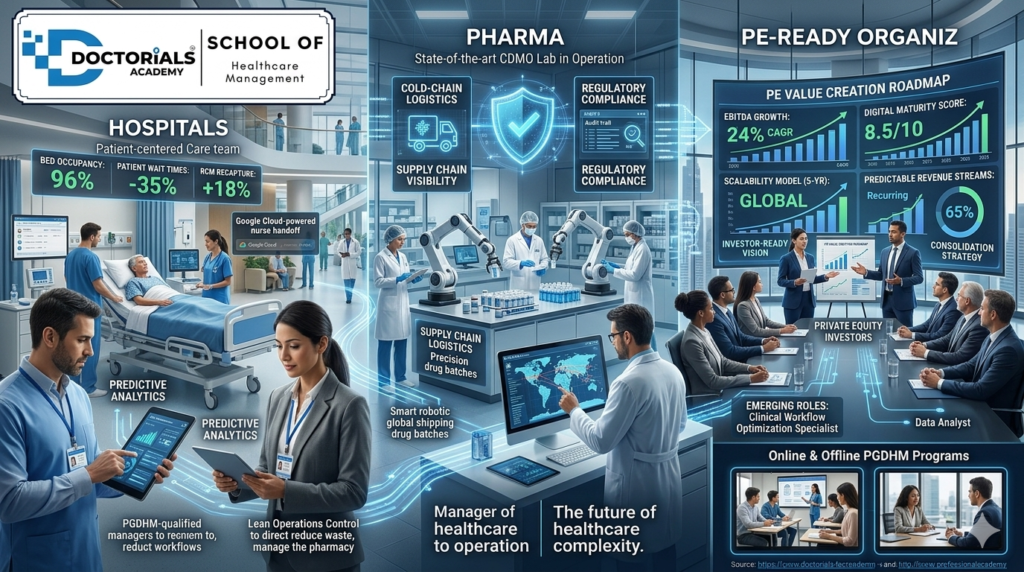
The healthcare industry in 2026 is no longer driven only by doctors, treatments, and medical advancements. It is now equally shaped by strong management systems, operational efficiency, digital transformation, financial discipline, and strategic leadership. Hospitals and pharmaceutical companies are increasingly being evaluated not just by the quality of care they provide, but by how effectively they are run as organizations. This shift has created enormous demand for healthcare management professionals who understand both the clinical and business sides of healthcare.
APPLY NOW: https://doctorialsacademy.com/pgdhm/
Today, a hospital with excellent doctors can still struggle if it lacks proper administration, financial control, patient management systems, and operational discipline. Similarly, a pharmaceutical company with strong products may fail to scale if it does not have supply chain optimization, compliance systems, or strategic investment planning. This is why healthcare management has become one of the most important pillars of modern healthcare organizations. It is no longer an optional support function—it is a core driver of growth, sustainability, and investor confidence.
This growing importance is also directly linked to the rise of Private Equity (PE) investment in healthcare. Investors are actively searching for hospitals, healthcare startups, specialty clinics, diagnostics chains, and pharmaceutical companies that show strong potential for scale and profitability. However, PE firms do not invest simply because a company is in the healthcare sector. They invest in organizations that demonstrate predictable revenue, strong systems, digital maturity, regulatory compliance, and a clear roadmap for growth. These are exactly the areas where healthcare management professionals create the strongest impact.
In fact, global healthcare private equity activity has shown remarkable strength. According to Bain & Company’s Global Healthcare Private Equity Report, healthcare private equity reached major momentum as investors continued focusing on scalable, defensible, and technology-enabled healthcare assets. The industry is moving rapidly from fragmented provider-owned models to centralized, professionally managed platforms. This is especially true in outpatient services, diagnostics, ambulatory care, fertility centers, ophthalmology chains, dental networks, and specialty pharmaceutical services. These sectors offer higher margins, faster scalability, and stronger 5–7-year return potential, making them highly attractive for PE investors.
Healthcare management begins with operational excellence. Every hospital faces daily challenges related to patient flow, staffing, pharmacy management, billing, procurement, and resource allocation. When these areas are poorly managed, even large hospitals suffer from financial leakage and poor patient satisfaction. Long waiting times, inefficient admissions, inventory wastage, poor staff coordination, and delayed discharge processes all reduce profitability and damage reputation. Healthcare managers solve these problems by creating structured systems that improve efficiency and reduce unnecessary costs.
Lean management and Six Sigma practices have become highly relevant in healthcare because they focus on reducing waste and improving quality. For example, optimizing bed occupancy can improve patient turnover and increase revenue without expanding infrastructure. Better pharmacy inventory management reduces medicine wastage and prevents stock shortages. Improved scheduling systems ensure better doctor utilization and smoother patient experience. These are not small improvements; they directly influence the financial strength of hospitals. Private Equity investors pay close attention to such operational efficiency because it reflects management maturity and future scalability.
Digital transformation is another major reason healthcare management professionals are in high demand. Hospitals today are rapidly adopting Electronic Health Records (EHR), AI-powered diagnostics, telemedicine platforms, predictive analytics, automated nurse handoff systems, and revenue cycle management tools. These technologies improve both patient care and organizational performance. However, technology alone does not create transformation. It requires healthcare managers who understand how to implement, monitor, and optimize these systems.
JPMorgan’s 2026 Healthcare Conference Trends report also highlights that technology is no longer a support system—it is becoming the center of healthcare strategy. The expanding role of technology, AI-enabled decision-making, and data-driven patient management is changing how healthcare organizations operate. Investors are no longer only funding hospitals; they are funding platforms that combine healthcare delivery with intelligent technology systems. This shift from “bricks to brains” means that healthcare organizations are investing less in only physical infrastructure and more in data systems, predictive analytics, automation, and workflow optimization.
A strong example of this can be seen in the case of Manipal Hospitals and Google Cloud. Their collaboration focused on improving patient workflow, ePharmacy systems, and nurse handoff processes using digital tools and AI-based systems. The results were remarkable. Order-taking time was reduced from fifteen minutes to less than five minutes. Nurse handover time dropped from ninety minutes to around twenty minutes. More than one lakh patients were integrated into the platform, and prescription workflow accuracy reached nearly ninety-nine percent. This case demonstrates how healthcare management combined with technology creates measurable business outcomes. It also shows why such organizations attract stronger investor interest. Digital maturity increases valuation because it proves scalability and operational discipline.
Revenue Cycle Management (RCM) is another critical area where healthcare managers play a transformative role. Many hospitals lose significant revenue not because they lack patients, but because of weak billing systems, delayed insurance claims, documentation errors, poor collections, and inefficient vendor coordination. Financial leakage in healthcare is often hidden inside everyday operations. Without proper management, hospitals may appear busy while struggling with cash flow problems.
Healthcare management professionals strengthen the financial health of organizations by improving billing processes, insurance coordination, claims management, procurement planning, and vendor negotiations. They ensure that hospitals not only provide care but also remain financially sustainable. A hospital with strong revenue cycle systems is far more attractive to investors because it demonstrates stability and predictability. In 2026, PE firms are placing strong emphasis on recurring revenue models and EBITDA performance, which makes RCM a major strategic priority.
Another often underestimated area is healthcare employee management. Hospitals depend heavily on people—doctors, nurses, technicians, administrators, support staff, and management teams. Without proper workforce planning and employee engagement, even the best infrastructure cannot deliver quality care. Staff burnout, high attrition, poor communication, and lack of motivation directly affect patient outcomes.
Research on healthcare employee management in the Indian healthcare sector highlights that effective HR practices significantly improve hospital performance. When hospitals invest in training, leadership development, performance management, and staff satisfaction, patient experience improves naturally. Happy employees create better patient interactions, stronger brand trust, and long-term organizational stability. This is why healthcare management is deeply connected to human resource strategy. It is not just about operations and finance; it is also about building strong teams that sustain healthcare excellence.
However, private equity-led healthcare transformation is also changing workforce dynamics significantly. As PE firms prioritize operational efficiency and standardized systems, many clinical roles are evolving from purely patient-focused functions to technology-enabled, system-driven roles. Physicians and nurses are increasingly expected to work within highly standardized digital systems, often managing multiple platforms for documentation, scheduling, billing coordination, and AI-supported care delivery. This has created what many professionals describe as “swivel chair work,” where clinicians spend more time managing systems alongside patients.
This has led to the rise of entirely new job categories. One of the most important emerging roles is the Clinical Workflow Optimization Specialist, a professional responsible for ensuring that doctors and nurses are using standardized technology systems efficiently. These professionals help reduce friction between healthcare delivery and operational systems. Similarly, AI and Data Analysts are becoming essential for hospitals and pharma companies because they transform clinical data into strategic insights for patient outcomes, operational performance, and investor reporting.
Revenue Cycle Management specialists are also seeing major demand growth. These professionals focus not just on billing, but on maximizing reimbursements, insurance efficiency, prior authorization systems, and payer relationships. In highly PE-driven healthcare organizations, financial optimization is treated as a strategic function rather than an administrative one.
Administrative roles are evolving too. Traditional front-desk and receptionist roles are transforming into Patient Experience Coordinators who manage CRM systems, patient engagement platforms, scheduling optimization, and long-term patient loyalty strategies. Since outpatient centers are becoming increasingly competitive, patient retention is now viewed as both a service and business priority.
The importance of healthcare management is equally strong in pharmaceutical companies. Many students assume hospital management applies only to hospitals, but the reality is much broader. Pharma companies require skilled professionals for supply chain optimization, regulatory compliance, quality systems, cold-chain logistics, hospital procurement, medical administration, and strategic operations. The healthcare ecosystem is interconnected, and management professionals are needed across all these areas.
In pharmaceutical operations, delays in supply chains or compliance failures can result in enormous financial losses. Regulatory issues can damage both brand value and investor confidence. Healthcare management professionals help create resilient systems that protect business continuity and support sustainable growth. This is especially important as global healthcare businesses face increasing regulatory scrutiny and demand for transparency. Investors look for companies that are not only profitable but also compliant and operationally strong.
Another major growth area is Contract Development and Manufacturing Organizations (CDMOs), where pharmaceutical companies outsource specialized manufacturing and development functions. These organizations are becoming central to global supply chain diversification and healthcare scalability. As PE investors continue backing CDMOs, there is rising demand for operations managers, compliance leaders, supply chain specialists, and healthcare business professionals who understand both pharma operations and strategic growth.
Private Equity investment trends in 2026 clearly show why management matters more than ever. PE firms are holding record levels of capital, often referred to as “dry powder,” but they are highly selective about where they invest. They focus on high-margin, defensible healthcare assets such as specialty hospitals, diagnostics chains, outpatient care networks, and specialized pharmaceutical manufacturing. They prefer businesses with proven management teams and systems that can scale without being dependent on a single founder.
Hospital private equity M&A activity is also expected to rise significantly in 2026, especially as investors move toward outpatient platforms and specialized care networks rather than traditional large inpatient hospital models. PE investors are aggressively consolidating fragmented healthcare providers into larger chains with centralized operations. This strategy improves efficiency, strengthens negotiating power, and creates stronger valuations.
A clear case study of this can be seen in ophthalmology practice consolidation. Private equity firms acquired hundreds of independent ophthalmology practices and merged them into unified regional platforms. The strategy involved acquiring independent practices, centralizing HR, billing, IT, and operational systems, and implementing standardized EMRs and AI-driven diagnostics. The focus shifted toward high-volume outpatient procedures like cataract surgeries, where margins were stronger than traditional acute care settings.
While this improved efficiency and faster patient access, it also created challenges. Studies showed a 265% increase in physician turnover in some consolidated ophthalmology platforms, largely due to higher caseload expectations and reduced professional autonomy. This demonstrates both the opportunity and complexity of PE-driven healthcare transformation. It improves scalability but also demands stronger healthcare leadership to balance business goals with clinician satisfaction and patient care quality.
Consolidation is another major PE strategy. Investors are actively combining fragmented healthcare providers into larger, more efficient chains. For example, multiple diagnostic centers or regional hospitals may be brought together under one structured management platform. This increases efficiency, improves negotiation power, and creates stronger valuation. However, such consolidation is only possible when healthcare management systems are strong enough to support it.
Compliance and transparency have also become non-negotiable. Regulatory oversight in healthcare is increasing, and organizations with strong governance systems are now viewed as safer and more valuable investment opportunities. Compliance is no longer treated as a cost—it is a strategic advantage. Healthcare managers play a crucial role in ensuring NABH standards, policy implementation, documentation quality, audit readiness, and legal compliance. These areas may not be visible to patients, but they are highly visible to investors.
Regulatory and compliance experts are now among the most valuable professionals in PE-backed healthcare companies. As state and federal scrutiny over healthcare deals intensifies, organizations need professionals who can protect both operational integrity and investor trust. This makes compliance knowledge a major career advantage for healthcare management students.
Perhaps the most important factor in attracting PE is the ability to present a clear value creation story. Investors ask one simple question: why should we invest in this company? The answer must be supported by data, systems, and strategy. It must show how the business will grow, how margins will improve, and how risks will be managed. Healthcare managers help build this story by connecting operations, finance, patient outcomes, and business strategy into one investor-ready vision.
This is where students pursuing PGDHM gain a major advantage. Many graduates from B.Sc Nursing, BHMS, BPT, B.Pharm, MBBS, Allied Health Sciences, and even general UG backgrounds often face uncertainty after graduation. They may have domain knowledge but lack the management exposure required for leadership roles. They want better salaries, hospital corporate jobs, healthcare consulting opportunities, or leadership positions in pharma and hospital administration, but do not know how to bridge the gap.
PGDHM, or Post Graduate Diploma in Hospital Management, provides that bridge. It transforms graduates from clinical or academic backgrounds into industry-ready healthcare professionals. It teaches hospital operations, healthcare finance, quality systems, HR management, compliance, healthcare marketing, digital health, and strategic leadership. Instead of being limited to traditional roles, students become prepared for management careers with long-term growth potential.
Today, the job market is shifting from clinician-only careers to hybrid leadership roles. Employers are looking for professionals who understand patient care, operations, technology, compliance, and business strategy together. This is exactly what healthcare management education provides. Students with PGDHM qualifications are positioned for leadership in hospitals, diagnostics chains, insurance companies, healthcare consulting firms, pharma operations, medical administration, and even healthcare entrepreneurship.
PGDHM is even more powerful for those who want to start their own hospitals, clinics, diagnostic centers, or healthcare businesses. Many people dream of building healthcare institutions but struggle because they lack understanding of operations, financial systems, compliance frameworks, and investor expectations. Clinical knowledge alone is not enough to run a successful healthcare business. Management education becomes essential.
This is where Doctorials Academy – School of Healthcare Management creates real value. Doctorials Academy offers both online PGDHM programs for working professionals and offline PGDHM plus PGP dual programs for students seeking deeper career-focused learning. The approach is practical, industry-oriented, and designed around real healthcare challenges rather than only classroom theory.
Students gain exposure to how hospitals function, how healthcare businesses grow, how investments happen, how PE firms evaluate healthcare companies, and how leadership decisions are made. Placement support, career guidance, and industry-oriented training ensure that students are not just earning a certificate but building a professional future. Whether someone is looking for a better job, salary growth, leadership opportunities, or entrepreneurial success in healthcare, PGDHM becomes a career accelerator.
The future of healthcare belongs to professionals who can manage complexity. Doctors save lives, but healthcare managers build systems that allow those lives to be saved efficiently, ethically, and sustainably. In 2026, hospitals and pharma companies are searching for professionals who understand both healthcare delivery and business excellence. This is why healthcare management is no longer a niche field—it is the future of the industry.
For students who want to become part of that future, PGDHM is not simply another qualification. It is the foundation of healthcare leadership. Whether the goal is employment, entrepreneurship, hospital ownership, pharma leadership, or attracting Private Equity into a healthcare venture, the journey begins with management education that is practical, strategic, and industry-driven.
Doctorials Academy stands at the center of that journey, preparing the next generation of healthcare leaders who will not only work in the industry but shape its future.
Source Links
Bain & Company – Global Healthcare Private Equity Report
https://www.bain.com/insights/topics/global-healthcare-private-equity-report
Holland & Knight – Hospital Private Equity M&A Expected to Rise in 2026
JPMorgan – Healthcare Conference 2026 Trends
https://www.jpmorgan.com/insights/banking/investment-banking/health-care-conference-2026-trends
Google Cloud – Manipal Hospitals Case Study
https://cloud.google.com/customers/manipal-hospitals
ResearchGate – Healthcare Employee Management
Website:- https://doctorialsacademy.com/
V-Library: https://doctorialsacademy.com/medical-courses/
PGDHM:- https://doctorialsacademy.com/pgdhm/
📞 Call / WhatsApp: 9108962129
📩 Email: sh****@***************my.com

