India is witnessing one of the largest expansions in medical education in its history. With the approval of 43 new medical colleges and thousands of additional MBBS and postgraduate seats, the government is taking a major step toward strengthening the country’s healthcare workforce. These reforms, guided by the National Medical Commission (NMC) and the Ministry of Health and Family Welfare, aim to improve access to medical education, address the doctor shortage, and modernize medical training across the country.
For aspiring medical students, educators, and healthcare institutions, these developments signal a transformative phase in India’s healthcare education ecosystem.
Historic Increase in Medical Colleges and Seats
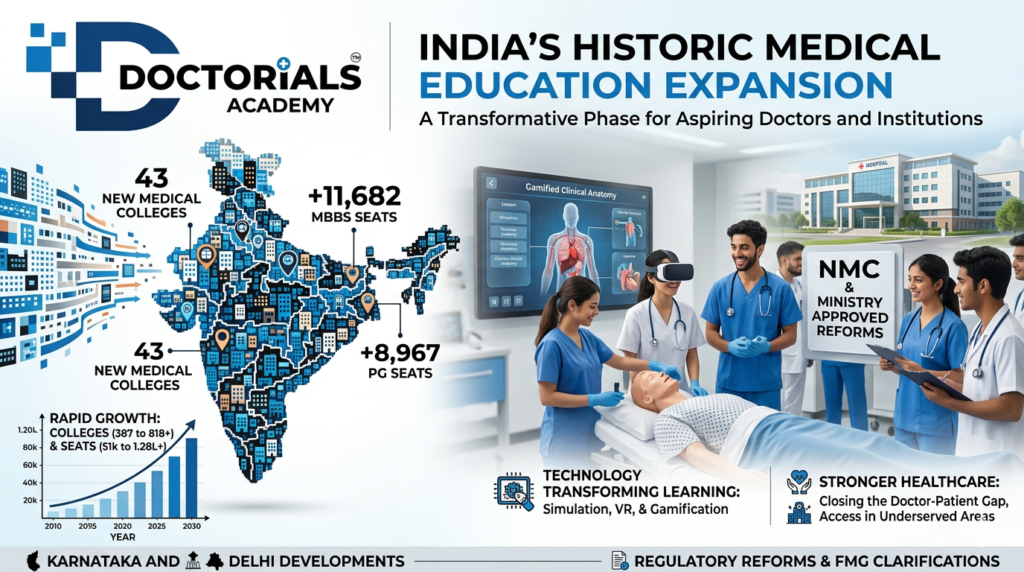
In March 2026, the Indian government approved 43 new medical colleges for the academic year 2025–26. Along with this, authorities sanctioned 11,682 additional MBBS seats and 8,967 postgraduate (PG) seats across medical institutions in India.
This expansion is expected to significantly improve access to medical education for thousands of students who compete every year through the National Eligibility cum Entrance Test (NEET).
Key Highlights of the Expansion
- 43 new medical colleges approved across India
- 11,682 new MBBS seats added
- 8,967 new postgraduate seats introduced
- Seats include institutions such as AIIMS and other Institutes of National Importance
- Focus on expanding medical education in underserved regions and districts
These reforms are part of the government’s broader strategy to increase healthcare capacity and improve the doctor-patient ratio in the country.
Rapid Growth in India’s Medical Education System
India’s medical education sector has grown dramatically over the past decade.
Government data indicates that:
- The number of medical colleges increased from 387 in 2014 to about 818 today
- MBBS seats increased from 51,348 to nearly 1.28 lakh
- Postgraduate seats increased from 31,185 to more than 85,000
This expansion reflects a strong national commitment to building a larger and more skilled healthcare workforce capable of meeting India’s growing healthcare demands.
To support this growth, the government has also launched schemes to establish new medical colleges attached to district hospitals, improving healthcare access in rural and semi-urban regions while offering practical clinical training to students.
Regulatory Reforms by the National Medical Commission
The National Medical Commission has introduced several policy reforms to accelerate medical education expansion.
One of the most notable changes is the relaxation of strict land requirements for establishing new medical colleges. Previously, institutions needed large land parcels to set up a medical college campus.
Under the new guidelines:
- Colleges can operate with flexible infrastructure models
- Urban campuses can use existing hospital facilities
- Institutions can expand more quickly and efficiently
These reforms are expected to encourage more institutions to enter the medical education sector, ultimately increasing the number of doctors trained each year.
New Rules for Foreign Medical Graduates (FMGs)
Another important regulatory development involves Foreign Medical Graduates (FMGs)—Indian students who pursue medical education abroad.
The NMC has clarified that:
- Students who completed online medical education during the pandemic must undergo compensation training through physical clinical postings.
- This ensures that all doctors practicing in India receive adequate hands-on clinical training.
The rule is aimed at maintaining consistent standards of medical education and patient safety.
State-Level Developments Strengthening Healthcare
Many states are also investing heavily in medical education and healthcare infrastructure.
Karnataka
Karnataka’s 2026 health budget includes major investments in medical infrastructure, including funding for super-specialty hospitals and improvements in training facilities. These developments will enhance clinical exposure for medical students and strengthen healthcare services across the state.
Delhi
Delhi is planning to introduce new specialised medical programs, including advanced fellowships such as Gynecologic Oncology training programs, which will expand opportunities for postgraduate specialisation.
Technology Transforming Medical Education
Medical education is also undergoing a technological transformation.
Modern training methods now include:
- Simulation-based medical training
- Virtual patient cases
- Microlearning modules
- Gamified clinical learning systems
These innovations allow students to practice complex procedures in safe simulated environments, improving both skill development and patient outcomes.
For healthcare education providers and EdTech organizations, this shift represents a major opportunity to revolutionize how medical knowledge is delivered and practiced.
Why This Expansion Matters
India continues to face a doctor shortage in many regions, particularly rural areas. Increasing the number of medical colleges and seats helps address this gap.
Key benefits include:
- Greater access to MBBS education
- More postgraduate specialization opportunities
- Improved healthcare services in underserved areas
- Enhanced clinical training infrastructure
- Stronger national healthcare capacity
The expansion will help India move closer to achieving the World Health Organization’s recommended doctor-patient ratio.
The Future of Medical Education in India
India’s healthcare education system is entering a new era of growth and transformation. With expanded infrastructure, progressive regulations, and advanced learning technologies, the country is building one of the largest medical education ecosystems in the world.
These reforms will not only produce more doctors but also ensure that they are well-trained, technologically skilled, and globally competitive.
For aspiring doctors, healthcare professionals, and educational institutions, the future of medical education in India is full of opportunities and innovation.
Sources
- https://indianexpress.com/article/education/43-new-medical-colleges-added-11682-mbbs-seats-cleared-for-2025-26-health-ministry-data-rajya-sabha-neet-ug-pg-10575098/
- https://www.ndtv.com/education/43-new-medical-colleges-added-11-682-mbbs-8-967-pg-seats-approved-for-2025-26-11200577
- https://www.ndtvprofit.com/india/centre-sanctions-11-682-mbbs-8-967-pg-seats-for-2025-26-approves-43-new-medical-colleges
- https://www.millenniumpost.in/nation/govt-to-rs-43-new-medical-colleges-established-11682-mbbs-seats-approved-651232
How Doctorials Academy is Supporting the Next Generation of Medical Students

As India expands its medical education ecosystem with new colleges and thousands of additional MBBS and postgraduate seats, academic support systems and digital learning resources are becoming more important than ever. With larger student populations and increasingly complex medical curricula, students require structured guidance, reliable study resources, and accessible digital learning platforms.
This is where Doctorials Academy plays a crucial role in supporting medical students across the country.
Doctorials Academy is a progressive healthcare education platform focused on strengthening academic support for MBBS, BDS, and Nursing students. The organisation works with medical colleges and healthcare institutions to enhance traditional classroom learning through modern digital tools and structured academic programs.
The V-Library: A Digital Knowledge Hub for Medical Students
One of the key initiatives developed by Doctorials Academy is the V-Library (Virtual Library) — a comprehensive digital learning ecosystem designed specifically for healthcare students.
The V-Library provides structured academic resources that complement university syllabi, making it easier for students to understand complex medical concepts and prepare effectively for examinations.
Key Features of the V-Library
The Doctorials Academy V-Library offers a wide range of academic resources, including:
- Subject-wise video lectures for MBBS, BDS, and Nursing
- Concept-based explanations aligned with the university curriculum
- Exam-oriented revision modules
- Clinical case discussions
- Interactive learning materials and digital notes
- Recorded seminars and expert sessions
- Structured preparation support for university exams
These resources help students bridge the gap between theoretical knowledge and clinical understanding, which is essential in medical education.
How the V-Library Benefits MBBS Students
For MBBS students, the curriculum is vast and academically demanding. The V-Library helps by offering:
- Simplified explanations of complex subjects such as Anatomy, Physiology, Biochemistry, Pathology, Pharmacology, and Medicine
- Structured revision materials for university exams and clinical postings
- Digital lectures that students can revisit anytime for better concept clarity
This allows MBBS students to reinforce classroom learning and build a stronger conceptual foundation throughout their academic journey.
Academic Support for BDS Students
Dental students also face intensive academic and clinical training. Through the V-Library, BDS students gain access to learning resources that cover:
- Dental anatomy and oral histology
- Prosthodontics and orthodontics concepts
- Clinical case discussions
- Exam-focused revision materials
By integrating digital learning with clinical education, the V-Library supports both theoretical understanding and practical application for dental students.
Empowering Nursing Students with Structured Learning
Nursing education requires a strong balance between theoretical knowledge and patient care skills. Doctorials Academy’s V-Library supports GNM and B.Sc Nursing students by providing:
- Clear explanations of nursing fundamentals
- Video-based learning modules for medical-surgical nursing, pediatric nursing, and community health
- Case-based learning to improve clinical decision-making skills
- Exam preparation resources for nursing university assessments
This structured learning environment helps nursing students develop confidence in both academic knowledge and clinical practice.
Supporting the Future of Healthcare Education
With the rapid expansion of medical colleges in India, institutions must also ensure quality education and effective learning support for students. Digital platforms like the Doctorials Academy V-Library are becoming essential tools in modern medical education.
By providing accessible, curriculum-aligned, and technology-driven learning resources, Doctorials Academy is helping medical students:
- Strengthen conceptual understanding
- Improve exam performance
- Develop clinical reasoning skills
- Adapt to modern healthcare learning environments
As India continues to expand its medical education infrastructure, initiatives like the Doctorials Academy V-Library will play a critical role in enhancing the quality of healthcare education and preparing the next generation of doctors, dentists, and nurses.
📞 Call / WhatsApp: 9108962129
📩 Email: sh****@***************my.com
Website:- https://doctorialsacademy.com/
PGDHM:- https://doctorialsacademy.com/pgdhm/
LinkedIn:- https://in.linkedin.com/company/doctorials-academy
PGDHM LinkedIn: https://www.linkedin.com/company/doctorials-academ-pgdhm/
Abroad LinkedIn: https://www.linkedin.com/company/mbbs-pg-and-pg-abroad-admission/
Facebook:- https://www.facebook.com/people/Doctorials-Academy/61558183675530/
YouTube:- https://www.youtube.com/channel/UCEukyOB7riOSdUhz68tdLzA
Instagram:- https://www.instagram.com/doctorialsacademy/
Android app:- https://play.google.com/store/apps/details?id=com.edmingle.doctorialsacademy&hl=en
LMS:- https://www.doctorialsacademy.in/