

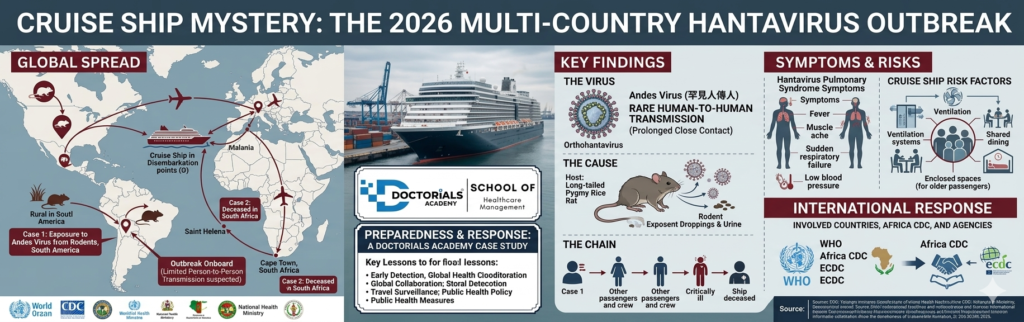
In May 2026, global health authorities were confronted with a rare and alarming public health event that quickly captured international attention. A luxury cruise ship travelling across the Atlantic Ocean became the centre of a multi-country outbreak involving a deadly strain of hantavirus known as the Andes virus. What initially appeared to be a cluster of severe respiratory illnesses soon evolved into one of the most closely monitored infectious disease events of the year.
The outbreak raised urgent questions for scientists, governments, cruise operators, and public health agencies worldwide. Could this rare zoonotic disease spread between humans? Was the confined environment of the cruise ship accelerating transmission? And how prepared was the world to respond to another international infectious disease threat after the lessons learned from COVID-19?
According to the World Health Organization, as of 8 May 2026, eight individuals linked to the cruise ship had developed illness associated with the outbreak, including six laboratory-confirmed infections and three deaths. The event triggered international emergency coordination involving multiple countries across Europe, Africa, and South America.
PGDHM:- https://doctorialsacademy.com/pgdhm/
How the Outbreak Began
The story of the outbreak began long before the cruise ship set sail. Investigations conducted by health authorities suggest that the first probable patient, identified as Case 1, had spent more than three months travelling through Argentina, Chile, and Uruguay before boarding the vessel on 1 April 2026.
During his travels, he reportedly participated in outdoor and ecotourism-related activities, including bird watching in rural environments. Public health investigators believe he was most likely exposed to infected rodents or contaminated environments during this period. The Andes virus is known to circulate naturally in certain rodent populations across South America, particularly in forested and rural regions.
The man developed symptoms on 6 April while aboard the cruise ship. Initially, the illness may not have appeared unusual. Early symptoms of hantavirus infection often resemble influenza or common viral illnesses, including fever, fatigue, headache, chills, and gastrointestinal discomfort. However, his condition rapidly deteriorated, and he died onboard on 11 April.
No laboratory testing was performed before his death, but epidemiological investigations later classified him as a probable case of Andes virus infection.
A Dangerous Chain of Transmission
The situation became more concerning when additional passengers and crew members began developing symptoms over the following weeks.
Case 2, a woman who had travelled closely with Case 1 and boarded the ship alongside him, developed gastrointestinal symptoms while disembarking at Saint Helena on 24 April. During a subsequent flight to Johannesburg, her condition worsened significantly. She died the following day in a clinic in South Africa. Laboratory testing later confirmed infection with the Andes virus.
Soon after, more cases emerged.
One critically ill passenger required medical evacuation from Ascension Island and was admitted to intensive care in South Africa. Another passenger died after developing pneumonia and severe respiratory complications. A ship doctor and a ship guide also tested positive for the virus after developing symptoms including fever, muscle pain, fatigue, and respiratory illness.
By early May, authorities confirmed that several cases were likely linked through close contact onboard the ship. This raised fears of possible human-to-human transmission, a phenomenon rarely documented in hantavirus outbreaks.
Unlike most hantaviruses worldwide, which spread only through exposure to infected rodents, the Andes virus has demonstrated limited human transmission in previous outbreaks in South America. Scientists believe close and prolonged exposure during the early stages of illness may allow the virus to spread between people.
The cruise ship environment, with shared cabins, dining halls, enclosed entertainment areas, and constant social interaction, created conditions that may have facilitated transmission.
Understanding Hantavirus
Hantavirus Pulmonary Syndrome, also called hantavirus cardiopulmonary syndrome, is a rare but potentially fatal viral disease caused by hantaviruses belonging to the Orthohantavirus genus.
Human infection usually occurs through:
- Inhalation of virus particles from rodent urine or droppings
- Contact with contaminated surfaces
- Touching rodent nests or infested materials
- Exposure during farming, camping, cleaning old buildings, or forest activities
The disease progresses in stages. Initial symptoms often resemble flu-like illness and may include fever, headache, chills, muscle aches, nausea, vomiting, diarrhoea, and abdominal pain.
However, after several days, the illness can rapidly progress to severe respiratory failure, low blood pressure, and life-threatening lung complications.
The fatality rate varies significantly depending on the virus strain and healthcare access. In the Americas, hantavirus infections can have fatality rates reaching 40–50%.
Why the Andes Virus Is Different
The current outbreak gained international attention largely because of the involvement of the Andes virus.
Most hantaviruses do not spread from person to person. However, Andes virus is one of the only hantavirus strains in the world known to occasionally transmit between humans.
Previous studies from South America documented rare clusters involving household contacts, intimate partners, and healthcare workers. Research published in the New England Journal of Medicine described “super-spreader” events in Argentina where close prolonged exposure contributed to secondary infections.
Scientists believe the virus is most infectious during the early symptomatic stage. Nevertheless, human transmission remains uncommon and typically requires close contact.
This distinction is important because it separates the current outbreak from typical rodent-borne hantavirus cases and explains why WHO and international agencies reacted swiftly.
International Response and Emergency Coordination
As the outbreak expanded across multiple countries, the World Health Organization activated a coordinated international response involving health authorities from:
- Argentina
- Chile
- South Africa
- Netherlands
- Germany
- Spain
- Switzerland
- United Kingdom
- Cabo Verde
Medical evacuations were organised from remote Atlantic locations to advanced healthcare centres in Europe and Africa. WHO and the European Centre for Disease Prevention and Control deployed experts to assist onboard the cruise ship.
Passengers were instructed to remain in cabins where possible, maintain physical distancing, and self-monitor for symptoms. International contact tracing operations were launched to identify individuals who may have been exposed during flights, onboard activities, or disembarkation events.
Passengers who travelled through Saint Helena, South Africa, Switzerland, Qatar, and other transit locations were contacted by health authorities and advised to monitor symptoms for 42 days.
Cruise Ships and Infectious Disease Risks
Cruise ships have long been recognised as environments where infectious diseases can spread rapidly.
Several factors contribute to this risk:
- Shared ventilation systems
- Crowded indoor environments
- Prolonged exposure periods
- Close social interaction
- International passenger movement
- Limited onboard medical capacity
The average age of passengers onboard the affected ship was reported to be approximately 65 years old, increasing vulnerability to severe illness.
Public health experts note that while cruise tourism provides recreation and economic benefits, outbreaks onboard ships can become operationally complex because passengers often travel across multiple countries before symptoms appear.
The current hantavirus event demonstrated how a localized zoonotic infection can quickly transform into an international public health challenge through global travel.
Clinical Management and Challenges
There is currently no approved antiviral treatment specifically for hantavirus pulmonary syndrome.
Treatment mainly focuses on supportive care, including:
- Oxygen therapy
- Intensive care monitoring
- Mechanical ventilation
- Careful fluid management
- Blood pressure support
- Extracorporeal membrane oxygenation (ECMO) in severe cases
WHO emphasized that early recognition and rapid transfer to intensive care facilities significantly improve survival chances.
Healthcare workers involved in patient management were advised to implement strict infection prevention and control measures, particularly during aerosol-generating procedures.
Standard precautions included:
- Hand hygiene
- Respiratory protection
- Environmental cleaning
- Safe handling of contaminated materials
- Use of personal protective equipment
The Global Risk Assessment
Despite the seriousness of the outbreak, WHO assessed the overall global risk as low.
Several factors influenced this assessment:
- Human-to-human transmission remains limited
- Most transmission appears linked to close prolonged exposure
- Rapid isolation and contact tracing measures were implemented
- International coordination was activated early
- No evidence of widespread community transmission existed
However, WHO considered the onboard risk moderate because of the ship’s confined environment and prolonged passenger interaction.
Health officials warned that additional cases could still emerge among exposed individuals during the virus incubation period, which can extend up to six weeks.
Public Health Lessons from the Outbreak
The 2026 cruise ship hantavirus outbreak serves as an important reminder of the growing challenges posed by emerging infectious diseases in an interconnected world.
Several major lessons emerged:
Importance of Early Detection
Rapid identification of unusual disease clusters remains critical for preventing wider spread.
Global Collaboration Matters
The outbreak required unprecedented coordination between laboratories, hospitals, emergency transport systems, and public health agencies across continents.
Travel Health Surveillance Is Essential
International travel can transport rare infections across borders within days.
Zoonotic Diseases Continue to Threaten Global Health
Many emerging infections originate from animal reservoirs, emphasizing the importance of environmental monitoring and One Health approaches.
Communication and Public Trust Are Critical
Transparent communication from WHO and national authorities helped reduce panic while ensuring appropriate precautions.
Protecting Against Hantavirus
Although hantavirus infections remain rare, preventive measures are important, particularly in rural or wilderness environments.
Recommended precautions include:
- Avoiding rodent-infested areas
- Sealing food containers
- Using disinfectants when cleaning rodent-contaminated spaces
- Avoiding sweeping dry rodent droppings
- Wearing masks and gloves during cleanup
- Practicing hand hygiene
- Seeking medical attention for unexplained fever or respiratory symptoms after exposure
WHO also emphasized that ordinary tourism activities generally carry low risk unless exposure to rodents or contaminated environments occurs.
Conclusion
The 2026 multi-country hantavirus outbreak linked to cruise ship travel stands as one of the most unusual infectious disease events in recent years. The involvement of the rare human-transmissible Andes virus, combined with the international movement of passengers across continents, transformed a localized zoonotic infection into a complex global public health investigation.
While the outbreak remains relatively small in numbers, its significance extends far beyond the confirmed cases. It demonstrates how rapidly diseases can spread in modern travel settings and highlights the importance of international surveillance, preparedness, and scientific collaboration.
As investigations continue, researchers hope that genomic sequencing and epidemiological analysis will provide deeper understanding of transmission dynamics, helping the global health community better prepare for future emerging infectious disease threats.
Source Links
- World Health Organization – Hantavirus Fact Sheet
- WHO Disease Outbreak News – Hantavirus Cluster Linked to Cruise Ship Travel
- WHO Response to Hantavirus Cases Linked to Cruise Ship
- PAHO Epidemiological Alert on Hantavirus Pulmonary Syndrome
- CDC Hantavirus Prevention Guidelines
- New England Journal of Medicine – Andes Virus Human Transmission Study
- WHO Handbook for Management of Public Health Events on Ships
- WHO Guide to Ship Sanitation
- Mayo Clinic – Hantavirus Pulmonary Syndrome
- MSD Manual – Hantavirus Infection

Website:- https://doctorialsacademy.com/
V-Library: https://doctorialsacademy.com/medical-courses/
PGDHM:- https://doctorialsacademy.com/pgdhm/
LinkedIn:- https://in.linkedin.com/company/doctorials-academy
PGDHM LinkedIn: https://www.linkedin.com/company/doctorials-academ-pgdhm/
Medical Admission Guidelines LinkedIn: https://www.linkedin.com/company/mbbs-pg-and-pg-abroad-admission/
Facebook:- https://www.facebook.com/people/Doctorials-Academy/61558183675530/
YouTube:- https://www.youtube.com/channel/UCEukyOB7riOSdUhz68tdLzA
Instagram:- https://www.instagram.com/doctorialsacademy/
Android app:- https://play.google.com/store/apps/details?id=com.edmingle.doctorialsacademy&hl=en
LMS:- https://www.doctorialsacademy.in/
Doctorials Academy through its innovative V-Library Program is empowering healthcare and medical students with a modern digital learning ecosystem designed to support academic excellence and career growth. The V-Library provides students with easy access to high-quality study materials, recorded lectures, e-books, research resources, clinical knowledge content, and career-oriented learning tools anytime and anywhere.
The program is specially designed for students pursuing MBBS, BDS, Nursing, Pharmacy, Allied Health Sciences, and Healthcare Management courses, helping them enhance conceptual understanding, improve exam preparation, and stay updated with the latest advancements in the healthcare industry. By combining technology-driven education with flexible learning access, the V-Library initiative reflects Doctorials Academy’s commitment to transforming medical education and making quality learning resources accessible to every aspiring healthcare professional.