
PGDHM:- https://doctorialsacademy.com/pgdhm/
The healthcare industry has transformed dramatically over the last four decades. Once viewed primarily as a support sector focused on hospitals, clinics, and caregiving services, healthcare has now become one of the most powerful economic and employment engines in the United States. According to the National Bureau of Economic Research (NBER) Working Paper titled “The Rise of Healthcare Jobs” by Joshua D. Gottlieb, Neale Mahoney, Kevin Rinz, and Victoria Udalova, healthcare employment has expanded at an extraordinary pace since 1980 and has reshaped the labor market, middle-class opportunities, workforce demographics, and regional economies across America.
The study reveals that healthcare employment has grown more than twice as fast as the overall labor force, eventually surpassing manufacturing and retail trade to become the nation’s largest employment sector. This transformation represents much more than just job creation. It reflects deep structural changes in the economy, society, education, technology, and workforce dynamics. Healthcare has emerged not only as a provider of essential medical services but also as a stable source of income, middle-class growth, professional mobility, and economic resilience.
From physicians and nurses to healthcare aides and advanced practitioners, millions of individuals now rely on healthcare as a pathway to financial security and career advancement. The industry’s rise has also reshaped the participation of women and immigrants in the workforce while influencing urban development and economic planning across regions struggling with industrial decline.
This article explores the complete story behind the rise of healthcare jobs, examining employment growth, salary expansion, occupational changes, demographic evolution, regional economic shifts, and the future implications of healthcare becoming one of the defining industries of the modern economy.
PGDHM:- https://doctorialsacademy.com/pgdhm/
The Extraordinary Growth of Healthcare Employment
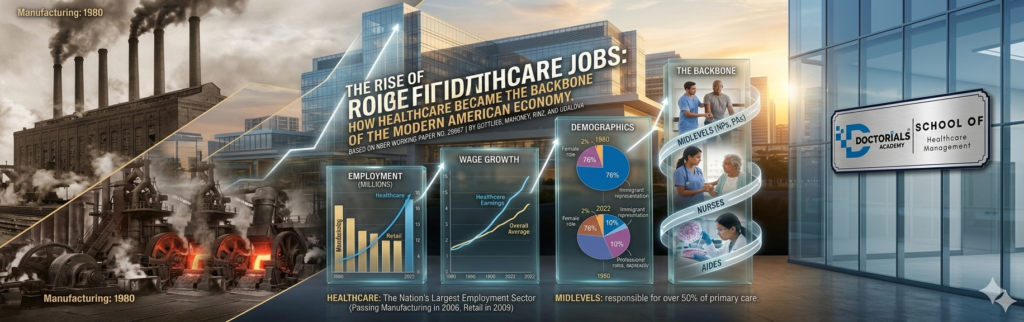
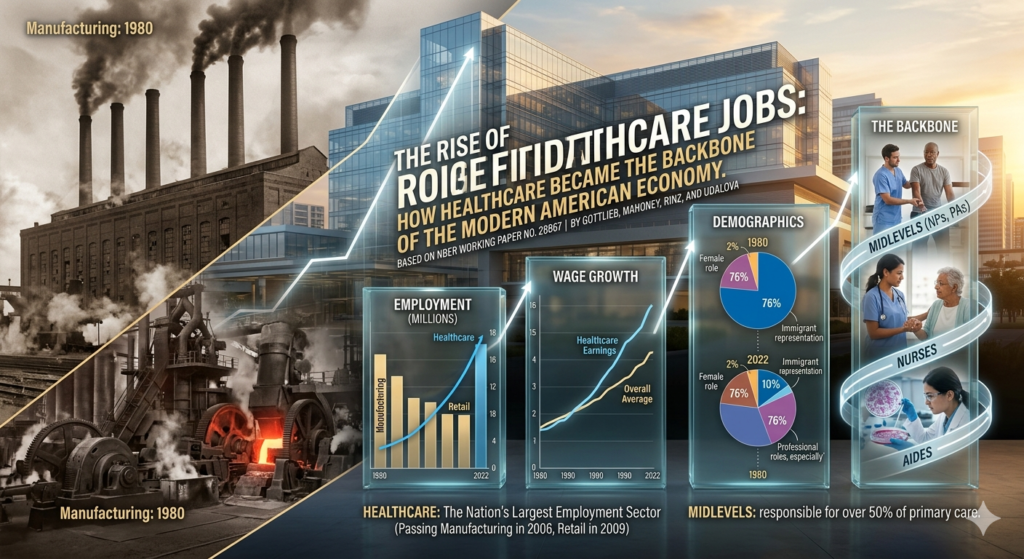
One of the most striking findings in the report is the sheer scale of healthcare employment growth over the past four decades. In 1990, healthcare employed approximately 9.3 million people. By 2022, this number had grown to more than 18 million workers.
The growth trajectory was so significant that healthcare surpassed manufacturing employment in 2006 and overtook retail trade in 2009 to become the single largest industry by employment in the United States. This marked a historic shift in the American economy. For much of the twentieth century, manufacturing had symbolized economic strength, industrial power, and middle-class prosperity. However, the decline of manufacturing jobs combined with the rapid expansion of healthcare services altered the economic landscape completely.
Several factors contributed to this growth:
- Aging populations requiring more medical care
- Increased life expectancy
- Expansion of hospitals and healthcare facilities
- Growth in chronic diseases
- Advancements in medical technology
- Expansion of insurance coverage
- Increased demand for long-term and home-based care
- Rising awareness regarding preventive healthcare
Healthcare evolved into a necessity-driven industry with demand that remained relatively stable even during economic downturns. Unlike manufacturing or retail sectors, healthcare services cannot easily be outsourced or paused during recessions. People continue to require medical attention regardless of broader economic conditions.
The COVID-19 pandemic further highlighted the importance and resilience of healthcare workers. Although healthcare employment experienced temporary disruptions during the pandemic, the sector quickly recovered and resumed its long-term growth pattern.
The study emphasizes that healthcare has effectively become a “modern middle-class jobs engine.” This is a particularly important conclusion because many industries have struggled with wage stagnation, automation, outsourcing, and declining job security. Healthcare, however, continued to generate both employment opportunities and rising earnings across multiple occupational levels.
Healthcare as a Powerful Middle-Class Career Engine
The report highlights that healthcare earnings increased much faster than wages in non-healthcare industries. Between 1980 and 2022, average healthcare earnings rose from slightly below the national average to significantly above the earnings of workers in other sectors.
This growth in income was especially strong among occupations positioned in the middle and upper-middle sections of the wage distribution. Nurses, physician assistants, nurse practitioners, and various clinical support roles experienced substantial improvements in compensation and professional opportunities.
Unlike many industries where wage growth became concentrated only among top executives or highly specialized professionals, healthcare demonstrated broader wage growth across a larger segment of workers. The report explains that wage growth in healthcare exceeded that of non-healthcare industries across almost the entire income distribution except for the very top 1% of earners.
This finding is particularly significant because it suggests that healthcare has avoided some of the extreme wage polarization observed in other sectors of the economy. In many industries, middle-income jobs disappeared due to automation or globalization. Healthcare, however, created new opportunities for stable and rewarding careers.
For example:
- Nurses experienced strong long-term earnings growth
- Midlevel practitioners such as nurse practitioners saw explosive employment growth
- Healthcare aides gained steady employment opportunities
- Clinical support occupations expanded significantly
- Non-clinical healthcare roles also experienced income growth
The healthcare sector therefore became one of the few areas where individuals without elite corporate backgrounds could still achieve stable middle-class lifestyles through education, training, and professional development.
The Rapid Rise of Midlevel Healthcare Professionals
One of the most fascinating developments discussed in the report is the rise of “midlevel” healthcare professionals. These include:
- Nurse Practitioners (NPs)
- Physician Assistants (PAs)
- Certified Registered Nurse Anesthetists (CRNAs)
- Certified Nurse Midwives (CNMs)
These professions experienced explosive growth between 2010 and 2022. Employment in these roles more than doubled during this period.
The study notes that by 2022, there were more midlevel practitioners than primary care physicians in the United States. Additionally, these professionals were responsible for delivering more than half of primary care services nationwide.
This shift represents a major transformation in healthcare delivery systems. Several factors contributed to the rise of midlevels:
- Physician shortages
- Rising healthcare demand
- Cost pressures in healthcare systems
- Expanded professional authority for advanced practitioners
- Increased reliance on team-based care
- Technological advancements simplifying diagnosis and treatment
Midlevel practitioners now play critical roles in hospitals, emergency departments, primary care clinics, telemedicine platforms, and rural healthcare systems. They often provide high-quality care while helping reduce healthcare costs and improve patient access.
The growth of these professions also created new educational pathways for healthcare careers. Many individuals who previously might not have pursued lengthy medical education programs could now enter advanced healthcare roles through nursing or allied health programs.
The Continuing Importance of Nurses and Healthcare Aides
Nurses and healthcare aides remain the backbone of the healthcare workforce. The report demonstrates that employment growth among these professions has remained consistently strong over several decades.
Nurses, in particular, experienced substantial wage growth alongside increasing professional responsibilities. Modern nursing roles now involve advanced patient management, technology integration, clinical decision-making, leadership responsibilities, and specialized care expertise.
Meanwhile, healthcare aides—including nursing aides, home health aides, medical assistants, and caregiving staff—have become increasingly important due to rising demand for elderly care and home-based healthcare services.
The expansion of these occupations reflects broader demographic trends, especially population aging. As life expectancy increases, healthcare systems require more long-term care services, rehabilitation support, chronic disease management, and personalized patient assistance.
Healthcare aides often represent entry-level pathways into healthcare careers. Many individuals begin in support roles and later pursue advanced certifications, nursing degrees, or specialized training programs.
The Role of Women in Healthcare Workforce Expansion
Healthcare has historically been a female-dominated industry, and the report provides detailed insight into gender trends within healthcare employment. The study found that women consistently represented approximately 76% of the healthcare workforce between 1980 and 2022.
However, beneath this stable overall percentage, important occupational shifts occurred.
The female share of physicians increased dramatically over time. Women entered medicine in much larger numbers than previous generations, reflecting broader societal progress in education and professional access.
At the same time:
- Nursing remained predominantly female
- Healthcare aide roles remained largely female
- Male participation in nursing and aide occupations gradually increased
This demonstrates a gradual convergence of gender representation across healthcare occupations.
The report also highlights healthcare’s enormous contribution to overall female labor force participation. As healthcare employment expanded, millions of women entered stable careers within hospitals, clinics, nursing services, home healthcare, administration, and allied health professions.
Healthcare therefore became one of the most important industries supporting women’s economic empowerment and professional advancement in the United States.
Immigration and the Healthcare Workforce
Another important finding from the study involves the growing role of foreign-born workers in healthcare. Across the broader economy, the percentage of foreign-born workers increased significantly between 1980 and 2022. Healthcare reflected this broader trend but with important occupational differences.
Foreign-born workers became especially prominent among:
- Physicians
- Healthcare aides
- Specialized medical professionals
By contrast, foreign-born representation among nurses and midlevel practitioners remained relatively lower.
The report emphasizes that immigrant healthcare workers have become essential contributors to healthcare delivery systems. Many regions facing physician shortages or staffing gaps rely heavily on internationally trained healthcare professionals.
Immigrant healthcare workers often serve underserved communities, rural populations, aging patients, and high-demand medical specialties. Their contributions became especially visible during healthcare crises such as the COVID-19 pandemic.
The study therefore highlights healthcare not only as an employment engine but also as an industry deeply interconnected with immigration patterns and global labor mobility.
Can Healthcare Replace Manufacturing?
One of the most important questions explored in the report is whether healthcare jobs can replace manufacturing jobs in regions affected by industrial decline.
Over the last several decades, many policymakers promoted the idea of “manufacturing-to-meds” economic transitions. The concept suggested that regions losing factory employment could reinvent themselves by expanding hospitals, healthcare systems, universities, and medical industries.
Cities such as:
- Pittsburgh
- Cleveland
- Rochester
were often presented as examples of successful healthcare-driven economic reinvention.
However, the study’s findings reveal that this transition was far less widespread than commonly believed.
Researchers examined whether regions experiencing larger manufacturing declines also experienced unusually large healthcare employment growth. Their conclusion was that healthcare offset only a modest portion of manufacturing job losses.
Specifically:
- Healthcare growth compensated for only about 11% of manufacturing job losses
- This was only slightly above what would naturally occur based on healthcare’s size within the economy
- Healthcare growth benefited certain demographic groups more than others
The report found that healthcare employment acted as a stronger stabilizing force for:
- Women
- College-educated workers
- White female workers
However, healthcare did not substantially offset manufacturing decline for:
- Non-college workers
- Many minority populations
- Traditional industrial labor groups
This finding challenges the idea that healthcare alone can fully replace the economic role once played by manufacturing industries.
Why Healthcare Could Not Fully Replace Manufacturing
The report discusses several possible reasons why healthcare failed to fully compensate for manufacturing decline.
First, healthcare jobs often require specialized education, certifications, or clinical training. Workers displaced from factories may not easily transition into medical professions without significant retraining.
Second, healthcare systems benefit from scale, institutional reputation, and advanced infrastructure. Building a thriving healthcare ecosystem requires large investments in hospitals, universities, medical research, technology, and professional talent.
Third, healthcare growth tends to concentrate around metropolitan regions with strong educational institutions, research centers, and higher-income populations.
As a result, although healthcare contributed positively to regional economies, it did not create a universal solution for industrial decline.
Technology, Innovation, and the Future of Healthcare Employment
The study also raises important questions about the future of healthcare employment in an era of rapid technological advancement.
Healthcare technology continues to evolve through:
- Artificial intelligence
- Telemedicine
- Digital diagnostics
- Robotics
- Electronic medical records
- Remote patient monitoring
- Precision medicine
Rather than eliminating jobs entirely, many technologies appear to be reshaping professional responsibilities and increasing demand for midlevel healthcare workers and technologically skilled clinicians.
The report suggests that technological innovation may actually strengthen middle-level healthcare occupations by enabling nurses and advanced practitioners to perform more sophisticated clinical tasks.
Healthcare therefore stands apart from many industries where automation primarily replaced workers. In healthcare, technology often complements human expertise rather than eliminating it completely.
The Economic and Social Importance of Healthcare Jobs
The rise of healthcare employment reflects a broader transformation in the American economy and society. Healthcare now represents:
- A major employment engine
- A driver of middle-class income growth
- A source of economic resilience
- A pathway for women’s workforce participation
- A critical destination for immigrant talent
- A stabilizing force during recessions
- An essential public service industry
The study concludes that understanding the future of labor markets requires understanding healthcare employment trends.
Healthcare has become deeply integrated into every aspect of modern economic life. As populations age and healthcare demand continues rising, the sector will likely remain central to employment growth for decades to come.
Conclusion
The rise of healthcare jobs represents one of the most important labor market transformations of the modern era. Over four decades, healthcare evolved from a growing service industry into the largest employment sector in the United States. It created millions of jobs, expanded middle-class career opportunities, improved wage growth for many workers, and reshaped workforce demographics across the nation.
The healthcare industry’s expansion demonstrates how economies evolve alongside demographic shifts, technological innovation, educational progress, and changing societal needs. While healthcare could not fully replace manufacturing as an economic foundation for every region, it nonetheless emerged as one of the strongest and most resilient pillars of modern employment.
The report also highlights the growing importance of nurses, midlevel practitioners, immigrant healthcare workers, and female professionals in shaping the future of healthcare systems.
As healthcare demand continues increasing worldwide, the industry’s influence on employment, wages, economic development, education, and social mobility will likely become even more significant. Understanding these trends is essential for policymakers, educators, healthcare institutions, and students preparing for the future workforce.
Source Article: NBER Working Paper – The Rise of Healthcare Jobs
Website:- https://doctorialsacademy.com/
V-Library: https://doctorialsacademy.com/medical-courses/
PGDHM:- https://doctorialsacademy.com/pgdhm/
LinkedIn:- https://in.linkedin.com/company/doctorials-academy
PGDHM LinkedIn: https://www.linkedin.com/company/doctorials-academ-pgdhm/
Medical Admission Guidelines LinkedIn: https://www.linkedin.com/company/mbbs-pg-and-pg-abroad-admission/
Facebook:- https://www.facebook.com/people/Doctorials-Academy/61558183675530/
YouTube:- https://www.youtube.com/channel/UCEukyOB7riOSdUhz68tdLzA
Instagram:- https://www.instagram.com/doctorialsacademy/
Android app:- https://play.google.com/store/apps/details?id=com.edmingle.doctorialsacademy&hl=en
LMS:- https://www.doctorialsacademy.in/
How Doctorials Academy’s PGDHM Program is Adding Value to the Rising Healthcare Industry
The healthcare industry is experiencing one of the biggest employment booms in modern history. According to the National Bureau of Economic Research (NBER) study “The Rise of Healthcare Jobs,” healthcare has become the largest employment sector in the United States, with rapid growth in healthcare administration, hospital operations, nursing management, and healthcare support services.
As hospitals and healthcare organizations continue to expand, the demand is no longer limited to doctors and nurses alone. The industry now requires professionally trained healthcare managers and administrators who can efficiently handle hospital operations, patient coordination, healthcare systems, quality management, and organizational leadership.
This is where the PGDHM (Post Graduate Diploma in Hospital Management) program offered by Doctorials Academy is creating exceptional value.
The PGDHM program is designed to prepare students and healthcare professionals for the rapidly evolving healthcare ecosystem by equipping them with industry-relevant management and operational skills. The program bridges the gap between clinical healthcare knowledge and hospital administration, helping learners become future-ready healthcare professionals.
One of the major findings from the NBER report is that middle-level healthcare occupations are growing rapidly and offering strong career growth opportunities. Doctorials Academy’s PGDHM program directly supports this industry transformation by preparing candidates for leadership and management roles in:
- Hospitals
- Multispecialty healthcare chains
- Healthcare startups
- Insurance companies
- Diagnostic centers
- Medical tourism companies
- Healthcare consulting firms
- Public health organizations
The PGDHM program adds value by developing practical expertise in:
- Hospital Administration
- Healthcare Operations
- Patient Relationship Management
- Medical Ethics
- Healthcare Marketing
- Healthcare HR Management
- Healthcare Finance
- Quality Assurance
- NABH Standards
- Digital Healthcare Systems
As healthcare systems become more technology-driven and patient-focused, hospitals increasingly seek professionals who understand both healthcare services and operational management. Doctorials Academy’s PGDHM curriculum aligns with these modern industry requirements.
The NBER article also highlights the growing importance of nurses, healthcare support professionals, and midlevel healthcare workers in shaping the future healthcare workforce. The PGDHM program provides these professionals with opportunities to transition from purely clinical roles into administrative and managerial positions. This helps them achieve:
- Career advancement
- Promotions
- Higher salary packages
- Leadership opportunities
- Non-clinical career growth
- Better professional stability
For working professionals, the flexibility of the PGDHM program becomes highly valuable. Many healthcare workers seek career growth but cannot leave their jobs for full-time education. Doctorials Academy supports these learners through accessible and flexible learning models, enabling professionals to upgrade their qualifications while continuing their careers.
The healthcare industry is also witnessing rapid digital transformation through:
- Telemedicine
- Healthcare analytics
- AI-based healthcare systems
- Electronic medical records
- Digital patient management systems
Doctorials Academy’s PGDHM program prepares students to adapt to these future healthcare technologies and management systems, making them more employable and industry-ready.
Another major contribution of the PGDHM program is its ability to create opportunities for graduates from multiple educational backgrounds. Students from:
- B.Sc Nursing
- BHMS
- BAMS
- Pharmacy
- Allied Health Sciences
- Physiotherapy
- Life Sciences
- General Graduation streams
can build strong careers in healthcare management through this program.
The NBER report explains that healthcare has become one of the strongest middle-class career engines in the modern economy. Doctorials Academy’s PGDHM program contributes directly to this transformation by helping students gain industry-focused skills that increase employability, professional confidence, and long-term career growth in one of the world’s fastest-growing industries.
In today’s healthcare-driven economy, hospitals and healthcare organizations need professionals who can combine compassion, management, technology, and operational excellence. Through its PGDHM program, Doctorials Academy is actively shaping the next generation of healthcare administrators and healthcare leaders who can contribute meaningfully to the future of healthcare systems.

