

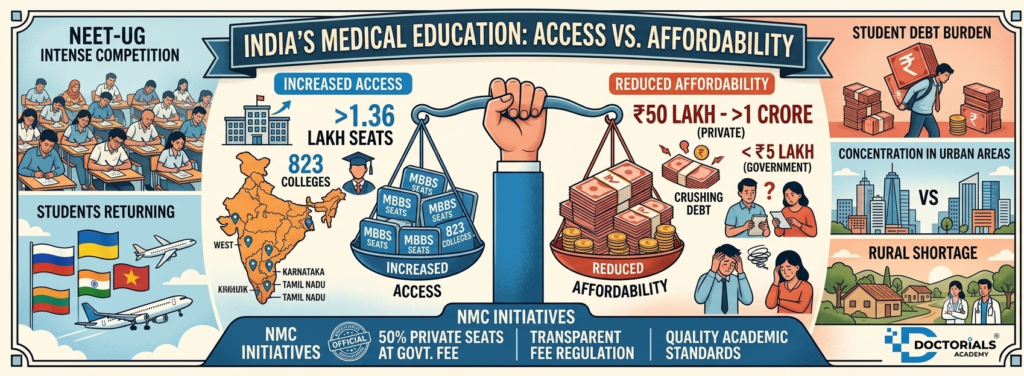
India’s medical education system is undergoing one of the biggest transformations in its history. Over the past decade, the country has witnessed an unprecedented increase in the number of medical colleges and MBBS seats, driven by the growing demand for healthcare professionals and the government’s vision of strengthening healthcare infrastructure. For the academic year 2026–27, India has crossed a historic milestone by offering more than 1.36 lakh MBBS seats across 823 medical colleges, making it one of the largest medical education systems in the world. While this expansion is a remarkable achievement, it also highlights a significant paradox: medical education has become more accessible in terms of seat availability, but for many students, it has simultaneously become less affordable.
Every year, more than 20 lakh students appear for the NEET-UG examination with the dream of becoming doctors. Despite the increase in seats, competition remains extremely intense, especially for government medical colleges where tuition fees are highly subsidized. Government colleges continue to be the preferred choice because the total cost of completing an MBBS degree is often less than ₹5 lakh. However, with private medical colleges now accounting for more than half of the total MBBS seats in India, thousands of students are left with only one practical option—private medical education, where the cost can range from ₹50 lakh to well over ₹1 crore depending on the institution and state. This creates a financial barrier that many deserving students and middle-class families struggle to overcome.
The rapid expansion of private medical colleges has undoubtedly increased educational opportunities. Students who previously travelled to countries such as Russia, Ukraine, Georgia, Kazakhstan, the Philippines, and China to pursue MBBS now have greater opportunities within India. This not only keeps talent within the country but also improves regulatory oversight and ensures that more graduates are trained according to Indian medical standards. Furthermore, expanding domestic medical education is essential because India continues to require thousands of additional doctors to meet the healthcare needs of its growing population.
However, accessibility is not merely about increasing the number of seats. True accessibility means ensuring that deserving students can pursue medical education regardless of their financial background. Unfortunately, this is where the current system faces serious challenges. The majority of newly added seats are concentrated in private institutions, particularly in economically developed states such as Karnataka, Tamil Nadu, Maharashtra, Telangana, and Andhra Pradesh. While these colleges have helped increase capacity, their high tuition fees place medical education beyond the reach of many talented students.
The financial burden extends beyond tuition fees alone. Students and their families often incur additional expenses related to hostel accommodation, books, laboratory charges, examination fees, clinical training, transportation, and living expenses. In many cases, families are forced to exhaust lifelong savings or take substantial education loans. Graduates entering the workforce with heavy financial liabilities may prioritize higher-paying private practice or overseas employment over serving in rural or public healthcare settings. Consequently, the healthcare workforce continues to remain unevenly distributed across the country.
Another major concern associated with rapid expansion is maintaining educational quality. Establishing a medical college requires not only physical infrastructure but also experienced faculty members, adequate patient inflow, teaching hospitals, modern laboratories, simulation centres, and strong clinical exposure. While many private institutions deliver excellent education, experts have repeatedly emphasized that rapid growth should never compromise academic standards. The National Medical Commission (NMC) therefore plays a critical role in ensuring that every institution consistently meets prescribed standards through transparent accreditation, periodic inspections, digital monitoring, and strict regulatory enforcement.
India’s healthcare challenges are also deeply linked with the geographical distribution of medical colleges. Most private medical institutions are established in urban and semi-urban regions where financial viability is higher. As a result, students receive their education and often establish their careers within metropolitan areas. Rural India, however, continues to experience shortages of doctors, specialists, and healthcare infrastructure. Increasing medical seats alone cannot solve this imbalance unless accompanied by better incentives for rural service, improved infrastructure, attractive salaries, quality housing, career advancement opportunities, and better educational facilities for healthcare professionals’ families.
Government initiatives have significantly contributed to expanding medical education by establishing new AIIMS institutions, upgrading district hospitals into teaching hospitals, increasing government medical colleges, and simplifying approval processes. These initiatives have substantially increased the availability of affordable medical education. Nevertheless, continued investment in government institutions remains essential to ensure that affordable MBBS education grows alongside private-sector expansion.
The National Medical Commission has also introduced measures aimed at improving affordability. One of its significant regulations requires that 50% of seats in private medical colleges should be charged at government medical college fee levels, wherever applicable under the policy framework. Effective implementation of such measures could provide substantial financial relief to deserving students while ensuring greater equity in admissions. Similarly, stronger action against illegal capitation fees, transparent fee regulation, and regular monitoring can improve public confidence in India’s medical education system.
Medical education is not simply about producing more doctors; it is about producing competent, ethical, and compassionate healthcare professionals capable of serving every section of society. India’s expanding medical education landscape presents enormous opportunities to strengthen healthcare delivery, improve doctor-patient ratios, reduce dependence on foreign medical education, and support the country’s long-term public health goals. However, achieving these outcomes requires balancing expansion with affordability, accessibility with quality, and private investment with public responsibility.
The future of India’s healthcare system depends not only on the number of MBBS seats available but also on ensuring that every deserving student has a fair opportunity to pursue medical education irrespective of economic status. As India continues to build one of the world’s largest healthcare education ecosystems, policymakers, regulators, educational institutions, and healthcare leaders must work together to create a system that is equitable, affordable, transparent, and globally competitive. Only then can the country’s remarkable expansion in medical education truly translate into improved healthcare access for every citizen.
Reference Sources
- The Hindu – Access paradox: On medical education in India
https://www.thehindu.com/opinion/editorial/access-paradox-on-medical-education-in-india/article71313988.ece - The Indian Express – India adds nearly 8,000 MBBS seats, taking total to 1.36 lakh, most in private colleges
https://indianexpress.com/article/education/nmc-medical-commission-mbbs-medical-colleges-seat-matrix-2026-27-private-colleges-increase-more-govt-colleges-neet-ug-10788440/ - National Medical Commission (NMC)
https://www.nmc.org.in/ - National Medical Commission – MBBS Seat Matrix 2026–27
https://www.nmc.org.in/ - Economic Times – NMC MBBS Seat Matrix 2026 Released
https://economictimes.indiatimes.com/news/new-updates/nmc-mbbs-seat-matrix-2026-released-check-state-wise-government-and-private-medical-college-seats/articleshow/132475287.cms
How Doctorials Academy’s V-Library is Transforming Medical Education
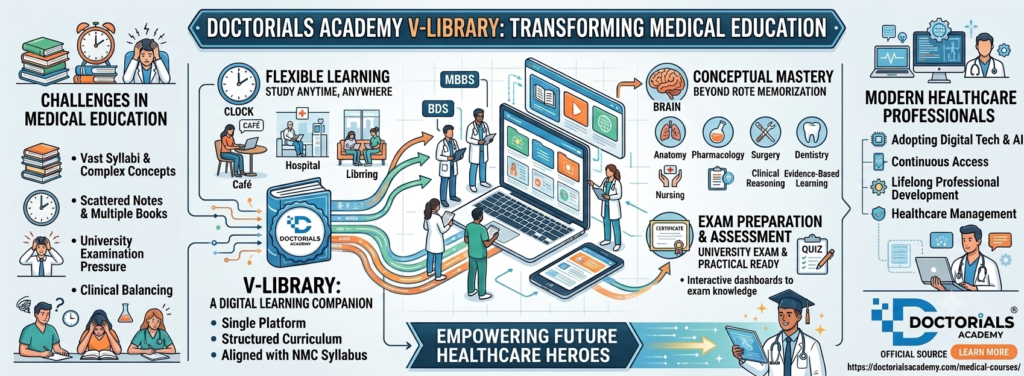
While India is expanding the number of MBBS, BDS, and Nursing seats, students continue to face another significant challenge—finding reliable, affordable, and comprehensive academic support throughout their medical education. Medical courses are academically intensive, requiring students to master vast syllabi, understand complex clinical concepts, and prepare for frequent university examinations. This is where Doctorials Academy’s V-Library serves as a valuable learning companion, helping students bridge the gap between classroom teaching and self-directed learning.
Designed specifically for MBBS, BDS, and Nursing students, the V-Library is a digital learning platform that provides structured, curriculum-focused educational resources aligned with the National Medical Commission (NMC) syllabus. Instead of relying on scattered notes, multiple books, and inconsistent online resources, students can access organized video lectures, subject-wise learning modules, revision materials, and assessment tools through a single platform.
One of the biggest advantages of the V-Library is its flexibility. Students can learn anytime and anywhere using their laptop, tablet, or mobile device. Whether preparing for university examinations, revising difficult concepts before practicals, or strengthening their understanding of foundational medical sciences, learners can study at their own pace. This self-paced approach is especially valuable for first-year students adapting to the demanding nature of medical education, as well as for senior students balancing clinical postings with academic responsibilities.
The platform is designed to simplify complex medical concepts through structured explanations delivered by experienced medical educators. Topics are broken down into manageable learning segments, enabling students to understand anatomy, physiology, pathology, pharmacology, microbiology, medicine, surgery, obstetrics and gynaecology, paediatrics, dentistry, and nursing subjects more effectively. Interactive assessments and regular practice further reinforce learning and help students identify areas requiring improvement.
Beyond examination preparation, the V-Library promotes continuous learning and conceptual understanding. Rather than encouraging rote memorization, it supports evidence-based learning and clinical reasoning, which are essential for becoming competent healthcare professionals. By providing quality educational resources in a digital format, the platform helps students make better use of their study time while improving confidence and academic performance.
Doctorials Academy also recognizes that today’s healthcare professionals require skills beyond traditional medical knowledge. As healthcare increasingly adopts digital technologies, artificial intelligence, healthcare management, and evidence-based practice, students need continuous access to updated educational content. The V-Library aims to support this evolving educational landscape by providing modern learning resources that complement classroom teaching and encourage lifelong professional development.
For many students, especially those studying in institutions with limited academic resources or faculty shortages, digital learning platforms like the V-Library can significantly enhance the quality of education. They reduce dependence on expensive coaching centres, provide standardized learning material, and create equal learning opportunities regardless of geographical location.
As India’s medical education ecosystem continues to expand, digital platforms such as Doctorials Academy’s V-Library represent an important step towards making high-quality medical education more accessible, flexible, and student-centric. By combining technology with structured academic content, the platform empowers future doctors, dentists, and nurses to learn more effectively, perform better in examinations, and build a stronger foundation for successful healthcare careers.
Learn more about Doctorials Academy’s Medical Courses and V-Library:
https://doctorialsacademy.com/medical-courses/

