
Healthcare is no longer just about doctors, hospitals and patients.
Today, the healthcare industry is one of the most rapidly evolving sectors, creating opportunities across hospital operations, healthcare technology, insurance, diagnostics, pharmaceuticals, medical devices, healthcare consulting, quality management, analytics, finance, administration and business development.
As the industry expands, there is growing demand for professionals who understand not only healthcare but also management, leadership, business strategy and operations.
This is why healthcare management has become an attractive career option for graduates and healthcare professionals.
But when students start exploring healthcare-management courses, one question appears frequently:
Should I choose a PGDHM or an MBA in Healthcare Management?
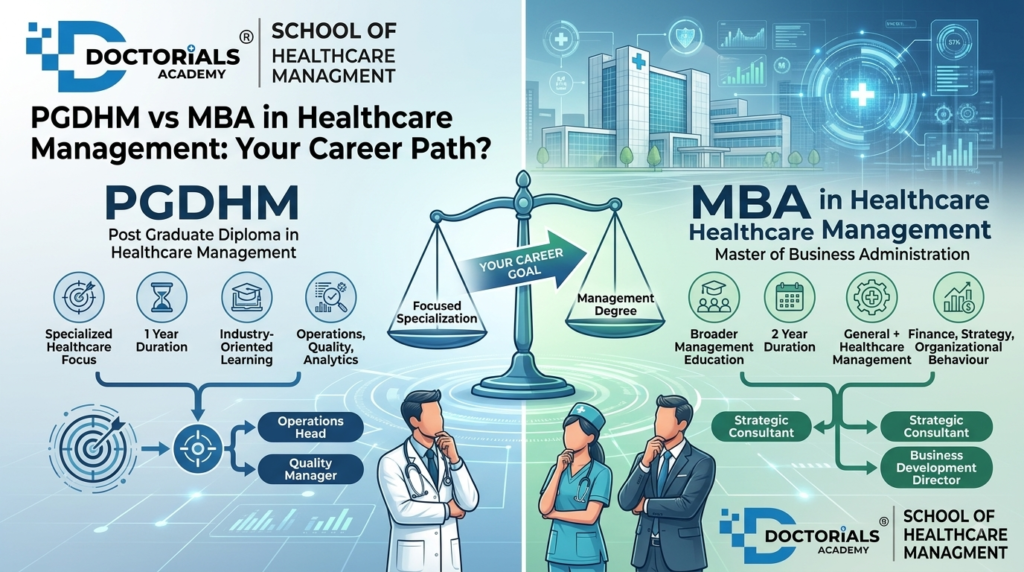
Both programs can lead toward exciting healthcare-management careers, but they are different qualifications with different approaches.
Let’s understand the difference—and more importantly, which one could be right for you.
What Is PGDHM?
PGDHM stands for Post Graduate Diploma in Healthcare Management.
It is a postgraduate-level program designed to develop management and leadership skills specifically for the healthcare sector.
Unlike a general management program, PGDHM focuses on applying management principles to the unique environment of healthcare.
Students can be introduced to areas such as:
- Healthcare Operations
- Hospital & Healthcare Administration
- Healthcare Finance
- Healthcare Human Resources
- Healthcare Quality Management
- Healthcare Analytics
- Healthcare Strategy
- Healthcare Marketing
- Patient Experience
- Healthcare Technology
- Risk Management
- Healthcare Supply Chain
- Leadership & Management
- Healthcare Entrepreneurship
The important point is that PGDHM is not limited to hospitals.
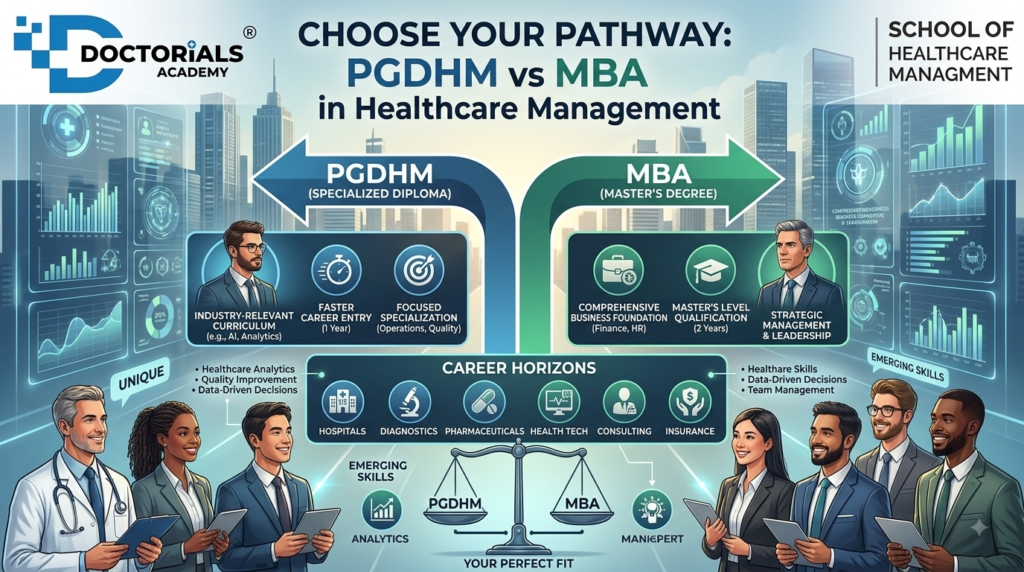
A healthcare-management professional can potentially work across hospitals, clinics, diagnostic centres, healthcare startups, insurance organizations, pharmaceutical companies, medical-device companies, healthcare technology companies, consulting firms and other healthcare organizations.
That makes healthcare management a much broader career field than traditional hospital administration.
What Is an MBA in Healthcare Management?
An MBA in Healthcare Management is a master’s-level management degree that combines business and management education with healthcare-sector specialization.
The curriculum may include traditional MBA subjects such as:
- Finance
- Marketing
- Human Resources
- Operations
- Business Strategy
- Organizational Behaviour
- Leadership
- Business Analytics
along with healthcare-specific subjects such as:
- Healthcare Administration
- Healthcare Economics
- Hospital Operations
- Healthcare Policy
- Healthcare Quality
- Healthcare Strategy
The MBA approach can therefore provide students with a broader management foundation while allowing them to specialize in healthcare.
PGDHM vs MBA: The Difference in Simple Words
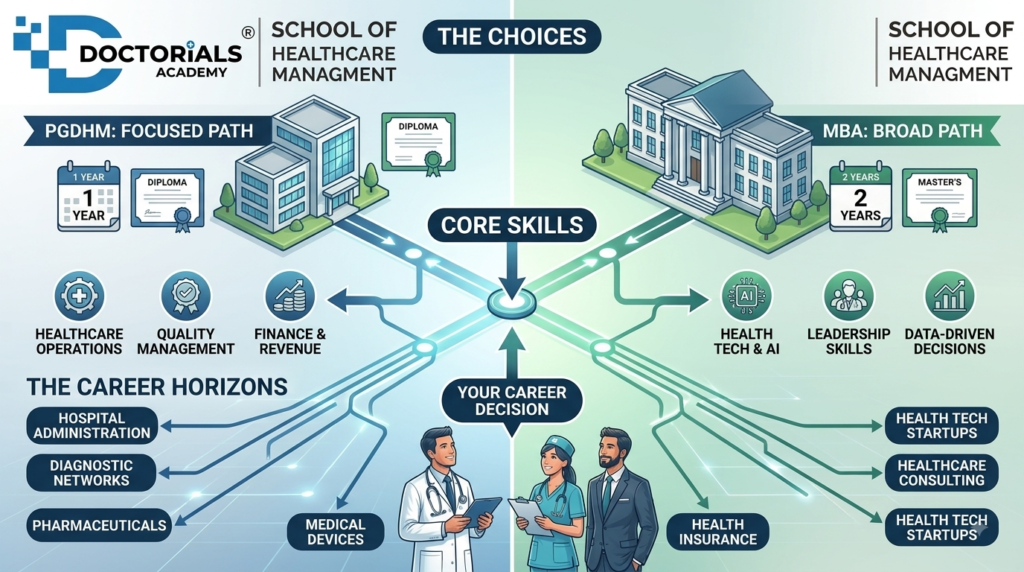
The simplest way to understand the difference is:
PGDHM
Healthcare-focused management education
MBA in Healthcare Management
Broader management education + healthcare specialization
Both can be valuable.
The right choice depends on your:
- Career objective
- Academic background
- Time available
- Budget
- Preferred learning style
- Desired qualification
- Long-term career plans
PGDHM vs MBA in Healthcare Management – Quick Comparison
| Factor | PGDHM | MBA in Healthcare Management |
|---|---|---|
| Full Form | Post Graduate Diploma in Healthcare Management | Master of Business Administration in Healthcare Management |
| Qualification | Postgraduate Diploma | Master’s Degree |
| Typical Duration | Often 1 year, depending on institution | Commonly 2 years |
| Primary Focus | Healthcare management | Management + healthcare |
| Healthcare Specialization | Highly focused | Depends on curriculum |
| Learning Approach | Often specialized and industry-oriented | Management-oriented and structured |
| Time Investment | Generally lower | Generally higher |
| Suitable For | Graduates & healthcare professionals seeking specialization | Students seeking a master’s degree |
| Career Area | Healthcare-focused roles | Healthcare + broader management roles |
| Practical Exposure | Depends on institution | Depends on institution |
| Best Suited For | Faster healthcare specialization | Broader management education |
Important: Duration, eligibility, recognition, curriculum and awarding authority can vary from one institution to another. Students should always verify the specific program before admission.
A PGDHM should also not automatically be considered equivalent to an MBA simply because both are postgraduate management programs. They are distinct qualifications unless the applicable authority or institution provides a specific equivalence.
Why Is Healthcare Management Becoming So Important?
Think about how healthcare has changed over the last decade.
A modern healthcare organization now has to manage:
Patients + Doctors + Nurses + Technology + Finance + Data + Quality + Regulation + Operations + Customer Experience
Running these systems efficiently requires professionals who understand both healthcare and management.
Healthcare organizations are increasingly looking for professionals who can:
- Improve operational efficiency
- Manage teams
- Control costs
- Improve patient experience
- Understand healthcare data
- Implement technology
- Support quality improvement
- Develop business strategies
- Coordinate multiple departments
- Manage healthcare projects
This is creating a new category of professionals:
Healthcare Managers.
Healthcare Management Is Much Bigger Than Hospital Administration
Many students still think:
Healthcare Management = Hospital Administration
That is no longer the complete picture.
Healthcare management can include a wide range of industries.
🏥 Hospitals & Healthcare Centres
Managing operations, administration, patient services and organizational performance.
🧪 Diagnostics
Managing diagnostic centres, laboratory operations, customer experience and business development.
💊 Pharmaceutical Industry
Working in business operations, market access, administration and strategic functions.
🩺 Medical Devices
Managing sales operations, business development, healthcare partnerships and market strategy.
💻 HealthTech
Working with digital-health companies, healthcare platforms, AI solutions and technology-enabled healthcare services.
🛡️ Health Insurance
Working in healthcare operations, claims management, provider networks and business functions.
📊 Healthcare Consulting
Helping healthcare organizations solve operational, financial and strategic problems.
🚀 Healthcare Startups
Building and managing innovative healthcare businesses.
This is why students should look at healthcare management as an industry-wide career, not simply hospital administration.
Why PGDHM Can Be Attractive to Students
One of the biggest advantages of a focused PGDHM can be its specialization.
Instead of spending significant time studying management concepts across many industries, students can concentrate on applying management principles to healthcare.
This can be particularly useful for students who already know that they want to build their career in healthcare.
For example:
“I don’t want to manage just any business. I want to work in healthcare.”
A healthcare-focused postgraduate program can help develop knowledge specifically relevant to that industry.
PGDHM Can Be a Good Option for Healthcare Professionals
Healthcare professionals already understand the clinical environment.
But clinical knowledge and management knowledge are different skill sets.
Consider a doctor who eventually wants to become a:
Hospital Administrator → Operations Head → Healthcare Leader
Or a nurse who wants to move from:
Clinical Nursing → Healthcare Operations → Healthcare Management
Or a dentist who wants to explore:
Clinical Practice → Healthcare Business → Healthcare Entrepreneurship
Healthcare-management education can help bridge the gap between clinical understanding and management capability.
PGDHM for Non-Medical Graduates
Healthcare management isn’t only for doctors and nurses.
Graduates from different educational backgrounds can explore healthcare-management careers, depending on the eligibility requirements of the program they choose.
For example:
Commerce Graduate
Can explore healthcare finance, administration or operations.
Science Graduate
Can explore healthcare operations, analytics or administration.
Management Graduate
Can specialize further in healthcare.
Life Science Graduate
Can explore healthcare organizations and healthcare business functions.
Engineering/Technology Graduate
Can explore HealthTech and healthcare analytics.
This diversity is one of the strengths of healthcare management.
What Skills Can Students Develop Through Healthcare Management Education?
A modern healthcare-management program should go beyond textbooks.
Students should aim to develop a combination of business + healthcare + technology + leadership skills.
1. Healthcare Operations
Understanding how healthcare organizations function efficiently.
2. Financial Management
Understanding budgets, costs, revenue and financial decision-making.
3. Human Resource Management
Managing healthcare teams and workforce requirements.
4. Quality Management
Understanding quality improvement, patient safety and healthcare standards.
5. Healthcare Analytics
Using data to support better healthcare decisions.
6. Strategic Management
Understanding how healthcare organizations grow and compete.
7. Leadership
Developing communication, decision-making and team-management abilities.
8. Healthcare Technology
Understanding the growing role of digital systems, AI and technology in healthcare.
9. Patient Experience
Understanding how healthcare organizations can improve service quality and patient satisfaction.
10. Business Development
Identifying opportunities, partnerships and growth strategies.
PGDHM vs MBA: Which One Is More Practical?
This is one of the most common questions students ask.
But there is an important point:
The qualification alone does not determine how practical the program is.
The institution and curriculum matter enormously.
Before choosing a program, ask:
Does it include case studies?
Are there industry experts?
Are there live projects?
Is there practical exposure?
Does it include healthcare analytics?
Does it cover healthcare finance?
Does it teach quality management?
Are students exposed to real healthcare challenges?
Is there career guidance?
The best program is not necessarily the one with the most impressive title.
It is the one that helps you develop skills you can actually use.
The Importance of Industry-Relevant Curriculum
Healthcare is changing rapidly.
A curriculum designed several years ago may not adequately prepare students for today’s healthcare environment.
Students should look for programs that introduce them to emerging areas such as:
- Artificial Intelligence in Healthcare
- Healthcare Analytics
- Digital Health
- Healthcare Technology
- Healthcare Innovation
- Data-driven decision-making
- Patient experience
- Healthcare quality
- Strategic healthcare management
The World Health Organization has also highlighted the importance of digital technologies and digital transformation in strengthening health systems, making technology awareness increasingly relevant for future healthcare professionals.
This means the healthcare manager of the future may need to understand both:
People + Technology
and
Healthcare + Business.
Career Opportunities After PGDHM
A PGDHM does not guarantee a particular job or salary. Career outcomes depend on the institution, skills, experience, location, employer and individual performance.
However, healthcare-management graduates can explore roles such as:
Healthcare Operations Executive
Managing daily operational activities and coordinating healthcare functions.
Hospital/Healthcare Administrator
Supporting administrative and organizational activities.
Healthcare Quality Executive
Working on quality improvement and healthcare standards.
Healthcare HR Executive
Supporting recruitment, workforce planning and employee management.
Healthcare Business Development Executive
Supporting partnerships, expansion and revenue-growth initiatives.
Healthcare Project Coordinator
Managing healthcare projects and coordinating teams.
Healthcare Analytics Executive
Working with healthcare data and performance metrics.
Patient Experience Executive
Improving patient-service processes and experience.
Healthcare Consultant
Supporting organizations with operational and strategic projects.
Healthcare Startup Professional
Working in business, operations, growth or strategy within HealthTech and healthcare startups.
With experience, professionals can progress into managerial and leadership positions.
Career Growth Can Be More Important Than Your First Job
Your first role after graduation is only the beginning.
A healthcare-management career can potentially develop along different pathways.
Operations Path
Healthcare Executive
↓
Operations Executive
↓
Operations Manager
↓
Senior Operations Manager
↓
Healthcare Operations Head
Quality Path
Quality Executive
↓
Quality Manager
↓
Quality Head
↓
Healthcare Quality Leadership
Business Path
Business Development Executive
↓
Business Development Manager
↓
Regional/Business Head
↓
Healthcare Strategy Leadership
Administration Path
Healthcare Administrator
↓
Hospital Administration Manager
↓
Senior Administrator
↓
Hospital Leadership
Your qualification is the foundation.
Your skills and experience determine how far you can build on it.
What About Salary?
Students often search for:
“PGDHM salary”
or
“MBA Healthcare Management salary”
But salary cannot be determined solely by the qualification.
Your earning potential may depend on:
- Job role
- Experience
- Employer
- Location
- Organization size
- Skills
- Communication
- Leadership capability
- Technical knowledge
- Industry specialization
- Performance
A highly skilled healthcare-management professional with practical experience can become valuable to an organization regardless of whether they started with a PGDHM or MBA.
Therefore, students should focus on:
Qualification + Skills + Experience + Industry Exposure
rather than qualification alone.
PGDHM vs MBA: Which Is Better for Doctors?
If you are a doctor and want to remain primarily clinical, neither qualification may be necessary for your immediate career.
But if you want to explore:
- Hospital leadership
- Healthcare operations
- Healthcare entrepreneurship
- Consulting
- Healthcare strategy
- Healthcare technology
- Administration
then healthcare-management education can become highly relevant.
A doctor who combines:
Clinical Knowledge + Healthcare Management + Leadership
can bring a valuable perspective to healthcare organizations.
PGDHM vs MBA: Which Is Better for Nurses?
Nurses are among the most important professionals in healthcare delivery.
With appropriate education and experience, nurses can also explore management pathways such as:
Nursing → Healthcare Operations → Quality → Administration → Leadership
A healthcare-management program can help professionals understand the broader organizational side of healthcare beyond direct patient care.
PGDHM vs MBA: Which Is Better for BDS Graduates?
Dental graduates can also explore careers beyond traditional clinical practice.
Healthcare management can open pathways into:
- Dental-chain operations
- Healthcare administration
- Clinic management
- Business development
- Healthcare consulting
- Healthcare startups
- Healthcare strategy
For BDS graduates interested in combining healthcare knowledge with management, a healthcare-management qualification can be an interesting career option.
PGDHM vs MBA: Which Is Better for a Fresh Graduate?
If you are a fresh graduate, ask yourself three questions:
Question 1:
Do I specifically want to work in healthcare?
If yes, a specialized healthcare-management program may be worth considering.
Question 2:
Do I want a broader management education?
If yes, an MBA may be more suitable.
Question 3:
How much time do I want to invest?
If you want a shorter specialized pathway, a PGDHM may be attractive.
If you are comfortable with a longer program and want a master’s degree, an MBA may be preferable.
Don’t Choose a Course Based Only on Its Name
This is perhaps the most important advice for students.
Before joining any PGDHM or MBA program, investigate:
Qualification
What exactly will you receive?
Awarding Institution
Who awards the qualification?
Recognition
What applicable approvals, recognition or accreditation does the program have?
Curriculum
What exactly will you learn?
Faculty
Who is teaching you?
Industry Exposure
Will you work on real healthcare problems?
Practical Learning
Are there case studies, projects and internships?
Technology
Does the curriculum include modern healthcare technology and analytics?
Career Support
What career services are actually provided?
Alumni
Where are previous students working?
Total Cost
What is the complete financial commitment?
Making a decision based on these factors is much smarter than simply choosing the course with the most attractive name.
Doctorials Academy PGDHM: A Healthcare-Focused Career Pathway
For students looking specifically for a focused pathway into healthcare management, Doctorials Academy’s PGDHM – Post Graduate Diploma in Healthcare Management is designed around the skills required to understand and manage modern healthcare organizations.
The program is structured as a 12-month healthcare-management program and is offered in collaboration with Medhavi Skills University.
The curriculum focuses on areas relevant to modern healthcare management, including:
- Healthcare Analytics
- Healthcare Finance
- Healthcare Strategy
- Risk & Quality Management
- AI in Healthcare
- Healthcare Operations
- Management & Leadership
This makes the program particularly relevant for students who want to understand not only how healthcare works, but also how healthcare organizations are managed and developed.
Students from healthcare and non-healthcare backgrounds can explore the program subject to the applicable eligibility criteria.
You can learn more about the program here:
Doctorials Academy – Healthcare Management Programs:
Explore Doctorials Academy Healthcare Courses
Who Should Consider PGDHM?
PGDHM may be worth considering if you are:
🎓 A graduate looking for a specialized healthcare career
🩺 A doctor interested in healthcare leadership
🦷 A BDS graduate exploring healthcare management
👩⚕️ A nursing professional interested in administration
💊 A pharmacy graduate interested in healthcare business
📊 A graduate interested in healthcare analytics
💻 A technology professional interested in HealthTech
🚀 An aspiring healthcare entrepreneur
🏥 A professional looking to move into healthcare operations
The key requirement is not simply your previous degree.
It is your interest in building a career around healthcare and management.
PGDHM vs MBA: The Final Decision
There is no single answer to:
“Which is better—PGDHM or MBA?”
Instead, ask:
“Which qualification matches my career goal?”
PGDHM may be the right choice if you want:
✅ Focused healthcare-management education
✅ A shorter postgraduate pathway
✅ Healthcare-specific knowledge
✅ Practical, industry-oriented learning
✅ Exposure to healthcare operations and strategy
✅ A transition into healthcare management
MBA in Healthcare Management may be the right choice if you want:
✅ A master’s degree
✅ Broader management education
✅ A longer academic pathway
✅ Strong exposure to general management concepts
✅ Healthcare specialization within an MBA structure
Both can lead toward rewarding careers.
The difference is how you want to reach your destination.
The Future Belongs to Healthcare Professionals Who Understand Management
Healthcare is evolving from a traditional service industry into a highly complex ecosystem involving:
Healthcare + Technology + Data + Finance + Business + Innovation + Patient Experience
Tomorrow’s healthcare leaders will need more than one skill.
They will need to understand:
How healthcare works.
How organizations work.
How people work.
How technology works.
How data drives decisions.
And most importantly:
How to create better healthcare outcomes through better management.
That is why healthcare management education is becoming an increasingly relevant career pathway.
Final Takeaway for Students
Don’t choose PGDHM simply because it takes less time.
Don’t choose an MBA simply because it says “Master’s.”
Don’t choose a program because someone tells you it guarantees a job.
Instead, compare:
Curriculum + Faculty + Practical Exposure + Industry Relevance + Recognition + Career Support + Your Career Goal
Then make your decision.
Because your goal should not simply be:
“I want another qualification.”
Your goal should be:
“I want to become a healthcare professional who can lead, manage and transform healthcare organizations.”
And if that is the career you envision, healthcare management could be the bridge between your education today and your leadership role tomorrow.
Frequently Asked Questions
1. What does PGDHM stand for?
PGDHM stands for Post Graduate Diploma in Healthcare Management.
2. Is PGDHM the same as MBA in Healthcare Management?
No. PGDHM is a postgraduate diploma, while an MBA is a master’s degree. They are different qualifications and should not automatically be treated as equivalent.
3. Is PGDHM only for hospital administration?
No. Healthcare Management is broader than hospital administration. Career areas can include hospitals, diagnostics, HealthTech, insurance, pharmaceuticals, medical devices, consulting, healthcare startups and other healthcare organizations.
4. Can doctors pursue PGDHM?
Yes, subject to the eligibility requirements of the particular institution. It can be useful for doctors interested in healthcare administration, operations, leadership, consulting or entrepreneurship.
5. Can BDS graduates pursue healthcare management?
Depending on the program’s eligibility criteria, BDS graduates can explore healthcare-management education and careers.
6. Can nurses pursue PGDHM?
Yes, depending on program eligibility. Healthcare management can provide nurses with a pathway toward administrative, operational and leadership roles.
7. Can non-medical graduates study healthcare management?
Many healthcare-management programs accept graduates from different academic backgrounds. However, eligibility differs between institutions and should be checked before applying.
8. Which is better: PGDHM or MBA?
Neither is universally better. PGDHM can suit students seeking focused healthcare-management education, while an MBA may suit students seeking a master’s degree and broader management education.
9. Does PGDHM guarantee a job?
No. No educational qualification can guarantee employment. Career outcomes depend on skills, practical exposure, experience, employer requirements and individual performance.
10. What should I check before choosing a PGDHM?
Check the awarding institution, recognition, eligibility, curriculum, faculty, practical exposure, industry connections, career support, total fees and alumni outcomes before making your decision.
Website:- https://doctorialsacademy.com/
V-Library: https://doctorialsacademy.com/medical-courses/
PGDHM:- https://doctorialsacademy.com/pgdhm/
Full time PGDHM: https://doctorialsacademy.com/offline/
LinkedIn:- https://in.linkedin.com/company/doctorials-academy
PGDHM LinkedIn: https://www.linkedin.com/company/doctorials-academ-pgdhm/
Medical Admission Guidelines LinkedIn: https://www.linkedin.com/company/mbbs-pg-and-pg-abroad-admission/
Facebook:- https://www.facebook.com/people/Doctorials-Academy/61558183675530/
YouTube:- https://www.youtube.com/channel/UCEukyOB7riOSdUhz68tdLzA
Instagram:- https://www.instagram.com/doctorialsacademy/
Android app:- https://play.google.com/store/apps/details?id=com.edmingle.doctorialsacademy&hl=en

