
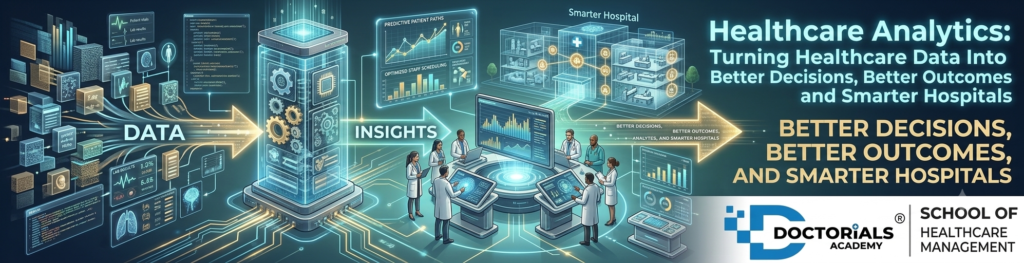
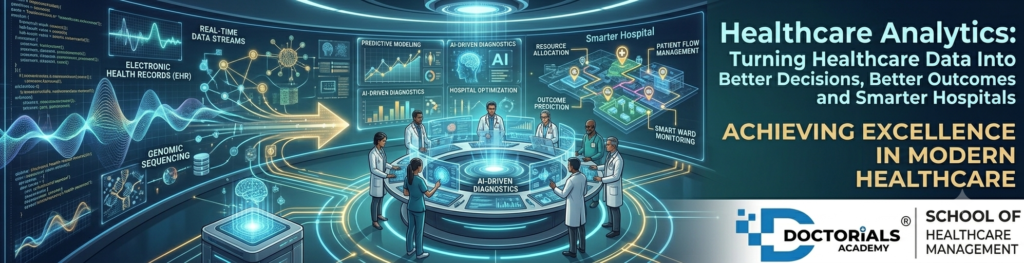
Healthcare Analytics: Turning Healthcare Data Into Better Decisions, Better Outcomes and Smarter Hospitals
Introduction
Healthcare is generating more data than ever before.
Every hospital visit, laboratory report, prescription, diagnostic image, insurance claim, wearable-device reading, patient survey and electronic health record contributes to an enormous and continuously growing pool of information. But data alone does not improve healthcare. The real value comes from converting data into meaningful insights and using those insights to make better decisions.
That is the fundamental purpose of healthcare analytics.
Healthcare analytics combines quantitative and qualitative methods to collect, organize and analyze medical and operational information from sources such as electronic health records, medical imaging, insurance claims, patient surveys, wearable devices, genomics and pharmaceutical data. Its objective is to support evidence-based, outcome-focused decisions while improving patient care and healthcare-system efficiency.
The field has evolved dramatically—from basic reporting and hospital administration to predictive models, artificial intelligence (AI), machine learning, clinical decision support and population-health management.
In today’s healthcare environment, the question is no longer simply “What happened?”
Healthcare organizations increasingly want to know:
- Why did it happen?
- What is likely to happen next?
- Which patients are at greater risk?
- How should resources be allocated?
- What action can produce the best possible outcome?
- Can healthcare systems identify problems before they become serious?
Healthcare analytics attempts to answer these questions.
What Is Healthcare Analytics?
At its simplest, healthcare analytics is the systematic use of healthcare data to discover patterns, understand problems, predict outcomes and support decisions.
The National Center for Biotechnology Information (NCBI) describes healthcare analytics as the use of quantitative and qualitative methods to systematically collect and analyze medical data from multiple sources. These include electronic health records, imaging, insurance claims, surveys, wearables, genomics and pharmaceutical information.
This means healthcare analytics extends far beyond a hospital dashboard.
It can connect clinical data + operational data + financial data + patient data + population data to provide a broader picture of how healthcare is being delivered.
For example, a hospital could analyze:
Patient data → diagnoses, medications, laboratory results and vital signs
Operational data → admissions, discharges, waiting times, bed occupancy and staffing
Financial data → claims, costs, billing and resource utilization
Population data → demographics, disease prevalence and social determinants
Technology data → wearable devices, remote monitoring and digital-health platforms
When these different datasets are analyzed effectively, healthcare organizations can identify patterns that may not be visible when information is examined separately.
The Evolution of Healthcare Analytics
Healthcare analytics did not appear overnight.
The evolution of healthcare data systems can be traced back to the increasing use of electronic systems for administrative activities. Early electronic health-record applications were associated with functions such as billing, payroll and research. Over time, electronic systems expanded into admissions, discharges, laboratory automation and clinical care.
The growth of electronic health records and health information technology created an important foundation for modern analytics.
Today, healthcare analytics has expanded into:
- Clinical decision support
- Predictive risk modelling
- Population-health management
- Hospital operations
- Patient-flow optimization
- Quality improvement
- Healthcare finance
- Chronic-disease management
- Precision medicine
- Remote patient monitoring
- AI and machine learning
- Medical research
The transformation can therefore be viewed as:
Data collection → Information → Analysis → Insight → Prediction → Action
And increasingly:
Action → Outcome → New data → Continuous improvement
This creates a feedback loop in which healthcare systems can learn from their own performance.
The Five Major Types of Healthcare Analytics
Healthcare analytics is commonly divided into five major categories:
- Descriptive analytics
- Diagnostic analytics
- Predictive analytics
- Prescriptive analytics
- Discovery analytics
NCBI’s StatPearls review identifies these five categories and explains that they serve different but interconnected purposes.
1. Descriptive Analytics — What Happened?
Descriptive analytics looks at historical and current information to understand what has happened and identify trends.
It is often the starting point of healthcare analytics.
For example, a hospital may examine:
- Monthly patient admissions
- Average length of stay
- ICU occupancy
- Emergency-department waiting time
- Readmission rates
- Infection rates
- Outpatient attendance
- Medication utilization
- Mortality trends
A dashboard showing hospital admissions over the previous 12 months is an example of descriptive analytics.
It does not necessarily explain why the numbers changed. Instead, it provides visibility into the situation.
As NCBI explains, descriptive analytics can summarize patient information, treatment outcomes and population-level health data and help healthcare professionals identify important trends.
Example
Suppose a hospital discovers that emergency-department waiting times increased by 25% during certain months.
Descriptive analytics identifies the pattern.
The next question becomes:
Why did waiting times increase?
That leads to diagnostic analytics.
2. Diagnostic Analytics — Why Did It Happen?
Diagnostic analytics moves from observation to explanation.
Instead of simply asking what happened, it investigates the relationships and contributing factors behind an outcome.
For example:
A hospital observes an increase in patient readmissions.
Diagnostic analytics may investigate:
- Patient age
- Disease severity
- Medication adherence
- Length of stay
- Follow-up appointments
- Discharge planning
- Comorbidities
- Socioeconomic factors
- Previous admissions
The objective is to understand the underlying factors associated with the outcome.
NCBI notes that diagnostic analytics can support root-cause analysis, quality-improvement initiatives and the development of clinical algorithms and guidelines.
Example
If a hospital discovers that readmissions are particularly high among patients who did not receive timely post-discharge follow-up, management can investigate whether improving follow-up processes could reduce avoidable readmissions.
Analytics has therefore moved from:
“Our readmission rate increased.”
to:
“Which factors are associated with the increase?”
3. Predictive Analytics — What Is Likely to Happen?
Predictive analytics represents one of the most powerful developments in modern healthcare.
Instead of only analyzing the past, predictive analytics uses historical data, statistical methods and machine-learning techniques to estimate what may happen in the future.
Potential applications include predicting:
- Patient readmission
- Disease progression
- Hospital demand
- ICU deterioration
- Patient no-shows
- Staffing requirements
- Bed requirements
- Healthcare utilization
- High-risk patients
- Potential complications
A simple example
Imagine a hospital has thousands of historical patient records.
A predictive model could learn relationships between variables such as:
Age + diagnosis + previous admissions + laboratory results + medications + vital signs
and a future outcome such as:
Probability of readmission within 30 days.
The result is not a guarantee.
It is a risk estimate that can help healthcare professionals prioritize attention and resources.
NCBI highlights predictive analytics as a tool for forecasting outcomes, optimizing staffing and resource allocation, supporting chronic-disease management and improving operational efficiency.
4. Prescriptive Analytics — What Should We Do?
Prescriptive analytics takes analytics one step further.
If predictive analytics asks:
“What is likely to happen?”
prescriptive analytics asks:
“What action should we take?”
It combines predictions with clinical guidelines, algorithms or decision-support systems to recommend possible actions.
For example:
A predictive model identifies a patient as having a high risk of deterioration.
Prescriptive analytics may support a recommendation such as:
- Increase monitoring
- Escalate clinical review
- Reassess medications
- Schedule follow-up
- Apply an appropriate clinical pathway
In hospital operations, prescriptive analytics could help determine:
- Which beds should be allocated?
- How should staff be scheduled?
- Which patients should be prioritized?
- How can operating-room capacity be optimized?
- How can resources be allocated during demand peaks?
NCBI also describes the role of computerized clinical decision-support systems in recommending assessments and supporting treatment and practice guidelines.
5. Discovery Analytics — What Don’t We Know Yet?
Discovery analytics is particularly exciting because it does not always begin with a clearly defined answer.
Instead, it explores data to uncover previously unknown relationships, patterns or opportunities.
Machine learning can be particularly valuable in this area.
Discovery analytics may help researchers investigate:
- Previously unknown risk factors
- New disease patterns
- Treatment responses
- Biomarkers
- Potential drug discoveries
- Alternative treatment strategies
- Unexpected relationships between patient characteristics and outcomes
NCBI describes discovery analytics as an approach for uncovering previously unknown relationships and insights, often using advanced analytical techniques such as machine learning.
Healthcare Analytics Is More Than Clinical Data
One of the biggest misconceptions is that healthcare analytics is only about patient diagnosis.
In reality, analytics can influence almost every part of a healthcare organization.
Clinical Care
Analytics can support:
- Risk stratification
- Clinical decision support
- Chronic-disease management
- Patient monitoring
- Precision medicine
- Diagnostic research
- Treatment evaluation
Hospital Operations
Analytics can help organizations understand:
- Bed occupancy
- Patient flow
- Emergency-department demand
- Staffing requirements
- Operating-room utilization
- Waiting times
- Length of stay
Financial Management
Healthcare organizations can analyze:
- Claims
- Revenue
- Costs
- Resource utilization
- Insurance patterns
- Financial performance
Quality and Patient Safety
Analytics can support the identification of:
- Hospital-acquired infections
- Medication errors
- Readmission patterns
- Adverse events
- Workflow failures
- Patient-safety risks
Population Health
Healthcare organizations can analyze large populations to understand:
- Disease prevalence
- Health inequalities
- Preventive-care gaps
- Chronic-disease trends
- Social determinants of health
- Healthcare access
NCBI specifically identifies applications including readmission-risk prediction, hospital-acquired infection trends, staffing optimization, chronic-disease management and population-health strategies.
A Real Research Example: ECG, Machine Learning and Sleep Apnea
The importance of healthcare analytics becomes even clearer when we look at a recent research example.
A 2026 study published in Healthcare Analytics investigated machine-learning approaches for detecting sleep apnea using electrocardiogram (ECG) signals. The study is particularly valuable because it demonstrates not only the potential of healthcare analytics, but also the importance of how healthcare data is evaluated.
Sleep apnea is associated with repeated interruptions in breathing during sleep and has been linked with cardiovascular risks. Conventional diagnosis commonly uses polysomnography, which records multiple physiological signals but requires specialized equipment and infrastructure. ECG-based approaches offer a potentially simpler route for screening and continuous monitoring.
The researchers used the publicly available Apnea-ECG database and analyzed 35 labeled recordings representing 35 subjects. The recordings were divided into non-overlapping 60-second ECG segments, producing 17,023 valid segments before feature-based exclusions.
The study extracted statistical ECG features and heart-rate-variability (HRV) measures, including:
- Mean ECG amplitude
- Standard deviation
- Minimum and maximum amplitude
- Signal energy
- Mean RR interval
- SDNN
- RMSSD
- Heart rate
These features were then evaluated using:
- K-nearest neighbors (KNN)
- Support Vector Machine (SVM)
- Random Forest
- A lightweight one-dimensional convolutional neural network (1D-CNN)
But the most important lesson from this study was not simply which algorithm achieved the highest accuracy.
It was how the model was tested.
Why Data Leakage Can Mislead Healthcare Analytics
Healthcare datasets often contain repeated observations from the same patient.
Imagine a patient contributes hundreds of ECG segments.
If some segments from that patient are placed into the training dataset while other segments from the same patient are placed into the testing dataset, the algorithm may learn characteristics specific to that individual.
The model may appear highly accurate.
But there is a problem:
It may have learned the patient rather than the disease.
The 2026 ECG study specifically addresses this problem by using subject-wise separation. All segments belonging to a particular subject were assigned exclusively to either the training or testing dataset.
The researchers repeated the process ten times using different subject-level partitions.
This is an extremely important lesson for healthcare analytics:
A high-performing model is not necessarily a clinically reliable model.
The quality of the evaluation methodology matters.
Broader machine-learning research has similarly emphasized leakage, reproducibility and the importance of making evaluation conditions resemble real-world clinical use.
What Did the ECG Study Find?
Under repeated subject-wise evaluation, the SVM achieved the strongest average overall performance among the models evaluated.
Its reported mean results included:
| Metric | SVM |
|---|---|
| Accuracy | 0.72 ± 0.05 |
| Balanced Accuracy | 0.69 ± 0.06 |
| Precision | 0.67 ± 0.08 |
| Recall | 0.55 ± 0.14 |
| Specificity | 0.83 ± 0.06 |
| F1-score | 0.60 ± 0.09 |
| ROC-AUC | 0.77 ± 0.08 |
| Cohen’s Kappa | 0.39 ± 0.11 |
| Golden Distance | 0.58 ± 0.08 |
Random Forest showed particularly strong specificity, averaging 0.86 ± 0.04. In the representative subject-wise split, Random Forest provided the most balanced performance profile, while SVM delivered the strongest average results across the repeated experiments.
Interestingly, the lightweight 1D-CNN did not outperform the classical machine-learning approaches under the study’s strict subject-independent evaluation.
Its average accuracy was 0.62 ± 0.07, while its balanced accuracy was 0.55 ± 0.05.
This finding is important because it challenges the assumption that “deep learning is always better.”
The study suggests that, particularly when the number of independent subjects is limited, carefully engineered physiological features can remain highly valuable.
The Bigger Lesson: Accuracy Is Not Everything
Healthcare analytics cannot be judged using one number.
A model might have high accuracy but poor sensitivity.
Another model might identify more high-risk patients but generate more false positives.
A third model might have excellent ROC-AUC but still miss clinically important cases at a particular decision threshold.
This is why the ECG study evaluated multiple measures, including accuracy, balanced accuracy, precision, recall, specificity, F1-score, ROC-AUC and Cohen’s kappa.
This approach reflects an important principle:
Healthcare analytics must be evaluated from a clinical perspective, not simply a technical perspective.
The best algorithm is not necessarily the one with the highest headline accuracy.
The better question is:
Does the model perform reliably for the intended clinical use?
The Role of Artificial Intelligence and Machine Learning
AI and machine learning are increasingly important components of healthcare analytics.
Machine-learning algorithms can analyze large datasets and identify relationships that may be difficult to detect manually.
Potential applications include:
Medical imaging
AI can assist with analysis of medical images and identification of patterns.
Risk prediction
Models can estimate the probability of outcomes such as readmission or deterioration.
Remote monitoring
Wearables and connected devices can continuously generate physiological data.
Clinical decision support
Algorithms can help organize patient information and support clinical decisions.
Population health
Large datasets can be used to identify disease trends and high-risk populations.
Operational analytics
Machine learning can help forecast demand, staffing requirements and patient flow.
NCBI notes that AI and machine learning enable real-time analysis within health IT systems and electronic health records and can support timely decision-making.
However, AI should be viewed as a decision-support capability rather than an automatic replacement for clinical judgment.
The Human Side of Healthcare Analytics
Technology is only one part of the equation.
Healthcare analytics requires professionals who understand both data and healthcare.
A technically excellent model can still fail if:
- The data is poor.
- The workflow is badly designed.
- Healthcare professionals do not trust the system.
- The output is difficult to interpret.
- Staff are not trained.
- The system does not integrate into clinical workflows.
- Privacy requirements are ignored.
NCBI identifies cost, infrastructure, staff training, usability, data quality and resistance to change as important barriers to implementing healthcare analytics.
This is why healthcare analytics is increasingly becoming a multidisciplinary field.
It brings together:
Healthcare + Management + Statistics + Technology + AI + Clinical Knowledge + Ethics
Data Quality: The Foundation of Healthcare Analytics
The famous phrase “garbage in, garbage out” becomes particularly serious in healthcare.
If the underlying data is inaccurate, incomplete, biased or poorly collected, an analytical system can produce misleading results.
NCBI highlights concerns including collection errors, human mistakes, interpretation problems and data-integrity issues. Healthcare professionals must therefore critically evaluate computerized outputs rather than relying blindly on them.
Healthcare analytics should therefore begin with:
Reliable data → Clean data → Appropriate analysis → Validated model → Clinically meaningful interpretation
Not:
Large dataset → AI → Answer
More data does not automatically mean better healthcare.
Better-quality data and better-designed analysis are what create value.
Privacy, Security and Ethics
Healthcare data is among the most sensitive forms of information.
Analytics may involve information about:
- Medical conditions
- Genetic characteristics
- Medications
- Diagnostic results
- Personal identifiers
- Insurance
- Lifestyle
- Family history
This makes privacy and security fundamental.
NCBI identifies data breaches, re-identification of supposedly anonymized information, unauthorized access and inappropriate use of patient information as important ethical concerns. It also emphasizes data minimization, encryption, controlled access and informed consent.
Another major concern is algorithmic bias.
If historical healthcare data reflects existing inequalities, an algorithm trained on that data may reproduce or amplify them.
Therefore, responsible healthcare analytics requires:
- Data governance
- Privacy protection
- Secure storage
- Appropriate access controls
- Transparency
- Bias assessment
- Validation
- Human oversight
- Regulatory compliance
- Patient trust
Challenges Facing Healthcare Analytics
Despite its enormous potential, healthcare analytics is not without challenges.
1. Data fragmentation
Healthcare information may be distributed across multiple systems, departments and organizations.
2. Poor data quality
Incomplete, inconsistent or inaccurate records can affect analytical results.
3. Privacy and cybersecurity
Sensitive patient information must be protected against unauthorized access and breaches.
4. Lack of skilled professionals
Healthcare organizations need professionals who understand analytics as well as healthcare workflows.
5. Infrastructure costs
Analytics requires appropriate hardware, software, data systems and technical support.
6. Resistance to change
Healthcare professionals may be reluctant to adopt technologies that disrupt established workflows.
7. Algorithmic bias
Models may reproduce biases present in historical data.
8. Lack of external validation
A model that performs well in one dataset may not perform equally well in another population.
9. Data leakage
Poor experimental design can produce artificially optimistic model performance.
10. Interpretability
Healthcare professionals may need to understand why an algorithm produced a particular prediction or recommendation.
These challenges are reflected both in the NCBI review and in the 2026 ECG research study.
The Future of Healthcare Analytics
The next phase of healthcare analytics is likely to be increasingly connected, predictive and real-time.
Healthcare organizations are moving toward systems in which data can flow from:
Hospital → EHR → Laboratory → Imaging → Wearables → Remote monitoring → Analytics → Decision support
This could enable healthcare systems to move progressively from reactive care toward proactive care.
Instead of waiting for a problem to become obvious, analytics may help identify risk earlier.
Instead of staffing based only on historical schedules, hospitals can increasingly forecast demand.
Instead of treating every patient in exactly the same way, analytics can support more personalized approaches.
Instead of reviewing thousands of records manually, healthcare professionals can use intelligent systems to prioritize information requiring attention.
Research in ECG-based sleep-apnea detection illustrates this direction. The 2026 study suggests that physiological signals combined with machine learning can support automated screening and risk assessment, while also demonstrating why robust subject-independent validation remains essential before clinical deployment.
Why Healthcare Analytics Matters for the Next Generation of Healthcare Managers
Healthcare analytics is no longer simply a technical function belonging to data scientists or IT departments.
It is becoming a management capability.
A modern healthcare manager may need to understand:
- Hospital data
- Healthcare KPIs
- Data visualization
- Quality metrics
- Patient-flow analytics
- Healthcare finance
- Predictive modelling
- AI and machine learning
- Digital health
- Data governance
- Healthcare operations
- Evidence-based decision-making
A healthcare manager who understands analytics can ask better questions.
Instead of asking:
“Why are our costs increasing?”
they can ask:
“Which departments, patient groups, processes and utilization patterns are driving the increase?”
Instead of asking:
“Why is patient satisfaction falling?”
they can investigate:
“Which touchpoints in the patient journey are associated with dissatisfaction?”
Instead of asking:
“Do we need more staff?”
they can examine:
“What does demand forecasting tell us about staffing requirements by department and time period?”
That is the difference between simply managing healthcare operations and managing healthcare intelligently.
Healthcare Analytics: From Data to Decisions
The real power of healthcare analytics can be summarized as a five-stage journey:
1. DESCRIBE
What happened?
2. DIAGNOSE
Why did it happen?
3. PREDICT
What is likely to happen?
4. PRESCRIBE
What should we do?
5. DISCOVER
What don’t we know yet?
Together, these capabilities can transform healthcare organizations from reactive systems into increasingly data-informed and proactive organizations.
But technology alone will not achieve that transformation.
The future belongs to professionals who can connect healthcare knowledge with analytics, management and technology.
Conclusion
Healthcare analytics represents one of the most important transformations taking place in modern healthcare.
It turns fragmented healthcare information into actionable intelligence. It can help clinicians understand patients, help hospitals improve operations, help researchers discover new patterns and help healthcare leaders make evidence-based decisions.
Yet the most important lesson is that healthcare analytics is not simply about collecting more data or building more sophisticated AI models.
It is about making better decisions with reliable evidence.
The recent ECG sleep-apnea research demonstrates this perfectly. Classical machine-learning models performed strongly under strict subject-wise testing, while a lightweight deep-learning model did not automatically outperform them. More importantly, the research shows how data leakage can produce overly optimistic results and why realistic evaluation on unseen patients is essential.
As healthcare becomes increasingly digital, the professionals who understand how to interpret data, evaluate analytical models, manage healthcare systems and translate insights into action will play an increasingly important role.
The future healthcare leader will not simply ask:
“What does the data say?”
They will ask:
“What does the data mean, how reliable is it, what should we do about it, and will that decision improve healthcare?”
That is where healthcare analytics becomes truly powerful.
Sources & References
1. National Center for Biotechnology Information — Healthcare Analytics
Tandon R, Harnden A, Brannan GD. Healthcare Analytics. StatPearls [Internet]. Treasure Island (FL): StatPearls Publishing. Updated April 27, 2025.
NCBI Bookshelf — Healthcare Analytics
This was the principal source for the definition, evolution, five types of healthcare analytics, clinical applications, implementation challenges, ethical considerations and the role of analytics in clinical and operational decision-making.
2. PubMed — Healthcare Analytics
Tandon R, Harnden A, Brannan GD. Healthcare Analytics. PMID: 40334026.
3. Health Analytics Types, Functions and Levels: A Review of Literature
This review examines the different types and organizational levels of health analytics and identifies descriptive, diagnostic, predictive, prescriptive and discovery analytics as major categories.
PubMed — Health Analytics Types, Functions and Levels
4. Systematic Review on Healthcare Analytics
This systematic review examined healthcare analytics applications and data-mining approaches, including descriptive, predictive and prescriptive analytics.
PMC — A Systematic Review on Healthcare Analytics
5. Melek N. — ECG-Based Sleep Apnea Detection Using Machine Learning
Melek N. A leakage-free analytics framework for subject-wise electrocardiogram-based sleep apnea detection using machine learning. Healthcare Analytics, Volume 10, 2026, Article 100477. DOI: 10.1016/j.health.2026.100477.
The uploaded research paper was used for the detailed real-world example concerning ECG analytics, HRV features, machine-learning models, subject-wise validation, data leakage, model performance and the limitations of deep learning under limited subject diversity.
6. Supporting Research Cited in the Uploaded Study
The uploaded study also references research covering ECG-based sleep-apnea detection, machine learning, deep learning, HRV, data leakage, clinical machine-learning evaluation and classification metrics. These include work by Varon et al., Hassan & Haque, Erdenebayar et al., Chang et al., Zarei et al., Kapoor & Narayanan, Saeb et al., Roberts et al., Shaffer & Ginsberg and others.
Important: The ECG study’s findings are research results from a specific Apnea-ECG dataset and should not be interpreted as proof that the described models are ready for independent clinical diagnosis. The authors themselves identify the limited number of independent subjects and lack of external validation as important limitations and recommend larger, multi-center datasets and external validation in future work.
PGDHM from Doctorials Academy: Building the Next Generation of Healthcare Leaders
From Healthcare Knowledge to Healthcare Leadership
Healthcare is no longer limited to doctors treating patients and nurses providing bedside care.
Modern healthcare is a complex ecosystem involving hospitals, diagnostic centres, health insurance, pharmaceutical companies, healthcare technology, digital health platforms, medical tourism, public health programmes and healthcare startups.
Behind every successful healthcare organization are professionals who understand how to manage people, processes, technology, finances, quality and patient experience.
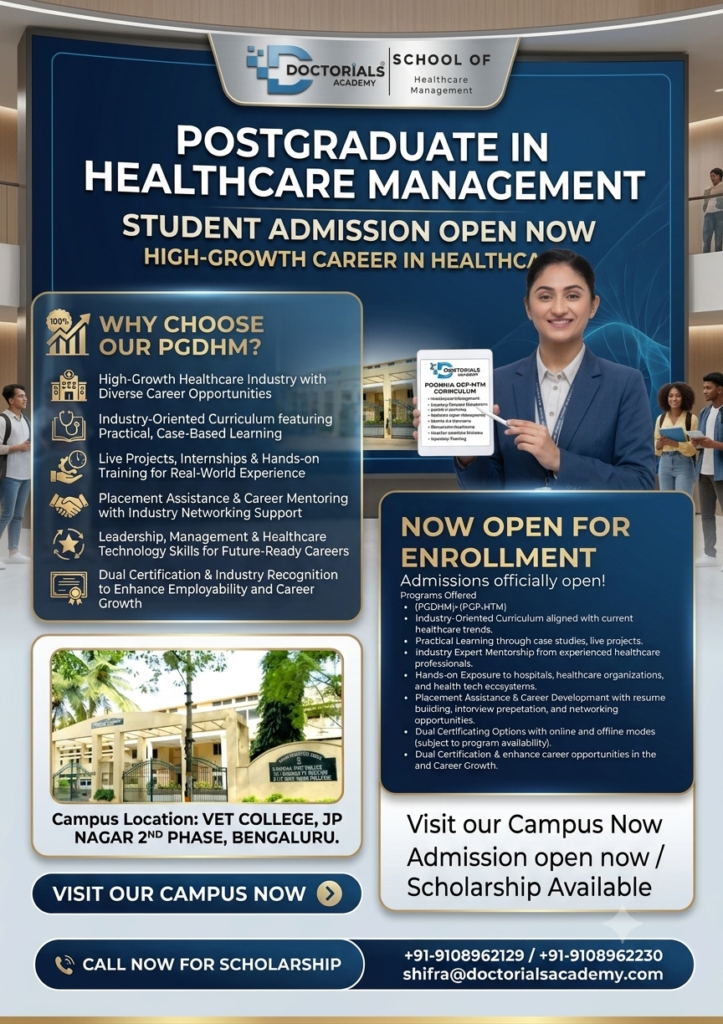
This is where PGDHM — Post Graduate Diploma in Healthcare Management becomes highly relevant.
At Doctorials Academy, the PGDHM program is designed to help graduates and healthcare professionals develop the management, operational, analytical and leadership capabilities required to work in today’s rapidly evolving healthcare environment. Doctorials Academy describes the program as a career-oriented pathway focused on hospital administration, healthcare operations and practical healthcare management.
The objective is simple:
To help learners move beyond understanding healthcare to understanding how healthcare organizations actually work.
What Is PGDHM?
PGDHM stands for Post Graduate Diploma in Healthcare Management.
It is a specialized postgraduate-level program focused on the management and administration of healthcare organizations.
Unlike a general management course, PGDHM focuses specifically on the challenges of the healthcare sector.
Students are introduced to areas such as:
- Hospital administration
- Healthcare operations
- Healthcare quality management
- Healthcare finance
- Human resource management
- Healthcare marketing
- Medical records management
- Healthcare technology
- Strategic management
- Patient relationship management
- Healthcare laws and ethics
- Digital healthcare
- Healthcare analytics
Doctorials Academy positions its PGDHM as an industry-oriented program designed to bridge the gap between academic learning and the practical requirements of healthcare organizations.
Why Does Healthcare Need Professional Managers?
A hospital is much more than a building containing doctors, nurses and medical equipment.
It is a highly interconnected organization.
Consider what happens when a patient enters a hospital.
The patient may interact with:
Reception → Registration → Insurance → Doctor → Diagnostics → Pharmacy → Billing → Nursing → Discharge → Follow-up
Behind these interactions are hundreds of processes.
Someone has to make sure that:
- Patients move efficiently through the system.
- Departments communicate effectively.
- Staff are appropriately managed.
- Hospital resources are utilized efficiently.
- Quality standards are maintained.
- Patient complaints are addressed.
- Costs are controlled.
- Healthcare regulations are followed.
- Technology is used effectively.
- Patient experience continuously improves.
This is the world of healthcare management.
A healthcare manager therefore becomes the bridge between clinical services and organizational performance.
Who Can Pursue PGDHM at Doctorials Academy?
One of the major advantages of healthcare management is that the field is not restricted to doctors.
Doctorials Academy’s current program information states that graduates from diverse academic backgrounds can apply, including medical, allied-health, business, engineering, arts, science and commerce backgrounds. The program also identifies medical and allied-health graduates, pharmacy and life-science graduates, management and commerce graduates, freshers, professionals, entrepreneurs and career switchers among potential applicants.
This creates opportunities for professionals such as:
Medical Professionals
- MBBS graduates
- BDS graduates
- BAMS graduates
- BHMS graduates
- Medical interns
Nursing & Allied Healthcare
- B.Sc Nursing graduates
- Allied-health professionals
- Pharmacy graduates
- Life-science graduates
Non-Medical Graduates
- B.Com graduates
- BBA graduates
- B.Sc graduates
- BA graduates
- Engineering graduates
- Management graduates
Working Professionals
Professionals who already work in healthcare can use management education to expand their responsibilities and move toward supervisory or managerial positions.
Entrepreneurs
Healthcare entrepreneurs can benefit from understanding hospital operations, finance, human resources, quality systems, technology and healthcare strategy.
The important idea is that you do not necessarily have to be a doctor to build a career in healthcare management.
What Will Students Learn?
Doctorials Academy’s PGDHM curriculum is designed around the practical functioning of healthcare organizations.
1. Hospital Administration
Students learn how healthcare organizations are structured and administered.
This includes understanding:
- Hospital departments
- Administrative workflows
- Coordination between clinical and non-clinical teams
- Hospital policies
- Operational planning
- Administrative responsibilities
The goal is to understand how different components of a hospital work together.
2. Healthcare Operations Management
Operations are at the heart of hospital performance.
Students can develop an understanding of:
- Patient flow
- Resource utilization
- Hospital workflows
- Capacity planning
- Process improvement
- Operational efficiency
- Department coordination
For example, if an emergency department experiences long waiting times, a healthcare manager must investigate the entire process rather than simply blaming one department.
Analytics, process mapping and operational management can help identify where bottlenecks are occurring.
3. Healthcare Quality Management
Quality is one of the most important pillars of modern healthcare.
Students are introduced to concepts surrounding:
- Quality assurance
- Patient safety
- Quality improvement
- Healthcare standards
- Accreditation
- Performance monitoring
- Continuous improvement
Doctorials Academy highlights NABH accreditation and healthcare quality systems among the program’s industry-oriented areas.
This is particularly important because healthcare organizations increasingly need professionals who understand both clinical quality and management processes.
4. Healthcare Analytics
Healthcare is becoming increasingly data-driven.
Modern hospitals generate enormous amounts of information through:
- Electronic health records
- Laboratory systems
- Patient registrations
- Billing systems
- Insurance claims
- Diagnostic systems
- Patient feedback
- Hospital operations
- Digital-health platforms
Healthcare analytics helps transform this information into actionable insights.
Students can understand how analytics supports:
Data → Information → Insight → Decision → Action
For example, hospital analytics can help managers identify:
- Increasing patient waiting times
- Bed occupancy patterns
- Readmission trends
- Department performance
- Resource utilization
- Patient satisfaction patterns
- Revenue and cost trends
This connects directly with the broader healthcare-analytics discussion: modern healthcare managers increasingly need to understand not just how to manage people, but also how to interpret data.
5. Healthcare Finance
Healthcare organizations must deliver quality services while remaining financially sustainable.
Healthcare management therefore requires an understanding of:
- Hospital budgeting
- Revenue management
- Cost control
- Resource allocation
- Financial planning
- Insurance
- Healthcare economics
A healthcare manager does not necessarily need to become an accountant.
But they need to understand the financial consequences of operational decisions.
6. Human Resource Management in Healthcare
Healthcare is fundamentally people-driven.
Doctors, nurses, technicians, administrators, pharmacists, receptionists, support staff and managers all contribute to patient care.
Healthcare HR therefore involves unique challenges such as:
- Workforce planning
- Recruitment
- Employee engagement
- Training
- Performance management
- Team coordination
- Leadership
- Conflict management
- Staff retention
Doctorials Academy’s PGDHM curriculum includes healthcare HR and administration as important areas of study.
7. Healthcare Marketing and Patient Experience
Today’s patients increasingly compare healthcare organizations based not only on clinical outcomes but also on their overall experience.
Healthcare managers therefore need to understand:
- Patient communication
- Patient relationship management
- Healthcare branding
- Digital marketing
- Patient feedback
- Service quality
- Reputation management
A satisfied patient can become a long-term advocate for a healthcare organization.
8. Healthcare Technology and Digital Transformation
Healthcare is rapidly becoming digital.
Hospitals and healthcare organizations are adopting:
- Electronic medical records
- Hospital information systems
- Telemedicine
- Digital payments
- AI-assisted systems
- Remote monitoring
- Wearable technologies
- Data analytics
- Digital patient engagement
Doctorials Academy’s current PGDHM positioning includes digital healthcare, health IT and healthcare technology as important components of future-ready healthcare management.
This means future healthcare managers need to understand both people and technology.
9. Healthcare Laws and Ethics
Healthcare management also involves significant legal and ethical responsibilities.
Managers need awareness of areas such as:
- Patient rights
- Confidentiality
- Medical ethics
- Regulatory compliance
- Healthcare documentation
- Data protection
- Professional responsibilities
As healthcare becomes increasingly digital, understanding patient-data protection and responsible technology adoption becomes even more important.
10. Strategic Healthcare Management
A hospital manager cannot focus only on today’s problems.
Healthcare organizations must also plan for the future.
Strategic management helps professionals think about:
- Organizational growth
- Competition
- New healthcare services
- Technology adoption
- Market expansion
- Patient needs
- Cost optimization
- Quality improvement
- Long-term sustainability
This transforms a manager from someone who simply handles daily problems into someone who helps build the future of the organization.
The Practical Advantage of Doctorials Academy’s PGDHM
One of the key differentiators highlighted by Doctorials Academy is its emphasis on industry-oriented learning rather than theory alone.
The program is positioned around practical healthcare scenarios, case studies, hospital operations, healthcare quality, analytics and digital transformation.
This is important because healthcare management is learned not only from textbooks.
Imagine being asked:
“Emergency department waiting time has increased by 30%. What would you do?”
A healthcare manager needs to investigate:
Patient volume → Staffing → Registration → Triage → Doctor availability → Diagnostics → Bed availability → Discharge → Patient flow
This type of problem requires management thinking.
That is the type of mindset a healthcare management program should develop.
Online and Offline Learning Options
Doctorials Academy currently provides both online and offline learning pathways for its healthcare management programs. The academy states that online learning provides flexibility for working professionals, while offline learning provides classroom-based engagement for students who prefer an in-person learning environment.
This creates flexibility for different learner profiles.
Online
Suitable for:
- Working professionals
- Students from different locations
- Career switchers
- Professionals balancing work and education
Offline
Suitable for:
- Fresh graduates
- Students who prefer classroom learning
- Learners seeking face-to-face interaction
The availability of different modes allows students to choose a learning format that fits their professional and academic situation.
PGDHM and Healthcare Analytics: A Powerful Combination
The healthcare industry is entering a new era where management decisions are increasingly influenced by data.
Consider a hospital administrator who wants to improve performance.
They might need to analyze:
Bed occupancy + Patient admissions + Average length of stay + Staffing + Revenue + Patient satisfaction + Readmissions
This is where healthcare management and healthcare analytics intersect.
A future healthcare leader may need to understand:
Management + Analytics + Technology + Healthcare Operations
rather than treating these areas as separate disciplines.
This is one reason Doctorials Academy’s healthcare management curriculum places emphasis on healthcare analytics and digital transformation.

What Career Paths Can PGDHM Open?
After completing a healthcare management program, graduates can explore opportunities across multiple segments of the healthcare industry.
Hospitals and Healthcare Organizations
Potential roles include:
- Hospital Administrator
- Hospital Manager
- Healthcare Operations Manager
- Patient Services Manager
- Quality Executive
- Healthcare HR Executive
- Medical Records Executive
Healthcare Technology
Opportunities can exist in:
- Health-tech companies
- Hospital information systems
- Digital-health platforms
- Telemedicine
- Healthcare analytics
- Healthcare technology operations
Insurance
Graduates may explore roles related to:
- Health insurance operations
- Claims management
- Healthcare administration
- Provider management
Diagnostics
Opportunities may include:
- Diagnostic-centre operations
- Quality management
- Patient services
- Business operations
Consulting
Healthcare management knowledge can also support careers in:
- Healthcare consulting
- Hospital consulting
- Process improvement
- Quality consulting
- Healthcare strategy
Entrepreneurship
For those interested in building healthcare businesses, PGDHM can provide exposure to:
- Healthcare operations
- Finance
- Marketing
- Human resources
- Technology
- Patient management
- Strategy
Doctorials Academy identifies hospitals, diagnostic chains, health insurance organizations, healthcare IT companies, NGOs, public-health programmes and medical-tourism organizations among the sectors where healthcare-management professionals can build careers.
PGDHM After MBBS, BDS, Nursing or Pharmacy
For healthcare professionals, PGDHM can serve a different purpose.
A medical or allied-health degree teaches the professional about their clinical or scientific discipline.
Healthcare management adds another layer:
Clinical knowledge + Management knowledge
For example:
MBBS + PGDHM
Can provide a foundation for exploring:
- Hospital administration
- Healthcare operations
- Clinical management
- Healthcare consulting
- Digital health
- Healthcare entrepreneurship
BDS + PGDHM
Can help dental professionals understand:
- Clinic administration
- Healthcare operations
- Patient management
- Healthcare business strategy
Nursing + PGDHM
Can complement clinical nursing knowledge with:
- Hospital administration
- Operations
- Quality management
- Team leadership
- Healthcare HR
Pharmacy + PGDHM
Can provide exposure to:
- Healthcare administration
- Hospital operations
- Healthcare business
- Pharmaceutical and healthcare management
The PGDHM does not replace a clinical qualification.
Instead, it can add a management dimension to an existing healthcare background.
PGDHM for Non-Medical Graduates
One of the most interesting aspects of healthcare management is that the industry also needs professionals from outside traditional clinical disciplines.
A hospital requires:
- Finance professionals
- HR professionals
- Operations managers
- Marketing professionals
- Data analysts
- Technology professionals
- Strategy professionals
Therefore, a graduate from commerce, management, science, engineering or arts can potentially enter healthcare management after acquiring sector-specific knowledge.
Doctorials Academy explicitly states that its current program welcomes graduates from diverse disciplines and that prior healthcare or technical knowledge is not necessarily required because the curriculum begins with foundational concepts.
Why Choose Doctorials Academy for PGDHM?
Doctorials Academy positions its PGDHM around several core principles.
1. Healthcare-Specific Education
Rather than teaching generic management alone, the program focuses on healthcare organizations and healthcare-sector challenges.
2. Industry-Oriented Curriculum
The curriculum incorporates areas such as hospital operations, quality, NABH, HR, healthcare technology, finance and strategy.
3. Medical + Management Perspective
The program can help healthcare professionals add management capabilities to their existing clinical or healthcare knowledge.
4. Open to Diverse Graduates
The current admissions information welcomes graduates from medical, allied-health and non-medical backgrounds.
5. Online and Offline Flexibility
Students can choose between learning formats according to their requirements.
6. Career-Focused Learning
Doctorials Academy emphasizes career guidance, professional development and industry-relevant skills as part of its healthcare management approach.
7. University-Awarded PGDHM
Doctorials Academy’s current program page states that the PGDHM is awarded by Medhavi Skills University through Doctorials Academy, alongside a professional certification in Healthcare & Technology Management from Doctorials Academy.
Doctorials Academy and Medhavi Skills University
Doctorials Academy has announced its association with Medhavi Skills University (MSU) for the PGDHM program.
According to Doctorials Academy’s published announcement, the academy became an approved training partner and its PGDHM qualification was recognized by MSU.
The academy’s current program page describes MSU as a UGC-recognized university and identifies it as the awarding body for the PGDHM.
For students, the important point is that the program combines Doctorials Academy’s healthcare-focused training with a university-awarded qualification.
Who Should Consider PGDHM?
PGDHM may be particularly relevant for someone who thinks:
“I want to work in healthcare, but I also want to understand management.”
It can be considered by:
- MBBS graduates
- BDS graduates
- Nursing graduates
- Pharmacy graduates
- Allied-health professionals
- Life-science graduates
- Science graduates
- Commerce graduates
- Management graduates
- Engineering graduates
- Working professionals
- Healthcare entrepreneurs
- Career switchers
The strongest candidates are likely to be those who are genuinely interested in healthcare operations, leadership, administration, technology and organizational growth.
PGDHM Is Not Just About Getting a Certificate
The real value of a healthcare management program should not be measured only by the certificate at the end.
The more important question is:
What can you do after completing it?
Can you understand a hospital workflow?
Can you analyze an operational problem?
Can you communicate with doctors and administrators?
Can you understand healthcare finance?
Can you participate in quality-improvement initiatives?
Can you interpret healthcare data?
Can you manage a team?
Can you understand digital-health systems?
Can you contribute to strategic decision-making?
These capabilities determine how effectively a professional can apply healthcare-management education in the real world.
The Future Healthcare Manager
The healthcare manager of tomorrow will need to understand much more than administration.
They will need to understand:
🏥 Hospitals
📊 Healthcare Analytics
🤖 Artificial Intelligence
💻 Digital Health
👥 Human Resources
💰 Healthcare Finance
📈 Strategy
✅ Quality & Patient Safety
❤️ Patient Experience
⚖️ Healthcare Ethics & Regulation
This is why healthcare management is becoming increasingly multidisciplinary.
The future healthcare leader may sit in one meeting with a doctor, another with a finance team, another with an IT team and another with a hospital operations team.
They must be able to understand all four conversations.
Why Healthcare Management Is Becoming a Strategic Career
Healthcare is one of the sectors where demand for services does not disappear.
But healthcare organizations themselves are becoming more complex.
Hospitals are adopting technology.
Patients are becoming more informed.
Insurance is expanding.
Digital health is growing.
Healthcare startups are emerging.
Analytics is becoming more important.
Quality standards are becoming more sophisticated.
Healthcare organizations are increasingly focused on efficiency and patient experience.
All of this creates a need for professionals who understand how to manage healthcare systems effectively.
Doctorials Academy’s healthcare-management program is positioned around this transformation, with a focus on developing industry-relevant skills for modern healthcare organizations.
The Doctorials Academy Advantage
The vision behind Doctorials Academy’s PGDHM can be summarized in one statement:
Don’t just learn healthcare. Learn how to manage, improve and transform it.
A medical professional may understand the patient.
A finance professional may understand the numbers.
An IT professional may understand the technology.
An HR professional may understand people.
A healthcare manager needs to understand how all of these pieces fit together.
That is the capability healthcare management education is designed to develop.
Final Takeaway
The healthcare industry needs more than clinical professionals.
It needs leaders, administrators, analysts, strategists, technology managers, quality professionals and operations experts who can make healthcare organizations more efficient, patient-centric and future-ready.
The PGDHM from Doctorials Academy is designed around this requirement, combining healthcare management fundamentals with areas such as hospital administration, operations, quality, healthcare analytics, finance, HR, digital healthcare and strategic management.
Whether you are a doctor looking to move toward healthcare leadership, a nursing or pharmacy graduate seeking management skills, a graduate from a non-medical background looking to enter healthcare, or a professional considering a career transition, healthcare management can provide a pathway into the administrative and strategic side of one of the world’s most essential industries.
The future of healthcare will not be shaped only by those who provide care.
It will also be shaped by those who know how to manage, improve, digitize and transform the systems that deliver that care.
And that is where PGDHM from Doctorials Academy aims to make a difference.
Learn More
Doctorials Academy – Official Website
Doctorials Academy PGDHM Program
Admissions & Enquiries: +91 9108962129
Email: co*****@***************my.com
Website:- https://doctorialsacademy.com/
V-Library: https://doctorialsacademy.com/medical-courses/
PGDHM:- https://doctorialsacademy.com/pgdhm/
Full time PGDHM: https://doctorialsacademy.com/offline/
LinkedIn:- https://in.linkedin.com/company/doctorials-academy
PGDHM LinkedIn: https://www.linkedin.com/company/doctorials-academ-pgdhm/
Medical Admission Guidelines LinkedIn: https://www.linkedin.com/company/mbbs-pg-and-pg-abroad-admission/
Facebook:- https://www.facebook.com/people/Doctorials-Academy/61558183675530/
YouTube:- https://www.youtube.com/channel/UCEukyOB7riOSdUhz68tdLzA
Instagram:- https://www.instagram.com/doctorialsacademy/
Android app:- https://play.google.com/store/apps/details?id=com.edmingle.doctorialsacademy&hl=en

