
From Turning Lights On and Off to Creating Intelligent Healing Environments
Hospital lighting is no longer simply about making rooms bright enough to see. As healthcare facilities become increasingly digital and connected, lighting is emerging as an important part of the hospital’s overall environmental management system.
Traditional manual switches are gradually being replaced by sophisticated digital controls that can automatically adjust lighting intensity, duration and even spectral characteristics according to the needs of patients, doctors, nurses and different clinical departments. The transformation is particularly important because the hospital environment can directly influence patient comfort, staff performance and the accuracy of critical medical tasks.
The latest generation of smart lighting systems uses sensors, network connectivity, automation and centralized controls to create environments that respond to what is happening inside the hospital in real time.
In other words, the hospital of the future may not simply illuminate patients—it may intelligently respond to them.
Why Lighting Matters in Healthcare
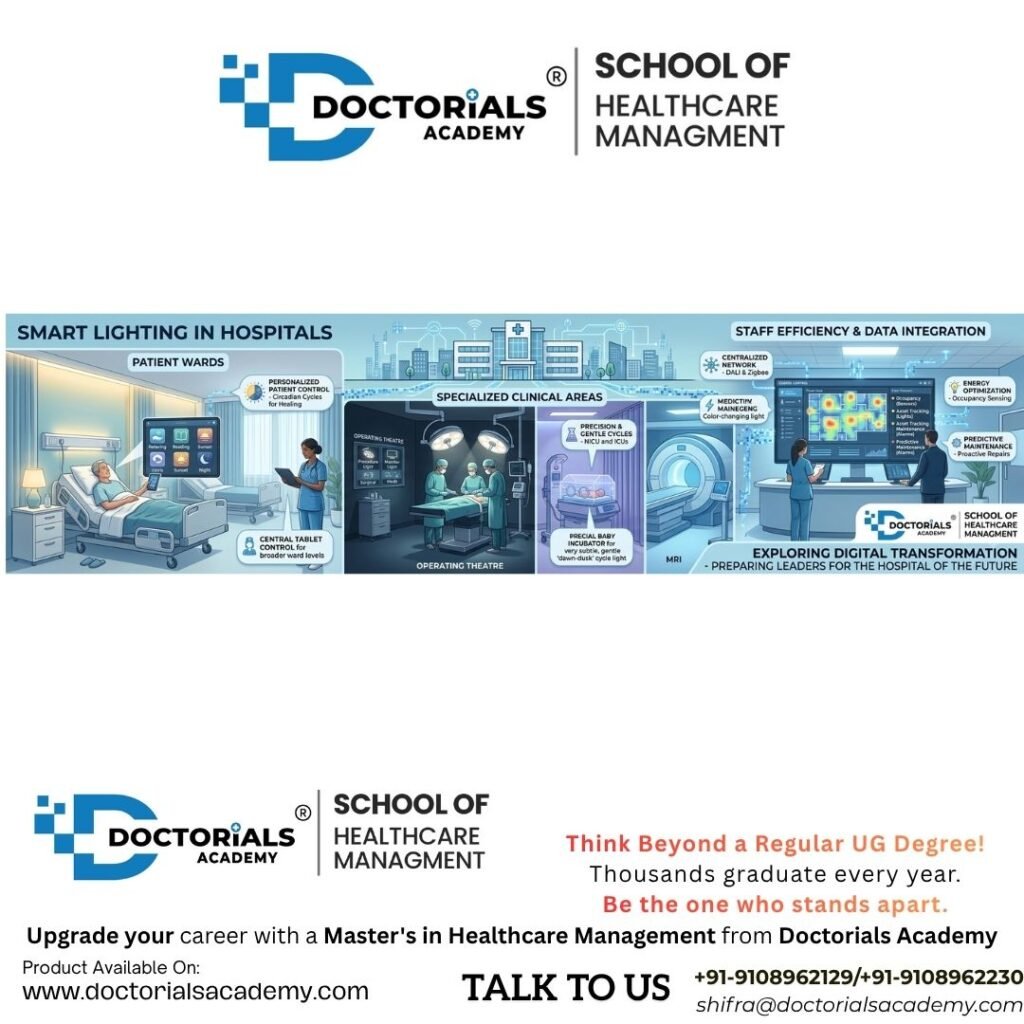
Hospitals operate 24 hours a day, seven days a week. A single facility may contain emergency departments, operating theatres, intensive care units, diagnostic imaging rooms, patient wards, laboratories, corridors and administrative areas—all with very different lighting requirements.
A corridor used during the day does not need the same lighting conditions at 2 a.m. A patient’s recovery room may require soft, low-intensity lighting, while an operating theatre needs highly controlled and focused illumination.
Smart lighting controls make these transitions possible without requiring healthcare workers to constantly adjust switches manually.
Sensors can monitor factors such as occupancy, available daylight and activity within different areas. The system can then provide the appropriate amount of illumination automatically. This can reduce unnecessary manual intervention while giving facility managers greater visibility into how lighting and other resources are being used.
Networked Lighting: Turning Thousands of Fixtures into One Intelligent System
One of the biggest developments in hospital lighting is the move toward networked systems.
Instead of treating every light as an isolated device, modern systems can connect thousands of fixtures through a centralized platform. Hospital administrators and facility managers can establish broad policies—for example, reducing corridor lighting during overnight hours while maintaining required safety illumination in emergency exits.
At the same time, individual rooms or fixtures can still be controlled when specific clinical requirements demand it.
Communication technologies such as DALI (Digital Addressable Lighting Interface) and Zigbee can support these interconnected systems. In complex healthcare environments, reliability and scalability are particularly important because lighting networks may operate alongside sensitive medical equipment.
The real potential becomes even greater when lighting is connected with other building-management systems.
For example, if sensors identify that a room is unoccupied, the lighting system could communicate with HVAC infrastructure to support more efficient environmental management.
Smart Lighting Can Also Predict Problems Before They Happen
Hospitals cannot afford frequent infrastructure failures. Even a seemingly minor lighting problem can become a significant operational inconvenience in a 24-hour clinical environment.
Networked lighting systems can provide real-time information about the performance of individual fixtures. This creates opportunities for predictive maintenance.
Instead of waiting for a light to fail, maintenance teams can identify potential problems and schedule repairs during suitable periods, reducing disruption to patient care.
This is an important shift—from reactive maintenance to proactive infrastructure management.
Operating Theatres: Lighting Designed Around Clinical Tasks
Few areas demonstrate the importance of intelligent lighting better than an operating theatre.
During surgery, ambient lighting may need to be reduced to improve visibility of monitor screens, while surgical lights provide highly focused illumination where clinicians need it.
Advanced controls can allow predefined lighting scenes to be activated according to clinical requirements, enabling rapid transitions between different lighting conditions.
The objective is simple: the medical team should be concentrating on the patient—not on adjusting the room.
This task-specific approach can make lighting an integrated component of the clinical workflow rather than a separate facility function.
Intensive Care and Neonatal Units Need Even Greater Precision
Lighting requirements become particularly sensitive in intensive care and neonatal environments.
Premature infants in neonatal intensive care units have developing eyes and nervous systems, meaning lighting conditions require careful management. The source material describes automated systems capable of delivering very low light levels and specific spectral characteristics, including gentler “dawn-dusk” cycles intended to support early circadian patterns.
This illustrates an important principle of smart healthcare infrastructure: the best lighting system is not necessarily the brightest one—it is the one that provides the right light at the right time for the right purpose.
Diagnostic Imaging: When Lighting Must Work Around Medical Technology
MRI and CT suites have highly specialized environmental requirements.
In MRI environments, lighting components and controls need to be compatible with the sensitive magnetic environment. At the same time, lighting can be used to create a more comfortable experience for patients undergoing stressful diagnostic procedures.
Soft colours and gradual lighting transitions can help create a calmer atmosphere, demonstrating that lighting can serve both technical and human purposes.
Lighting Is Becoming Part of the Hospital’s Data Infrastructure
Perhaps one of the most exciting developments is the transformation of lighting networks into data-gathering systems.
Modern LED fixtures equipped with sensors can potentially provide information about occupancy, movement and the location of equipment. Hospitals can use this information to better understand how spaces are being used, improve cleaning schedules, support patient throughput and help ensure that critical equipment is available where it is required.
This changes the traditional definition of hospital lighting.
Lighting is no longer just infrastructure. It can become an information network.
The possibilities become even more interesting when lighting data is connected with broader hospital information systems.
The source discusses the potential for environmental settings to eventually respond to individual patient requirements. For example, clinical information could potentially be used to limit brightness for a patient who is sensitive to light. Such integration remains at an early stage, but the underlying concept points toward increasingly personalized healthcare environments.
Patient-Centred Lighting: Giving Patients Control
Healthcare technology is often discussed in terms of doctors, equipment and clinical outcomes. But smart lighting also has a role in giving patients greater control over their surroundings.
In recovery suites, intuitive controls such as bedside tablets, simplified wall panels and voice activation can allow patients to adjust their lighting according to their preferences.
This can be particularly meaningful for patients who spend extended periods in hospitals and may otherwise feel that they have little control over their environment.
Accessibility is also essential.
Large buttons, high-contrast displays and voice controls can make systems easier for patients with different physical or cognitive abilities. At the same time, nursing staff can have override controls that allow them to immediately return the environment to a clinical setting when required.
From “Night Mode” to “Wellness Mode”
Smart lighting can also introduce predefined scenes designed around specific activities.
A reading mode could illuminate the patient’s bedside area while keeping the rest of the room dim. A night mode could provide very low-level lighting to allow safe movement without unnecessarily disturbing sleep.
These seemingly small features can make a hospital room feel less institutional and more comfortable.
The larger concept is human-centric healthcare design—creating environments that support not only clinical treatment but also comfort, dignity and recovery.
Energy Efficiency: A Major Operational Opportunity
Smart lighting can also contribute to more efficient hospital operations.
Sensors can respond to occupancy and daylight levels, while centralized systems allow facility managers to monitor how lighting resources are being consumed. Automated controls can reduce unnecessary illumination in areas where full lighting is not required.
When lighting networks are integrated with HVAC and other building-management systems, the opportunity extends beyond electricity consumption. Hospitals can begin managing environmental infrastructure as an interconnected ecosystem rather than as separate systems.
For large healthcare facilities, this type of data-driven infrastructure management could become increasingly important.
Privacy and Cybersecurity Cannot Be Ignored
Greater connectivity also introduces new responsibilities.
When lighting networks collect information about occupancy, movement, equipment and potentially patient-related environmental preferences, cybersecurity and privacy become critical considerations.
The source emphasizes that lighting networks should receive appropriate protection through encryption and firewalls, while the use of sensor-generated information must respect patient privacy requirements and ethical considerations.
The smarter the hospital becomes, the more important it is to ensure that its digital infrastructure is secure.
What Could the Hospital of the Future Look Like?
The next stage of smart lighting could take healthcare automation even further.
One possibility highlighted in the source is Li-Fi, which uses light waves to transmit data and could potentially provide an alternative communication pathway in sensitive clinical environments.
Artificial intelligence could also analyse information collected by lighting sensors and learn the normal activity patterns of different hospital departments. Instead of simply reacting to changes, AI-driven systems could potentially anticipate environmental requirements and automatically optimize settings for efficiency and staff wellbeing.
Another emerging possibility is bio-feedback.
Future systems could potentially connect wearable devices with environmental controls, allowing lighting conditions to respond to physiological information such as heart rate or skin conductance. Although these applications are still being researched, they point toward a future in which hospital environments become increasingly responsive to individual needs.
The Bigger Picture: A Hospital That Responds
The evolution of smart lighting reflects a much larger transformation taking place across healthcare infrastructure.
Hospitals are moving from static buildings toward connected, data-driven environments. Lighting, HVAC, security, medical equipment and patient spaces can increasingly communicate with one another.
The result could be a healthcare facility in which the physical environment actively supports clinical work.
Imagine entering a hospital where lights automatically adjust as daylight changes; patient rooms transition into gentle night settings; operating theatres instantly activate procedure-specific lighting; sensors help identify underused spaces; maintenance teams receive early warnings about failing fixtures; and future AI systems learn how different departments operate.
This is no longer simply about installing better lights.
It is about building a smarter hospital.
Why Smart Lighting Should Be on the Healthcare Infrastructure Agenda
For hospital administrators, architects, healthcare technology companies and facility managers, intelligent lighting deserves attention because it sits at the intersection of several priorities:
- Patient experience through personalized and comfortable environments
- Clinical workflow through task-specific lighting
- Staff efficiency through automation
- Operational management through centralized control
- Energy optimization through occupancy and daylight sensing
- Predictive maintenance through real-time monitoring
- Data-driven decision-making through connected sensors
- Future healthcare innovation through AI, Li-Fi and responsive environments
Smart lighting should therefore be viewed not as a decorative upgrade, but as part of the broader digital transformation of healthcare infrastructure.
Conclusion: The Future of Healthcare May Be More Responsive Than We Think
The hospital environment plays a surprisingly important role in healthcare delivery. While medical technology traditionally focuses on diagnosis, treatment and monitoring, smart environmental technologies are beginning to address another important question:
Can the hospital itself become intelligent?
Smart lighting provides one possible answer.
By combining digital controls, sensors, network connectivity, automation and data analytics, hospitals can create environments that adapt to clinical activities, patient preferences and operational requirements.
The journey from a simple wall switch to an intelligent lighting network may appear small—but it represents a much larger change in how healthcare facilities are designed and managed.
As AI, connected devices and intelligent building systems continue to evolve, the hospital of tomorrow could become an environment that does more than house healthcare.
It could actively participate in delivering it.
Source: Healthcare and Hospital Management (HHM Global), “Smart Lighting Controls Optimizing Hospital Environmental Conditions.” The article discusses the evolution of digital lighting controls, networked hospital systems, specialized clinical lighting, patient-centred controls, data integration and future technologies such as Li-Fi and AI.
Sources
The article was primarily based on the source you provided:
- Healthcare and Hospital Management (HHM Global) — “Smart Lighting Controls Optimizing Hospital Environmental Conditions”
HHM Global – Smart Lighting Controls Optimizing Hospital Environmental Conditions - Uploaded source document — Smart Lighting Controls Optimizing Hospital Conditions.pdf, which contains the five-page article from HHM Global.
Key source topics used
- Digital and automated lighting controls in hospitals
- Networked lighting systems and centralized management
- DALI and Zigbee communication protocols
- Smart lighting in operating theatres and ICUs
- Specialized lighting for MRI/CT environments
- Neonatal intensive care lighting
- Lighting sensors and hospital data ecosystems
- Patient-centred lighting and recovery suites
- Energy optimization and predictive maintenance
- Privacy and cybersecurity considerations
- Future applications of AI, Li-Fi and bio-feedback
Source note: The detailed news article I created is a rewritten and expanded presentation of the information contained in the HHM Global source; it is not intended to reproduce the original article verbatim.
From Hospital Rooms to Intelligent Clinical Spaces: How Doctorials Academy Prepares Future Healthcare Managers
Modern hospitals are no longer just buildings filled with medical equipment. They are complex, technology-driven environments where space, people, equipment, technology, safety and patient experience must work together seamlessly.
Operating theatres, ICUs, emergency departments, diagnostic areas, patient rooms, laboratories and recovery spaces each have different operational requirements. Managing these spaces efficiently requires healthcare professionals who understand both clinical needs and healthcare management principles.
This is where Doctorials Academy’s Masters in Healthcare Management (PGDHM) can play an important role.
What Is Clinical Space Management?
Clinical space management is the systematic planning and utilization of hospital spaces to ensure that the right facilities, equipment, staff and resources are available where they are needed.
It involves questions such as:
- How can patient rooms be utilized more efficiently?
- How should clinical departments be planned and organized?
- How can patient movement through the hospital be improved?
- How can overcrowding and unnecessary waiting be reduced?
- Where should critical medical equipment be located?
- How can operating theatres and diagnostic areas be scheduled efficiently?
- How can hospitals balance patient comfort with clinical requirements?
- How can technology and data support better utilization of hospital infrastructure?
For tomorrow’s healthcare managers, understanding these questions is increasingly important.
How Smart Hospital Infrastructure Changes Healthcare Management
The smart-lighting example demonstrates how even a seemingly simple hospital function can become part of a larger digital ecosystem.
Modern lighting systems can monitor occupancy, support automated environmental controls, provide operational data and potentially integrate with other building-management systems. In specialized areas such as operating theatres, ICUs, diagnostic imaging suites and neonatal units, environmental requirements can vary significantly.
This means healthcare managers need to understand more than traditional administration.
They need to understand how infrastructure, technology and clinical operations connect.
This is where healthcare management education becomes valuable.
How Doctorials Academy’s Masters in Healthcare Management Can Help
Doctorials Academy’s healthcare management program is designed to help learners understand the broader business and operational side of healthcare.
The program covers areas such as:
1. Healthcare Operations Management
Clinical space cannot be managed independently from hospital operations.
Healthcare management education helps students understand how departments, people, resources and processes need to work together to deliver efficient patient care.
Students can develop an understanding of operational planning, workflow management and resource utilization—skills that can be applied when evaluating clinical areas such as emergency departments, wards, OPDs, ICUs and diagnostic facilities.
2. Hospital Strategy and Planning
A hospital manager needs to think beyond today’s requirements.
Healthcare facilities must plan for changing patient volumes, new technologies, additional services and evolving models of care.
The principles of healthcare strategy help future managers think about questions such as:
“Are we using our existing infrastructure effectively, or do we need to redesign the way the space is being used?”
This strategic mindset is essential for modern clinical space management.
3. Healthcare Analytics
One of the biggest advantages of modern hospitals is the availability of data.
Smart building technologies can generate information about occupancy, staff movement, equipment utilization and space usage.
Healthcare managers who understand analytics can use such information to support better operational decisions.
For example, data can potentially help identify:
- Underutilized clinical areas
- Peak patient-flow periods
- Bottlenecks
- Space utilization patterns
- Equipment movement
- Operational inefficiencies
- Opportunities for better resource allocation
Data turns hospital space from a fixed asset into a measurable management resource.
4. Quality and Risk Management
Clinical environments must be designed around safety and quality.
Operating theatres, ICUs, diagnostic imaging suites and other specialized areas require carefully controlled environments. The source article highlights the importance of appropriate lighting systems, automation and specialized controls in such settings.
Healthcare management education introduces learners to the importance of quality systems, risk management and operational standards.
This helps future managers understand that improving space utilization should never come at the expense of patient safety or quality of care.
5. Technology and AI in Healthcare
The future of hospital infrastructure is increasingly connected.
The source discusses the potential integration of lighting systems with hospital data ecosystems and emerging technologies such as AI and Li-Fi. AI could potentially analyze sensor data and help optimize environmental conditions based on departmental activity.
For healthcare management students, understanding these developments is important because the healthcare manager of the future will increasingly work at the intersection of:
Healthcare + Technology + Data + Operations + Patient Experience
Doctorials Academy’s focus on healthcare technology and AI in healthcare can help learners build awareness of this changing environment.
From Classroom Knowledge to Real Hospital Problems
The real value of healthcare management education is not simply learning definitions.
It is learning to look at a hospital differently.
For example, instead of seeing a patient room simply as a room, a healthcare manager can evaluate:
Space → Patient flow → Staff movement → Equipment → Technology → Safety → Cost → Patient experience
Similarly, an operating theatre can be viewed not simply as a physical space, but as a complex operational unit where scheduling, equipment, staff, infection-control requirements, technology and patient movement must work together.
That is the mindset required for modern clinical space management.
Patient Experience Is Also Part of Space Management
Clinical space management should not focus only on efficiency.
Patients spend significant amounts of time inside hospitals, and the environment can influence their overall experience.
The source material highlights patient-centred lighting controls, including bedside controls, accessible interfaces and predefined wellness modes such as reading and night settings.
Healthcare managers therefore need to think about:
“How can we make the hospital more efficient without making it less human?”
This balance between operational efficiency and patient comfort is an important part of modern healthcare management.
A New Generation of Healthcare Managers
The healthcare industry needs professionals who can understand both sides of the equation:
Smarter Healthcare Management
Doctorials Academy’s Masters in Healthcare Management (PGDHM) can help students develop this broader perspective by exposing them to important healthcare management areas including healthcare analytics, hospital finance, strategy, quality and risk management, and AI in healthcare.
Who Can Benefit?
The program can be particularly relevant for learners from diverse backgrounds who want to build careers in healthcare management, including:
- MBBS graduates
- BDS graduates
- Nursing professionals
- BAMS and BHMS graduates
- Pharmacy graduates
- Science graduates
- Commerce graduates
- Arts graduates
- Professionals looking to transition into healthcare management
The objective is to help learners understand that healthcare is not only about clinical treatment—it is also a large, complex management ecosystem.
Career Opportunities in Healthcare Management
With hospitals becoming increasingly digital and data-driven, healthcare management professionals can explore roles across areas such as:
- Hospital Operations
- Healthcare Administration
- Clinical Operations Coordination
- Quality Management
- Healthcare Analytics
- Hospital Planning
- Facility and Infrastructure Management
- Patient Experience
- Healthcare Technology Management
- Healthcare Consulting
- Business Development
- Hospital Strategy
Clinical space management can therefore become one component of a much broader healthcare operations and management career.
Why Learn Healthcare Management Now?
The hospital of tomorrow will be very different from the hospital of yesterday.
Connected sensors, AI, analytics, smart infrastructure and digital patient systems are transforming the way healthcare facilities operate.
The source article describes a future in which the hospital environment itself could become increasingly responsive—using technology to adapt lighting and other environmental conditions according to patient, staff and operational requirements.
This transformation creates a growing need for professionals who can understand how technology can be converted into better healthcare operations.
Doctorials Academy: Building Healthcare Managers for the Future
At Doctorials Academy, the goal is not simply to teach students how hospitals function.
It is to help learners understand how hospitals can function better.
From healthcare analytics and hospital strategy to quality management, risk management and AI in healthcare, the Masters in Healthcare Management (PGDHM) provides a pathway for learners who want to understand the management side of the healthcare industry.
Because the future hospital will need more than doctors and nurses.
It will also need healthcare managers who know how to manage people, processes, technology, infrastructure and data together.
The future of healthcare is not only about better treatment.
It is about building smarter hospitals—and smarter healthcare managers.
Learn Healthcare Management with Doctorials Academy and prepare to be part of the next generation of healthcare transformation.
Note: The discussion of smart lighting, networked infrastructure, clinical environments, patient-centred controls, data integration, AI and future hospital technologies above is based on the provided HHM Global source. The connection to Doctorials Academy’s healthcare-management curriculum is presented as an educational application of those concepts, rather than a claim that the source itself discusses Doctorials Academy.

