
Exploring High-Demand Healthcare Career Opportunities, Skills, Qualifications and Future Growth
Published: September 2026
Category: Healthcare Education | Career Development | Healthcare Management
India’s healthcare industry is entering a period of significant transformation. Advances in medical technology, growing healthcare infrastructure, increasing demand for quality patient care, and the expansion of digital health services are creating new opportunities for professionals across clinical and non-clinical fields.
Traditionally, healthcare careers were primarily associated with doctors, nurses, pharmacists and other clinical professionals. However, the healthcare industry now requires a much broader range of expertise, including hospital administration, healthcare analytics, quality management, digital health, rehabilitation and mental health services.
According to the World Health Organization (WHO), India has expanded its medical and nursing education infrastructure, while the National Commission for Allied and Healthcare Professions is contributing to the development of professional regulation across allied healthcare fields. These developments highlight the growing importance of a diverse, skilled healthcare workforce.
By 2030, healthcare professionals who combine industry knowledge, management capabilities, technology skills and patient-centred thinking may find opportunities across an increasingly diverse employment landscape.
This article explores seven emerging healthcare career areas, the responsibilities involved, relevant qualifications, essential skills and the ways students can prepare for future opportunities.
Why Is India’s Healthcare Industry Expected to Create New Career Opportunities?
Before examining individual career paths, it is important to understand the factors influencing India’s healthcare employment landscape.
1. Expansion of Healthcare Infrastructure
India continues to develop hospitals, diagnostic centres, medical colleges, rehabilitation facilities and healthcare delivery networks.
According to the Ministry of Health and Family Welfare, India’s healthcare infrastructure includes primary health centres, community health centres, district hospitals and medical colleges. The government’s Health Dynamics of India report provides information about the infrastructure and human resources supporting these facilities.
The expansion of healthcare infrastructure creates requirements for professionals who can support:
- Hospital operations and administration
- Patient coordination
- Healthcare finance and billing
- Quality assurance
- Human resources
- Medical records and information systems
- Clinical and non-clinical department coordination
Healthcare expansion therefore creates career opportunities beyond direct clinical practice.
2. Growing Demand for Skilled Healthcare Professionals
Healthcare delivery depends on the availability of trained personnel across different specialties.
In February 2026, the Ministry of Health and Family Welfare reported 39.40 lakh nursing personnel in India and approximately 3.82 lakh nursing personnel being produced annually through nursing institutions, according to the information cited in its parliamentary update.
Although workforce numbers have increased, healthcare systems must continue addressing workforce distribution, professional development, service quality and changing patient needs.
3. Digital Transformation of Healthcare
Technology is changing how hospitals and healthcare organizations manage information, communicate with patients and deliver services.
Digital health developments include:
- Electronic health records
- Telemedicine
- Hospital information systems
- Health data analytics
- Artificial intelligence applications
- Digital patient engagement
- Remote healthcare services
A 2025 Confederation of Indian Industry report identified opportunities in AI, generative AI, patient engagement platforms, infrastructure and healthcare automation.
These developments create a need for professionals who understand both healthcare workflows and technology.
4. Increasing Focus on Healthcare Quality
Patients, healthcare providers, insurers and regulators increasingly require reliable healthcare services and effective operational systems.
Hospitals need personnel who can contribute to:
- Patient safety
- Quality monitoring
- Accreditation preparation
- Regulatory compliance
- Clinical documentation
- Risk management
- Service improvement
This creates opportunities for healthcare quality and administration professionals with appropriate training.
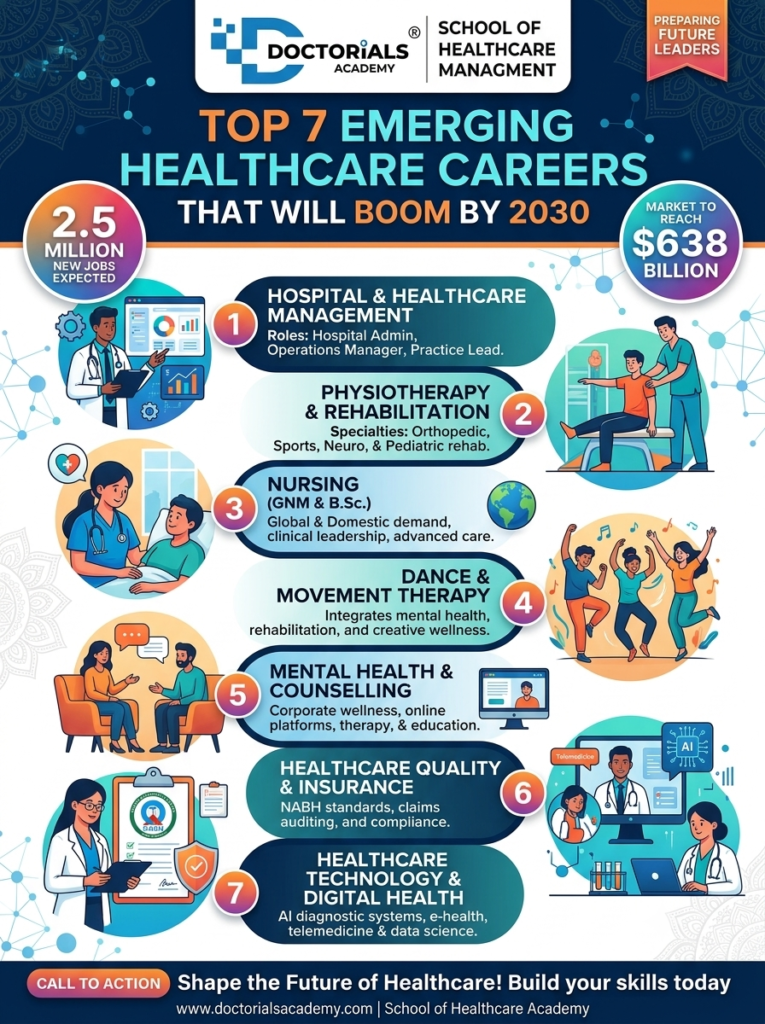
Top 7 Emerging Healthcare Careers in India by 2030
1. Hospital and Healthcare Management
A Career Combining Healthcare, Business and Leadership
Hospital and healthcare management is one of the important non-clinical career areas within the healthcare industry.
Modern hospitals are complex organizations that require coordinated management of clinical services, administration, finance, human resources, technology and patient services.
Doctors and nurses focus on clinical care, while healthcare management professionals help coordinate the systems that support healthcare delivery.
The need for specialized management skills in India’s healthcare system has been discussed in research examining the workforce requirements for health management professionals through 2030. A study published in Human Resources for Health identified a need to strengthen the supply, competencies and training of healthcare management professionals.
What Does a Healthcare Manager Do?
Depending on the organization and job position, healthcare managers may be responsible for:
Hospital Operations
- Coordinating day-to-day hospital operations
- Supporting efficient patient flow
- Coordinating clinical and non-clinical departments
- Monitoring operational performance
Financial Administration
- Supporting hospital budgets
- Monitoring operational expenses
- Coordinating billing and revenue-cycle processes
- Assisting with financial planning
Human Resources
- Supporting staff scheduling
- Coordinating recruitment and onboarding
- Monitoring training and development
- Supporting employee engagement
Patient Experience
- Monitoring patient feedback
- Supporting grievance-resolution processes
- Improving administrative service delivery
- Coordinating patient support services
Potential Job Roles
Students pursuing healthcare management may explore roles such as:
| Job Role | General Responsibilities |
|---|---|
| Hospital Operations Executive | Supporting daily hospital operations |
| Healthcare Administrator | Coordinating administrative functions |
| Hospital Operations Manager | Managing operational processes |
| Patient Relations Executive | Supporting patient experience |
| Healthcare Business Development Executive | Supporting organizational growth |
| Hospital HR Executive | Managing healthcare workforce processes |
| Healthcare Project Coordinator | Supporting healthcare projects |
Job titles, responsibilities and eligibility requirements vary between employers.
Who Can Pursue Healthcare Management?
Healthcare management programmes may be suitable for graduates from different educational backgrounds, depending on institutional eligibility criteria.
Potential candidates include:
- BBA graduates
- BCom graduates
- BA graduates
- BSc graduates
- BCA graduates
- BPharm graduates
- MBBS graduates
- BDS graduates
- BSc Nursing graduates
- Allied healthcare professionals
Students should check the specific eligibility requirements of each institution before applying.
Skills Required
Successful healthcare management professionals benefit from a combination of:
- Leadership and team coordination
- Communication
- Financial understanding
- Problem-solving
- Healthcare operations knowledge
- Data interpretation
- Patient-centred thinking
- Regulatory awareness
Career Outlook Through 2030
Healthcare management may become increasingly relevant as healthcare organizations expand their facilities, services and operational complexity.
However, employment growth will depend on healthcare investment, organizational requirements, professional qualifications and the availability of suitable positions.
Career takeaway: Students interested in healthcare, administration and business can explore healthcare management as a pathway into non-clinical healthcare careers.
2. Physiotherapy and Rehabilitation
Supporting Recovery, Mobility and Quality of Life
Physiotherapy and rehabilitation play an important role in helping people recover from injuries, manage movement-related conditions and improve functional abilities.
As healthcare systems develop, rehabilitation services may be required across hospitals, outpatient clinics, rehabilitation centres, sports facilities and community-based care.
Rehabilitation needs can arise from:
- Musculoskeletal injuries
- Neurological conditions
- Orthopaedic surgery
- Sports injuries
- Age-related mobility challenges
- Certain chronic health conditions
The nature of rehabilitation depends on the patient’s diagnosis, functional limitations and clinical care plan.
Major Areas of Physiotherapy
1. Orthopaedic Physiotherapy
Focuses on movement and functional recovery related to musculoskeletal conditions.
Potential areas include:
- Post-operative rehabilitation
- Joint and muscle conditions
- Mobility training
- Injury recovery
2. Neurological Rehabilitation
Supports individuals with movement and functional difficulties associated with neurological conditions.
Services may include:
- Mobility training
- Balance-related rehabilitation
- Functional exercises
- Patient and caregiver education
3. Sports Physiotherapy
Supports injury management and rehabilitation for athletes and physically active individuals.
4. Geriatric Rehabilitation
Focuses on functional mobility, independence and rehabilitation needs among older adults.
Career Opportunities
Qualified physiotherapists may work in:
- Hospitals
- Physiotherapy clinics
- Rehabilitation centres
- Sports facilities
- Home healthcare services
- Community rehabilitation programmes
Additional specialization and experience may open opportunities in particular practice areas.
Education and Skills
Physiotherapy is a regulated professional field, and students should pursue appropriate recognized qualifications and registration as required by applicable regulations.
Important professional capabilities include:
- Clinical assessment
- Knowledge of human anatomy and physiology
- Rehabilitation planning
- Communication
- Patient education
- Clinical documentation
Career takeaway: Physiotherapy offers a clinical career pathway for students interested in rehabilitation, movement science and patient recovery.
3. Nursing: GNM and B.Sc. Nursing
A Profession Supporting Healthcare Delivery Across India and the World
Nursing remains a central part of healthcare delivery.
Nurses contribute to patient care, health education, clinical monitoring, coordination and support for patients and families.
India’s nursing workforce and educational infrastructure have expanded, while government and international healthcare stakeholders continue to focus on nursing education, workforce development and professional standards.
Why Nursing Continues to Matter
Healthcare organizations require nursing professionals across different levels of care.
Nurses may work in:
- Government hospitals
- Private hospitals
- Primary healthcare facilities
- Specialty hospitals
- Community health services
- Home healthcare
- Long-term care settings
Career Progression in Nursing
A nursing career may develop through different stages, depending on qualifications, experience and applicable regulations.
Entry-Level Clinical Practice
Professionals contribute to direct patient care under the scope of their qualification and employment.
Specialized Nursing
With relevant education and experience, nurses may pursue specialized clinical areas, subject to institutional and regulatory requirements.
Nursing Leadership
Experienced professionals may explore supervisory, administrative and educational roles.
Examples include:
- Nursing supervisor
- Nurse educator
- Nursing administration roles
- Quality-related nursing positions
International Career Opportunities
Nursing professionals may explore international employment opportunities in countries such as the United Kingdom, Canada and nations in the Middle East.
However, international employment generally requires meeting the destination country’s requirements, which may include:
- Qualification recognition
- Registration or licensing examinations
- English-language requirements
- Professional experience
- Immigration and employment conditions
Opportunities and requirements differ by country.
Skills Required
- Clinical knowledge
- Patient communication
- Teamwork
- Compassionate care
- Clinical decision-making within professional scope
- Documentation
- Time management
Career takeaway: Nursing offers a broad professional pathway with opportunities in clinical practice, specialized care, leadership and education.
4. Dance and Movement Therapy
An Emerging Area Connecting Movement, Wellbeing and Therapeutic Practice
Dance and movement therapy is a specialized area that uses movement and creative processes within a therapeutic framework.
It should be distinguished from general dance instruction, fitness training and recreational movement activities.
Dance/movement therapy may be used in suitable therapeutic settings to support emotional expression, body awareness, communication and psychosocial wellbeing. The actual scope of practice depends on professional training, clinical supervision, patient needs and applicable standards.
Potential Areas of Application
Movement-based therapeutic approaches may be explored in settings such as:
- Mental health services
- Rehabilitation programmes
- Community wellbeing initiatives
- Educational environments
- Support programmes
- Certain healthcare settings
The suitability of an intervention depends on the population, therapeutic objectives and available professional expertise.
Skills That May Be Relevant
Professionals working in this area may need:
- Knowledge of movement and body awareness
- Communication skills
- Understanding of psychological principles
- Ethical practice
- Ability to work with multidisciplinary teams
- Appropriate therapeutic training
Career Considerations
Students interested in this field should carefully investigate:
- The qualification offered
- The institution’s credibility
- Clinical training opportunities
- Supervision arrangements
- Professional practice requirements
- The specific populations served
The availability of roles and professional recognition varies by location and employer.
Career takeaway: Dance and movement therapy represents a specialized pathway for individuals interested in movement, wellbeing and therapeutic practice, but it requires appropriate training and realistic understanding of employment opportunities.
5. Mental Health and Counselling
A Growing Area of Healthcare and Community Support
Mental health has become an increasingly important part of healthcare discussions in India.
The demand for mental health services is influenced by multiple factors, including awareness, accessibility, the availability of professionals and the integration of mental health into broader healthcare services.
The World Health Organization emphasizes the importance of strengthening health workforce capacity to meet evolving healthcare needs.
Where Can Mental Health Professionals Work?
Depending on qualifications and professional scope, opportunities may exist in:
- Hospitals
- Mental health clinics
- Educational institutions
- Corporate wellbeing programmes
- Community organizations
- Rehabilitation services
- Research and public health programmes
Not every role requires the same professional qualification. Students should distinguish between counselling, clinical psychology, psychiatric care and other mental health professions.
Counselling-Related Career Areas
Possible areas of work include:
Educational Counselling
Supporting students with appropriate counselling and wellbeing services within the professional scope of the role.
Corporate Wellbeing
Contributing to workplace wellbeing programmes, awareness initiatives and employee support services.
Community Mental Health
Supporting community-based programmes under relevant professional and organizational structures.
Rehabilitation Support
Working as part of multidisciplinary teams supporting individuals with rehabilitation needs.
Skills Required
- Active listening
- Communication
- Ethical awareness
- Emotional sensitivity
- Documentation
- Knowledge of professional boundaries
- Appropriate counselling or clinical training
Important Qualification Consideration
Students must identify the qualification required for their intended role. A short-term certificate does not automatically qualify an individual to practise as a clinical psychologist, psychiatrist or another regulated professional.
Career takeaway: Mental health offers several professional pathways, but appropriate education, supervised training and scope-of-practice requirements are essential.
6. Healthcare Quality and Insurance Management
Building Safer, More Efficient and Better-Coordinated Healthcare Services
Healthcare quality and insurance management is an important career area for professionals interested in hospital systems, documentation, patient safety and healthcare financing.
Healthcare organizations need processes that support quality improvement, regulatory compliance and efficient administrative operations.
Insurance and third-party administrator (TPA) processes also influence the way many patients access and finance healthcare services.
What Is Healthcare Quality Management?
Healthcare quality management involves systematic efforts to monitor and improve the quality and safety of healthcare services.
Potential areas include:
- Quality indicators
- Patient safety
- Process improvement
- Documentation
- Internal audits
- Incident reporting
- Accreditation preparation
NABH and Healthcare Quality
The National Accreditation Board for Hospitals & Healthcare Providers (NABH) is associated with healthcare accreditation and quality standards in India.
Professionals interested in this field may benefit from understanding:
- Relevant NABH standards
- Hospital policies and procedures
- Quality indicators
- Documentation requirements
- Internal audit processes
- Patient safety practices
Accreditation status, requirements and implementation depend on the relevant programme and healthcare organization.
Insurance Management
Healthcare insurance management involves administrative processes related to insurance coverage and claims.
Potential responsibilities include:
- Insurance desk operations
- Claims documentation
- Coordination with insurers and TPAs
- Eligibility verification
- Claims follow-up
- Process monitoring
The exact responsibilities depend on the employer and the position.
Potential Job Roles
| Job Role | General Responsibilities |
|---|---|
| Quality Executive | Supporting quality monitoring and improvement |
| NABH Coordinator | Supporting accreditation-related activities |
| Quality Analyst | Reviewing quality information and processes |
| Insurance Executive | Supporting insurance and claims processes |
| TPA Coordinator | Coordinating insurance-related activities |
| Hospital Compliance Executive | Supporting documentation and compliance processes |
Skills Required
- Documentation
- Process analysis
- Communication
- Healthcare administration
- Quality improvement
- Regulatory awareness
- Data interpretation
Career takeaway: Healthcare quality and insurance management can offer non-clinical career pathways for graduates interested in hospital operations, compliance and healthcare administration.
7. Healthcare Technology, Digital Health and Healthcare Analytics
Connecting Healthcare Delivery With Technology and Data
Healthcare technology is transforming how information is collected, processed and used within healthcare organizations.
As hospitals and healthcare networks adopt digital systems, professionals who understand healthcare operations and technology may find opportunities in a range of specialized roles.
A 2025 CII report on healthcare’s digital transformation discussed opportunities related to AI, generative AI, patient engagement, data use and automation.
Major Areas of Digital Healthcare
1. Electronic Health Records
Electronic health records help healthcare organizations manage patient information digitally.
Professionals working in this area may contribute to:
- Health information management
- Data quality
- System implementation
- Documentation workflows
- User training
2. Telemedicine
Telemedicine uses telecommunications technology to support healthcare consultations and related services where clinically appropriate.
Potential roles include:
- Telehealth operations
- Patient coordination
- Digital service support
- Healthcare technology implementation
3. Healthcare Analytics
Healthcare analytics involves examining data to support operational, clinical, financial or public health decisions.
Examples include:
- Hospital performance analysis
- Patient flow analysis
- Financial reporting
- Healthcare utilization analysis
- Quality indicator monitoring
4. Artificial Intelligence in Healthcare
AI applications may support areas such as medical imaging, administrative automation, data analysis and clinical decision support.
However, AI systems have limitations, and their use in clinical settings requires appropriate validation, governance and professional oversight.
5. Health Information Technology
Healthcare organizations need personnel who can connect technology systems with operational requirements.
Potential responsibilities include:
- Supporting health IT implementation
- Coordinating software deployment
- User support
- Data governance
- System documentation
Potential Job Roles
| Job Role | General Responsibilities |
|---|---|
| Healthcare Data Analyst | Analysing healthcare-related data |
| Health Information Executive | Supporting healthcare information management |
| Digital Health Operations Executive | Supporting digital healthcare services |
| Health IT Coordinator | Coordinating healthcare technology systems |
| Healthcare Business Analyst | Analysing processes and operational requirements |
| Healthcare Product Support Executive | Supporting healthcare technology products |
Skills Required
Students interested in digital healthcare may benefit from learning:
- Excel and data analysis
- Healthcare terminology
- Statistics
- SQL
- Data visualization
- Healthcare information systems
- Data privacy and security principles
- Process mapping
Technical requirements vary by job role.
Career takeaway: Digital health combines healthcare knowledge with technology, creating career pathways in analytics, health information management, technology implementation and operations.
Additional Healthcare Career Opportunities to Watch Before 2030
Although this article focuses on seven career areas, the healthcare industry includes several other emerging or expanding specializations.
1. Medical Coding and Health Information Management
Medical coding and health information management support the organization and processing of healthcare information.
Potential work areas include:
- Medical coding
- Documentation review
- Health information services
- Revenue-cycle support
- Claims-related processes
Specific qualifications and certifications depend on the employer, role and relevant professional requirements.
2. Healthcare Business Development
Hospitals, healthcare technology companies, diagnostic organizations and medical service providers require business development professionals.
Responsibilities may include:
- Partnership development
- Market research
- Institutional outreach
- Service expansion
- Client relationship management
Professionals with healthcare knowledge and business skills may explore this pathway.
3. Medical Tourism Management
Medical tourism involves healthcare services provided to patients travelling across regions or countries.
Potential administrative roles include:
- International patient coordination
- Hospital partnerships
- Patient support services
- Travel and service coordination
- Healthcare communication
The responsibilities and regulatory considerations vary depending on the organization.
4. Healthcare Project Management
Healthcare projects may involve hospital expansion, digital transformation, service implementation and quality improvement.
Professionals may contribute through:
- Project coordination
- Timeline management
- Stakeholder communication
- Budget monitoring
- Implementation support
Project management skills can complement healthcare education.
How Should Students Prepare for Healthcare Careers by 2030?
Choosing a healthcare career requires more than identifying a growing industry. Students should understand the educational requirements, responsibilities and skills associated with their intended profession.
Step 1: Identify Your Career Interest
Consider whether you are interested in:
- Clinical healthcare
- Hospital administration
- Business and management
- Technology and data
- Rehabilitation
- Mental health
- Healthcare quality
Your interests can help you explore relevant education pathways.
Step 2: Choose the Appropriate Qualification
Different healthcare careers require different educational backgrounds.
For example:
| Career Area | Typical Educational Direction |
|---|---|
| Hospital Management | Healthcare management or related graduate-level education |
| Physiotherapy | Recognized physiotherapy qualification |
| Nursing | Recognized nursing qualification |
| Mental Health | Relevant professional qualification and training |
| Healthcare Quality | Healthcare management, quality or related education |
| Digital Health | Healthcare, IT, analytics or interdisciplinary education |
| Medical Coding | Relevant training and employer-specific requirements |
These are broad directions rather than universal eligibility rules.
Step 3: Develop Industry-Relevant Skills
Academic knowledge is important, but employers may also value practical skills.
Consider developing:
- Communication
- Problem-solving
- Data interpretation
- Computer literacy
- Documentation
- Teamwork
- Professional ethics
- Healthcare industry knowledge
Step 4: Gain Practical Exposure
Students can explore practical learning through:
- Internships
- Industry projects
- Hospital visits
- Case studies
- Practical assignments
- Mentorship
- Relevant work experience
The value of an internship depends on the quality of supervision and the actual learning opportunities provided.
Step 5: Understand Professional Requirements
Some healthcare professions are regulated and require specific qualifications or registration.
Before enrolling in a programme, verify:
- Institutional recognition
- Course eligibility
- Qualification awarded
- Applicable registration requirements
- Practical training arrangements
- Career relevance
This is particularly important for clinical and regulated healthcare professions.
How Doctorials Academy Helps Students Prepare for Healthcare Management Careers
Building the Next Generation of Healthcare Management Professionals
Doctorials Academy, an initiative of Shivanagere Edutech Pvt. Ltd., focuses on healthcare education and professional development.
The institution offers healthcare management education for students and graduates interested in understanding healthcare operations, administration and management.
Master’s in Healthcare Management: Full-Time and Online Learning
Doctorials Academy offers healthcare management education through full-time and online learning pathways, subject to programme-specific eligibility and academic arrangements.
The programme is intended for students from diverse undergraduate backgrounds who want to explore healthcare management as a professional career direction.
What Can Students Explore Through Healthcare Management Education?
Healthcare management education can help students develop foundational understanding of:
Hospital Administration
- Hospital departments and operational processes
- Healthcare service coordination
- Administrative responsibilities
Healthcare Operations
- Operational planning
- Patient service processes
- Team coordination
Healthcare Finance
- Financial concepts in healthcare
- Billing and revenue-cycle fundamentals
- Budgeting principles
Healthcare Quality
- Quality management concepts
- Documentation
- Patient safety and accreditation awareness
Healthcare Human Resources
- Workforce coordination
- Recruitment and training concepts
- Employee management
Healthcare Business Development
- Healthcare market understanding
- Partnership development
- Service growth concepts
The exact curriculum, teaching methods and learning outcomes should be confirmed through the programme’s current official information.
Who Can Consider This Career Pathway?
Students from various undergraduate disciplines may explore healthcare management education, including graduates from:
- BBA
- BCom
- BA
- BSc
- BCA
- BPharm
- MBBS
- BDS
- BSc Nursing
- Allied healthcare backgrounds
Eligibility depends on the specific programme and institution.
Career Areas After Healthcare Management Education
Graduates may explore opportunities in areas such as:
- Hospital administration
- Healthcare operations
- Patient relations
- Healthcare business development
- Healthcare quality
- Hospital human resources
- Healthcare project coordination
Important: Completing a healthcare management programme does not automatically guarantee employment, a specific designation or a particular salary. Career outcomes depend on qualifications, skills, experience, employer requirements and market conditions.
Exploring More Healthcare Education Opportunities
Students interested in broader healthcare education can also explore Doctorials Academy’s educational offerings in healthcare-related areas, including medical education support and healthcare management.
For current programme details, eligibility, admission procedures and available learning formats, students should consult the official Doctorials Academy website.
Official website: Doctorials Academy
What Will Healthcare Employers Look for by 2030?
The future healthcare workforce will likely require a combination of professional knowledge and adaptable skills.
The following areas are worth developing:
1. Digital Literacy
Understanding healthcare technology, data and digital workflows can be valuable across administrative and operational positions.
2. Communication
Healthcare professionals regularly coordinate with patients, colleagues, administrators and external stakeholders.
3. Analytical Thinking
The ability to understand data, identify problems and support decisions can be useful in quality, finance and operations.
4. Continuous Learning
Healthcare practices, technologies and regulatory requirements change over time.
5. Ethical Professional Practice
Patient confidentiality, responsible data handling and professional boundaries are important considerations in healthcare.
6. Interdisciplinary Collaboration
Healthcare delivery involves professionals from multiple clinical and non-clinical disciplines.
Frequently Asked Questions
1. Which healthcare careers may offer opportunities by 2030?
Potential career areas include hospital management, nursing, physiotherapy, healthcare quality, mental health services and digital health. Employment opportunities will depend on workforce demand, qualifications and healthcare sector development.
2. Can non-medical graduates enter healthcare management?
Yes, some healthcare management programmes accept graduates from non-medical backgrounds. Eligibility varies by institution.
3. Is healthcare management a clinical profession?
Healthcare management is generally a non-clinical professional field. It focuses on administration, operations, finance, quality and organizational management rather than independent clinical diagnosis or treatment.
4. Is digital health suitable for students without a computer science degree?
Some digital health roles may be accessible to graduates from healthcare, management or other backgrounds, depending on the job requirements. Technical roles may require more specialized qualifications.
5. Will healthcare jobs definitely increase by 2030?
Healthcare needs and technological development may create new opportunities, but no specific job growth or employment outcome is guaranteed. Actual demand will depend on investment, policy, technology adoption, workforce availability and employer requirements.
Conclusion: Preparing for the Future of Healthcare in India
India’s healthcare sector is developing across clinical services, hospital administration, rehabilitation, mental health, quality management and digital technology.
The seven career areas discussed in this article demonstrate the diversity of professional pathways available within healthcare.
From managing hospital operations to supporting digital transformation, healthcare professionals can contribute to different parts of the healthcare delivery system.
However, selecting a career should involve careful consideration of qualifications, personal interests, professional responsibilities and employment requirements.
The future of healthcare will need professionals who can combine knowledge, practical skills, ethical practice and a commitment to improving healthcare services.
If you are a student or graduate exploring healthcare management, now is an opportunity to research relevant programmes, understand career pathways and develop the skills required for your chosen direction.
Build Your Future in Healthcare with Doctorials Academy
Master’s in Healthcare Management (PGDHM) – Full-Time & Online Programs
Healthcare is evolving. Are you ready to become the next generation of healthcare management professionals? 🏥🚀
The healthcare industry is no longer limited to doctors and nurses. Modern hospitals, healthcare organizations, pharmaceutical companies, diagnostic centres, insurance providers and digital health companies need skilled professionals who understand healthcare operations, administration, leadership and business management.
At Doctorials Academy, we help students and graduates explore healthcare management education through our Full-Time and Online PGDHM programs, designed to develop knowledge relevant to the evolving healthcare industry.
Whether you are a fresh graduate, healthcare professional, doctor, nurse or someone looking to transition into healthcare management, our programs provide an opportunity to explore the business and operational side of healthcare.
🌟 Why Choose a Career in Healthcare Management?
India’s healthcare sector is developing rapidly, creating demand for professionals who can contribute to efficient operations, quality improvement and patient-centred services.
A healthcare management career can open pathways into:
🏥 Hospital Administration
📊 Healthcare Operations
💼 Healthcare Business Development
🛡️ Healthcare Quality Management
💰 Healthcare Finance & Billing
👥 Healthcare Human Resources
💻 Digital Health & Healthcare Technology
🌍 Medical Tourism & Healthcare Services
Your healthcare career can go beyond clinical practice. Explore the management side of an industry that serves millions of people.
🎓 1. Full-Time PGDHM – On-Campus Healthcare Management Education
📍 Study, Learn, Network and Build Your Healthcare Career
Doctorials Academy’s full-time healthcare management program is designed for students who prefer an on-campus learning experience.
The program provides an opportunity to engage with classroom learning, academic activities and exposure to healthcare management concepts.
✨ What Makes Full-Time Learning Attractive?
📚 Classroom-Based Learning
Engage in structured academic sessions and develop an understanding of healthcare management principles.
🤝 Industry Exposure
Explore healthcare operations and organizational practices through relevant academic and practical learning opportunities.
👨🏫 Faculty Interaction
Learn through discussions, guidance and academic engagement.
🏥 Healthcare Management Knowledge
Understand the operational, administrative and organizational aspects of healthcare delivery.
🌐 Professional Networking
Interact with fellow students and develop professional connections.
📍 Full-Time Program Location
VET First Grade College Campus
Diploma Block, Second Floor
JP Nagar 2nd Phase, Bengaluru, Karnataka
📌 Students are advised to confirm the latest campus details, programme structure and admission availability with Doctorials Academy.
💻 2. Online PGDHM – Learn Healthcare Management Flexibly
🚀 Advance Your Healthcare Career Without Leaving Your Current Commitments
Do you want to study healthcare management while continuing your job, business or other responsibilities?
Doctorials Academy’s online learning pathway offers an opportunity to explore healthcare management education through a flexible learning format.
Online learning can be particularly relevant for:
✅ Working professionals
✅ Graduates seeking career transition
✅ Healthcare professionals
✅ Students managing other commitments
✅ Learners seeking remote access to education
✨ Benefits of Exploring Online Healthcare Management Education
🕒 Learning Flexibility
Study through an online format that can support different schedules.
🌍 Accessible Learning
Explore healthcare management education from locations outside Bengaluru, subject to programme arrangements.
📖 Career-Oriented Knowledge
Develop foundational knowledge in hospital administration, healthcare operations and management.
💼 Professional Development
Build knowledge that may complement existing experience and future career plans.
📈 Continuous Learning
Explore healthcare management while pursuing professional and personal commitments.
📌 The actual delivery format, live sessions, recorded content, examinations and academic requirements should be confirmed with the admissions team.
🎯 Who Can Apply for PGDHM?
Your Undergraduate Degree Can Be Your First Step Toward Healthcare Management
Healthcare management education may be relevant to graduates from different academic backgrounds, subject to programme eligibility.
Potential applicants include:
🎓 BBA Graduates
🎓 BCom Graduates
🎓 BA Graduates
🎓 BSc Graduates
🎓 BCA Graduates
🎓 BPharm Graduates
🩺 MBBS Graduates
🦷 BDS Graduates
👩⚕️ BSc Nursing Graduates
🏥 Allied Healthcare Graduates
Whether you come from a medical or non-medical background, explore the eligibility requirements and career relevance of healthcare management education.
📚 What Can You Learn Through Healthcare Management?
Healthcare management education can introduce students to important areas of healthcare administration and organizational operations.
🏥 Hospital Administration
Understand the administrative structure and coordination of healthcare organizations.
📊 Healthcare Operations
Explore operational processes, service coordination and healthcare delivery systems.
💰 Healthcare Finance
Develop an understanding of financial concepts, budgeting and healthcare billing.
🛡️ Healthcare Quality Management
Learn about quality improvement, documentation and accreditation-related concepts.
👥 Healthcare Human Resources
Explore workforce management, recruitment and employee coordination.
📈 Healthcare Business Development
Understand healthcare markets, partnerships and organizational growth.
💻 Digital Health
Explore the role of technology and information systems in modern healthcare.
📌 The specific subjects, modules and learning outcomes depend on the programme curriculum.
💼 Career Opportunities After Healthcare Management Education
A healthcare management qualification can help students explore different non-clinical career directions.
Potential Career Roles
| Career | Area of Work |
|---|---|
| Hospital Administration Executive | Administrative coordination |
| Healthcare Operations Executive | Hospital operations |
| Patient Relations Executive | Patient service support |
| Healthcare Quality Executive | Quality and documentation |
| Healthcare HR Executive | Human resources |
| Healthcare Business Development Executive | Partnerships and growth |
| Healthcare Project Coordinator | Healthcare projects |
| Insurance/TPA Executive | Insurance administration |
Important: Job titles, eligibility and employment opportunities depend on the employer, qualifications, skills and experience. Programme completion does not guarantee employment or a specific salary.
🌟 Why Explore Doctorials Academy?
Healthcare Education Focused on Your Career Aspirations
At Doctorials Academy, we aim to support learners exploring healthcare education and professional development.
Our healthcare management learning opportunities are relevant to students who want to understand the administrative and operational side of the healthcare industry.
What Students Can Explore
📚 Healthcare Management Education
🏥 Healthcare Industry Knowledge
💼 Career-Oriented Learning
🌐 Full-Time and Online Learning Options
🎯 Professional Development
Explore the programme, understand the curriculum and choose the learning format that aligns with your educational goals.
🎁 Scholarship Opportunities
Your Healthcare Education Journey Deserves Support
Doctorials Academy provides scholarship application opportunities for eligible students, subject to applicable criteria and institutional approval.
🎓 Interested in pursuing healthcare management?
Submit your scholarship application and explore the available opportunities.
🔗 Apply for Scholarship:
https://doctorialsacademy.com/apply-now-copy/
📌 Scholarship availability, eligibility and award terms should be confirmed with the admissions team.
🚀 Full-Time or Online? Choose Your Learning Pathway
| Feature | Full-Time | Online |
|---|---|---|
| Learning format | On-campus | Online |
| Suitable for | Students preferring classroom learning | Learners seeking online access |
| Academic engagement | Campus-based sessions | Online learning activities |
| Flexibility | Structured schedule | Subject to online arrangements |
| Career focus | Healthcare management | Healthcare management |
| Location | Bengaluru | Location-independent, subject to programme arrangements |
Both formats require students to evaluate their learning preferences, academic requirements and professional goals.
📢 Admissions Open – Explore Your Healthcare Management Journey!
🎓 Master’s in Healthcare Management (PGDHM)
Are you ready to explore the world of hospital administration, healthcare operations and management?
Whether you are a fresh graduate, healthcare professional or someone interested in a healthcare career transition, Doctorials Academy invites you to explore its full-time and online healthcare management learning opportunities.
🏥 Learn Healthcare. Understand Management. Build Your Future.
📍 Full-Time Program – Bengaluru
💻 Online Program – Flexible Learning Format
🎁 Scholarship Application Available
🔗 Apply Now:
https://doctorialsacademy.com/apply-now-copy/
🌐 Visit Doctorials Academy:
https://doctorialsacademy.com/
📞 Call / WhatsApp: 9108962129
📱 Short Promotional Version for Social Media
🚀 Your Future in Healthcare Management Starts Here! 🏥
Dreaming of a career in Hospital Administration, Healthcare Operations, Quality Management or Digital Health?
🎓 Explore Master’s in Healthcare Management (PGDHM) at Doctorials Academy!
✨ Full-Time Classes in Bengaluru
💻 Online Learning Options
🎯 Open to Eligible Graduates from Diverse Backgrounds
🎁 Scholarship Application Opportunities
Whether you’re from BBA, BCom, BA, BSc, BCA, BPharm, MBBS, BDS or Nursing—explore your healthcare management pathway!
📢 Admissions Open – Take the Next Step!
🔗 Apply Now: https://doctorialsacademy.com/apply-now-copy/
📞 Call / WhatsApp: 9108962129

