
Healthcare is no longer just a sector focused on treating patients. It has become one of the most significant engines of employment growth, professional development, and economic transformation.
Over the past four decades, the healthcare industry in the United States has experienced remarkable growth, creating millions of jobs while reshaping the professional landscape for physicians, nurses, healthcare support workers, and non-clinical professionals.
A research paper titled “The Rise of Healthcare Jobs,” published by the National Bureau of Economic Research (NBER) in March 2025, examines how healthcare employment and earnings have changed between 1980 and 2022. The study, authored by Joshua D. Gottlieb, Neale Mahoney, Kevin Rinz, and Victoria Udalova, offers valuable insights into the evolution of healthcare careers, wage growth, workforce demographics, and the relationship between healthcare and manufacturing employment.
This analysis explores the major findings of the research and explains what they reveal about the changing healthcare employment landscape, the importance of healthcare management, and the skills professionals may need in a growing industry.
Healthcare Jobs Are Growing Faster Than the Broader Workforce
Why Is Healthcare Becoming a Major Employment Industry?
One of the most important findings of the NBER study is that healthcare employment has grown substantially faster than employment in the wider economy.
According to the research:
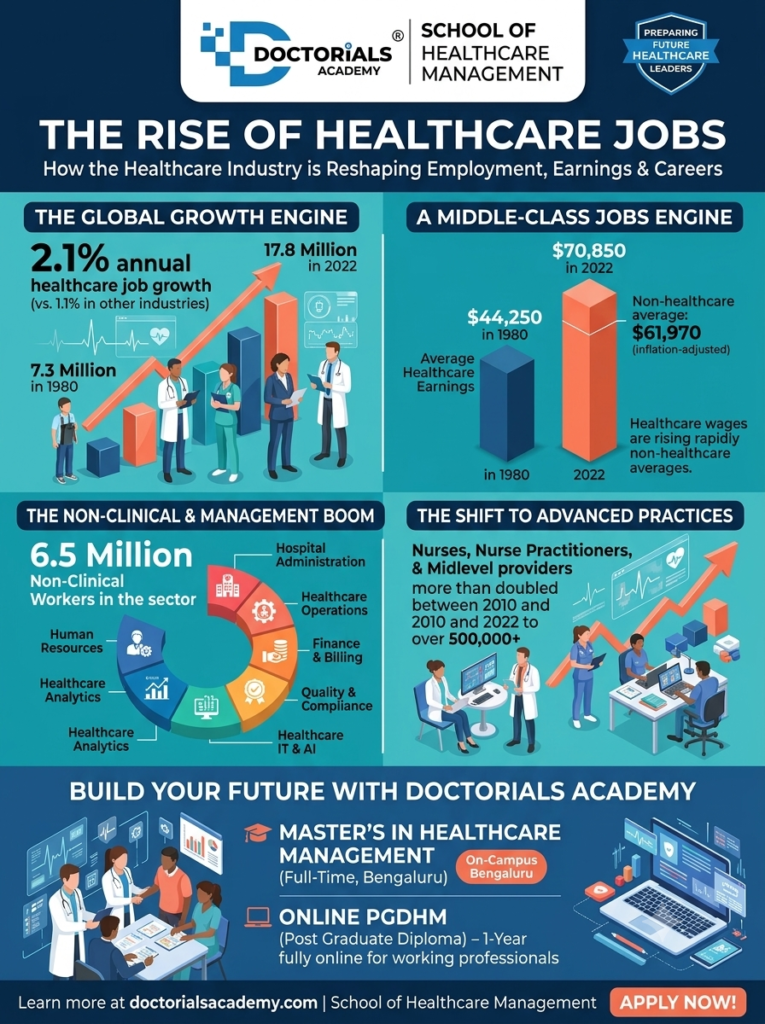
- Healthcare employment grew approximately 2.1% annually between 1980 and 2022.
- Employment in non-healthcare industries grew approximately 1.1% annually during the same period.
- Healthcare employment increased from approximately 7.3 million workers in 1980 to 17.8 million in 2022.
- Healthcare’s share of the labor force increased from 6.8% to 10.4%.
- Healthcare overtook manufacturing in employment in 2006 and retail trade in 2009.
These findings demonstrate the growing role of healthcare in the U.S. labor market.
A Shift in the Employment Landscape
Historically, manufacturing, retail, and other industries played central roles in employment generation. However, the expansion of healthcare services has created a broader range of professional opportunities.
Healthcare organizations require more than doctors and nurses. Hospitals, diagnostic centers, pharmaceutical companies, health technology organizations, and insurance providers also depend on professionals working in:
- Healthcare administration
- Hospital operations
- Finance and billing
- Human resources
- Healthcare information technology
- Quality management
- Patient experience
- Healthcare analytics
- Supply chain management
The growth of healthcare employment highlights the importance of understanding both clinical services and the systems that support healthcare delivery.
It is important to recognize that the NBER study focuses on the United States. Its findings should not automatically be interpreted as direct employment statistics for India or other countries.
1. Healthcare Has Become a Significant Source of Middle-Class Employment
Employment Growth and Earnings: What Does the Research Reveal?
The NBER study identifies an important trend: healthcare employment has expanded alongside substantial earnings growth, particularly across the middle and upper-middle portions of the earnings distribution.
The researchers describe healthcare as a modern “jobs engine” because of its combination of employment expansion and earnings growth.
Healthcare Earnings Have Increased Over Time
Between 1980 and 2022:
| Indicator | 1980 | 2022 |
|---|---|---|
| Average healthcare worker earnings | $44,250 | $70,850 |
| Average non-healthcare worker earnings | $46,200 | $61,970 |
| Healthcare employment | 7.27 million | 17.78 million |
Figures are based on the study’s inflation-adjusted 2022-dollar estimates.
The research reports that average healthcare earnings increased from approximately 4% below average non-healthcare earnings to approximately 14% above them during the study period.
What Does This Mean for Healthcare Professionals?
The findings suggest that healthcare career opportunities should not be understood only through the lens of traditional medical professions.
Healthcare includes a wide range of occupations with different education requirements, responsibilities, and earning patterns.
For students and graduates, this highlights the importance of exploring career paths that match their:
- Educational background
- Professional interests
- Technical and management skills
- Long-term career goals
A healthcare career can involve patient care, organizational leadership, technology, administration, or specialized support services.
2. The Growing Importance of Nurses and Advanced Practice Professionals
How Is the Healthcare Workforce Changing?
The NBER research examines several clinical occupational groups, including physicians, nurses, aides, and midlevels.
In the paper, midlevels refers to a group that includes nurse practitioners, physician assistants, certified registered nurse anesthetists, and certified nurse midwives. The researchers analyze this category primarily from 2010 to 2022 because consistent occupational classification was not available for earlier years.
Midlevel Employment More Than Doubled
Between 2010 and 2022:
- Midlevel employment increased from approximately 227,000 to 505,000 workers.
- Employment in this category increased by more than 120%.
- The number of physicians relative to midlevel professionals declined during the period.
The paper also references HRSA research indicating that midlevel professionals provided more than half of primary care services in the United States in 2022.
Why Does This Matter?
The growth of different healthcare occupations reflects changes in how healthcare services are organized and delivered.
Healthcare systems require professionals with a variety of capabilities, including:
- Clinical expertise
- Patient coordination
- Service delivery management
- Workforce planning
- Operational efficiency
- Healthcare quality improvement
However, the employment trends in the research should not be interpreted as evidence that one profession will replace another. The study discusses potential explanations for the growth of nurses and midlevels, including workforce supply constraints and technological changes, but identifies the need for further research.
3. Healthcare Careers Are Expanding Beyond Traditional Clinical Roles
Why Are Non-Clinical Healthcare Jobs Important?
When people think about healthcare careers, they often focus on doctors, nurses, and other clinical professionals.
However, the healthcare industry also depends on a substantial non-clinical workforce.
The NBER study includes professionals working in healthcare organizations who do not report clinical occupations, such as:
- Managers
- Billing specialists
- Administrative staff
- Support workers
- Security personnel
The research recorded approximately 6.5 million non-clinical healthcare workers in 2022, compared with approximately 2.9 million in 1980.
The Increasing Need for Healthcare Management Professionals
As healthcare organizations expand, their operational requirements also become more complex.
Hospitals and healthcare institutions must coordinate multiple functions, including:
Patient Services → Operations → Finance → Human Resources → Quality → Technology
Effective coordination across these functions supports the delivery of healthcare services.
This creates opportunities for professionals interested in healthcare administration and management.
Potential career areas include:
| Career Area | Typical Focus |
|---|---|
| Hospital Administration | Managing institutional operations |
| Healthcare Operations | Coordinating processes and service delivery |
| Healthcare Finance | Budgeting, financial management, and billing |
| Quality Management | Monitoring and improving service quality |
| Healthcare Human Resources | Workforce planning and employee management |
| Healthcare Analytics | Using data to support organizational decisions |
| Health IT Management | Coordinating digital healthcare systems |
The research establishes the importance of the broader healthcare workforce, while specific career opportunities and employment requirements depend on the country, employer, and role.
4. The Healthcare Industry Is Experiencing Changes in Workforce Demographics
Women and Internationally Born Workers in Healthcare
Healthcare employment growth is not only about the number of jobs created. It is also about who participates in the workforce and how professional roles evolve.
The NBER study examines gender and foreign-born workforce patterns in the United States between 1980 and 2022.
Women’s Participation in Healthcare
The research reports that:
- Women accounted for approximately 76% of healthcare employment in both 1980 and 2022.
- The female share of physicians increased from 13.3% to 39.8%.
- Nursing and aide occupations remained predominantly female, although the male share increased.
These findings demonstrate that the overall gender composition of healthcare employment remained relatively stable while occupational patterns changed.
Why Workforce Diversity Matters
Healthcare organizations serve diverse populations and require professionals with different experiences and skills.
Workforce development involves more than increasing the number of employees. It also involves supporting appropriate education, professional growth, and opportunities across different occupational groups.
The study’s findings provide a basis for understanding these demographic changes, but they do not establish the effects of workforce diversity on healthcare quality or organizational performance.
5. Can Healthcare Replace Manufacturing Jobs?
Understanding the “Manufacturing to Meds” Debate
One of the most interesting parts of the NBER research examines whether regions that experienced manufacturing job losses systematically transitioned into healthcare employment.
This idea is sometimes described as a shift from “manufacturing to meds.”
The concept suggests that healthcare could help communities adapt when manufacturing employment declines, particularly because hospitals and healthcare organizations can serve as important local institutions.
However, the study finds limited evidence of a systematic transition across regions.
What Did the Researchers Discover?
The analysis examined geographic regions across the United States and compared manufacturing employment losses with healthcare employment growth.
The study estimates that healthcare employment growth offset approximately 11% of manufacturing job losses, which was only slightly greater than the benchmark expected based on healthcare’s employment share.
The researchers also identified differences across demographic groups, including stronger offsetting effects for white women and college-educated workers.
The Broader Lesson
Healthcare employment growth does not automatically mean that every region experiencing manufacturing decline can successfully transition to healthcare.
A successful healthcare employment ecosystem may depend on several factors, including:
- Healthcare infrastructure
- Availability of skilled workers
- Educational institutions
- Investment
- Regional demand
- Organizational capacity
The study is descriptive and does not establish that manufacturing losses directly caused healthcare employment growth.
6. Technology and the Future of Healthcare Employment
How Could Technology Reshape Healthcare Careers?
Healthcare is increasingly connected to technology, data, and digital systems.
The NBER paper discusses technological innovation as one possible explanation for differences in earnings growth across healthcare occupations. The authors suggest that technological advances may have affected the demand for different types of healthcare workers, while emphasizing that further research is necessary.
Emerging Areas of Healthcare Technology
Healthcare technology includes a broad range of applications, such as:
- Electronic health records
- Healthcare analytics
- Telemedicine
- Digital health platforms
- Hospital information systems
- Artificial intelligence applications
- Patient scheduling systems
- Healthcare automation
These technologies may create new responsibilities for professionals who can understand both healthcare processes and technological tools.
Why Healthcare Management Education Matters
Healthcare professionals increasingly need to understand how clinical services, organizational systems, and technology interact.
A healthcare management education can introduce students to areas such as:
- Healthcare administration
- Hospital operations
- Healthcare finance
- Human resource management
- Healthcare quality
- Healthcare information systems
- Strategic planning
The specific value of any program depends on its curriculum, teaching quality, institutional recognition, and the student’s career objectives.
7. What Does the Rise of Healthcare Jobs Mean for Students?
Healthcare Education Is Becoming Increasingly Diverse
The research provides insights into the changing healthcare labor market in the United States. For students considering healthcare-related careers, one important takeaway is that the sector includes a variety of professional pathways.
Students do not necessarily need to pursue the same educational route to work in healthcare.
Career preparation depends on the occupation and its requirements.
Clinical and Non-Clinical Career Pathways
| Clinical Pathways | Non-Clinical Pathways |
|---|---|
| Medicine | Hospital Administration |
| Nursing | Healthcare Operations |
| Allied Health | Healthcare Finance |
| Patient Care | Healthcare Human Resources |
| Clinical Support | Healthcare Analytics |
The educational requirements differ across these fields. Clinical professions often involve regulated qualifications and professional training, while management and administrative roles may have different academic and experience requirements.
Why Healthcare Management Deserves Attention
Healthcare organizations need professionals who can help coordinate people, processes, resources, and services.
Students from diverse undergraduate backgrounds may explore healthcare management education, depending on the eligibility requirements of the institution and program.
For students interested in hospital operations, healthcare administration, and organizational leadership, studying healthcare management can be one potential educational pathway.
8. Healthcare Management: Connecting Education With Industry Needs
Developing the Next Generation of Healthcare Professionals
The expansion of healthcare organizations creates a need for professionals who understand how healthcare institutions function.
Healthcare management education focuses on the organizational and operational aspects of healthcare delivery.
It can help students develop knowledge in areas such as:
Hospital Administration
Understanding hospital departments, organizational structures, and institutional operations.
Healthcare Operations
Learning how healthcare services and processes are coordinated.
Healthcare Finance
Exploring budgeting, financial planning, and healthcare-related financial processes.
Quality Management
Understanding approaches to monitoring and improving organizational performance.
Human Resource Management
Learning about healthcare workforce planning and employee management.
Healthcare Technology
Developing an understanding of digital systems and technology applications in healthcare.
Healthcare management brings together organizational knowledge and healthcare-sector understanding, creating an academic pathway for students interested in the business and operational side of healthcare.
9. Doctorials Academy: Building Skills for Healthcare Management Careers
Explore a Master’s in Healthcare Management Through Doctorials Academy
As the healthcare industry continues to evolve, students can explore educational programs designed to build their understanding of healthcare administration, management, and organizational operations.
Doctorials Academy offers Master’s in Healthcare Management / PGDHM learning pathways through online and full-time programs.
The programs are intended for students and professionals who want to develop knowledge of healthcare management and explore career opportunities in healthcare-related organizations.
Full-Time Healthcare Management Program
Doctorials Academy’s full-time program in Bengaluru provides an on-campus learning pathway for students interested in healthcare management.
The program is positioned for graduates from different academic backgrounds, subject to applicable eligibility and institutional requirements.
Students can explore healthcare management topics and develop an understanding of how healthcare organizations operate.
Program highlights:
- Full-time, on-campus learning
- Healthcare management-focused education
- Exposure to organizational and operational concepts
- Opportunities to build professional knowledge
- Career guidance and placement assistance, subject to applicable policies
Online PGDHM Program
Doctorials Academy also offers a one-year fully online Post Graduate Diploma in Healthcare Management (PGDHM).
The online pathway is designed for learners who prefer studying through a digital learning environment.
Program highlights:
- Fully online learning format
- Healthcare management-focused curriculum
- Flexible learning access
- Suitable for learners seeking to develop healthcare management knowledge
- Opportunity to study alongside other commitments, depending on the program structure
For complete program details, eligibility, curriculum, and current admission information, students should visit the official Doctorials Academy website.
👉 Explore Doctorials Academy Healthcare Management Programs:
Visit Doctorials Academy
10. What Can Students Learn From the Future of Healthcare Employment?
The NBER research provides several important observations about the evolution of healthcare employment.
However, it is essential to distinguish between the study’s documented findings and broader conclusions about education and career planning.
Key Takeaway 1: Healthcare Is a Major Employment Sector
Healthcare employment grew substantially faster than non-healthcare employment in the United States during the study period.
Key Takeaway 2: Career Opportunities Extend Beyond Clinical Roles
The healthcare workforce includes clinical and non-clinical occupations, including management and administrative roles.
Key Takeaway 3: Workforce Patterns Are Changing
The study identifies changes in gender composition across occupations and differences in foreign-born workforce representation.
Key Takeaway 4: Regional Transitions Are Complex
Healthcare employment growth did not systematically replace manufacturing employment across regions.
Key Takeaway 5: Education and Skills Matter
Students exploring healthcare careers should consider the requirements of their preferred occupations and the skills relevant to their professional goals.
Conclusion: The Future of Healthcare Careers Is Broader Than Ever
The rise of healthcare employment represents a significant development in the U.S. labor market.
The NBER study shows that healthcare employment expanded substantially between 1980 and 2022, accompanied by earnings growth and changes in occupational and demographic patterns.
The research also highlights an important distinction: Healthcare growth is not simply about creating more clinical jobs. It involves a broader workforce that supports the delivery, management, and organization of healthcare services.
For students and professionals exploring healthcare careers, understanding this wider employment landscape can help inform educational and career planning.
Healthcare management, hospital administration, healthcare analytics, and other non-clinical fields represent areas that learners may investigate alongside traditional clinical pathways.
The future of healthcare depends not only on those who deliver care but also on the professionals who help healthcare organizations function effectively.
Frequently Asked Questions (FAQs)
1. Why are healthcare jobs growing faster than other industries?
The NBER study documents faster healthcare employment growth than non-healthcare employment in the United States between 1980 and 2022. It examines employment and earnings trends but does not establish a single cause for the entire expansion.
2. What are the major healthcare career opportunities?
Healthcare careers include clinical professions such as medicine and nursing, as well as non-clinical roles in hospital administration, operations, finance, human resources, and healthcare technology.
3. Is healthcare management a good field to study?
Healthcare management is an educational and professional field focused on the organization and administration of healthcare services. Its relevance to an individual depends on their career goals, qualifications, and the opportunities available in their target market.
4. Can graduates from different backgrounds study healthcare management?
Some healthcare management programs accept graduates from a range of academic backgrounds. Eligibility varies by institution and program, so students should verify the specific requirements before applying.
5. Does this NBER study focus on healthcare jobs in India?
No. The research analyzes healthcare employment in the United States from 1980 to 2022. Its findings should not be treated as direct employment statistics for India.
Research Source
Gottlieb, Joshua D., Neale Mahoney, Kevin Rinz, and Victoria Udalova. “The Rise of Healthcare Jobs.” NBER Working Paper No. 33583, March 2025.
The paper is a working paper circulated for discussion and has not been peer-reviewed by the NBER Board.
Official research paper: NBER Working Paper No. 33583
Full article given below.
https://www.nber.org/system/files/working_papers/w33583/w33583.pdf
Build Your Future in Healthcare with Doctorials Academy
Master’s in Healthcare Management (PGDHM) – Full-Time & Online Programs
Healthcare is evolving. Are you ready to become the next generation of healthcare management professionals? 🏥🚀
The healthcare industry is no longer limited to doctors and nurses. Modern hospitals, healthcare organizations, pharmaceutical companies, diagnostic centres, insurance providers and digital health companies need skilled professionals who understand healthcare operations, administration, leadership and business management.
At Doctorials Academy, we help students and graduates explore healthcare management education through our Full-Time and Online PGDHM programs, designed to develop knowledge relevant to the evolving healthcare industry.
Whether you are a fresh graduate, healthcare professional, doctor, nurse or someone looking to transition into healthcare management, our programs provide an opportunity to explore the business and operational side of healthcare.
🌟 Why Choose a Career in Healthcare Management?
India’s healthcare sector is developing rapidly, creating demand for professionals who can contribute to efficient operations, quality improvement and patient-centred services.
A healthcare management career can open pathways into:
🏥 Hospital Administration
📊 Healthcare Operations
💼 Healthcare Business Development
🛡️ Healthcare Quality Management
💰 Healthcare Finance & Billing
👥 Healthcare Human Resources
💻 Digital Health & Healthcare Technology
🌍 Medical Tourism & Healthcare Services
Your healthcare career can go beyond clinical practice. Explore the management side of an industry that serves millions of people.
🎓 1. Full-Time PGDHM – On-Campus Healthcare Management Education
📍 Study, Learn, Network and Build Your Healthcare Career
Doctorials Academy’s full-time healthcare management program is designed for students who prefer an on-campus learning experience.
The program provides an opportunity to engage with classroom learning, academic activities and exposure to healthcare management concepts.
✨ What Makes Full-Time Learning Attractive?
📚 Classroom-Based Learning
Engage in structured academic sessions and develop an understanding of healthcare management principles.
🤝 Industry Exposure
Explore healthcare operations and organizational practices through relevant academic and practical learning opportunities.
👨🏫 Faculty Interaction
Learn through discussions, guidance and academic engagement.
🏥 Healthcare Management Knowledge
Understand the operational, administrative and organizational aspects of healthcare delivery.
🌐 Professional Networking
Interact with fellow students and develop professional connections.
📍 Full-Time Program Location
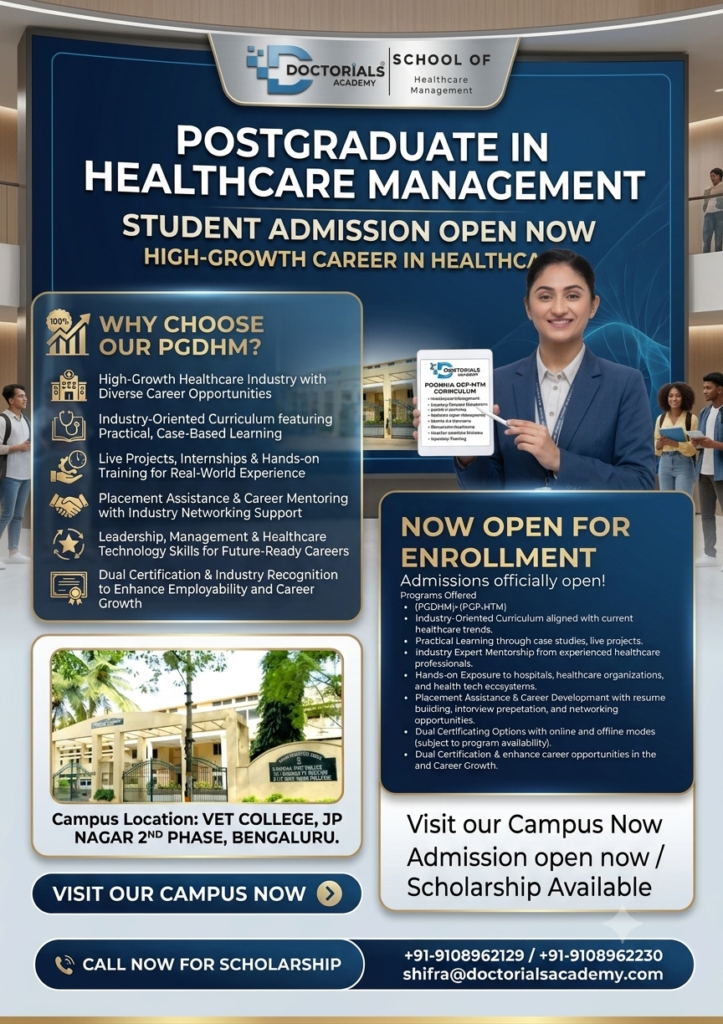
VET First Grade College Campus
Diploma Block, Second Floor
JP Nagar 2nd Phase, Bengaluru, Karnataka
📌 Students are advised to confirm the latest campus details, programme structure and admission availability with Doctorials Academy.
💻 2. Online PGDHM – Learn Healthcare Management Flexibly
🚀 Advance Your Healthcare Career Without Leaving Your Current Commitments
Do you want to study healthcare management while continuing your job, business or other responsibilities?
Doctorials Academy’s online learning pathway offers an opportunity to explore healthcare management education through a flexible learning format.
Online learning can be particularly relevant for:
✅ Working professionals
✅ Graduates seeking career transition
✅ Healthcare professionals
✅ Students managing other commitments
✅ Learners seeking remote access to education
✨ Benefits of Exploring Online Healthcare Management Education
🕒 Learning Flexibility
Study through an online format that can support different schedules.
🌍 Accessible Learning
Explore healthcare management education from locations outside Bengaluru, subject to programme arrangements.
📖 Career-Oriented Knowledge
Develop foundational knowledge in hospital administration, healthcare operations and management.
💼 Professional Development
Build knowledge that may complement existing experience and future career plans.
📈 Continuous Learning
Explore healthcare management while pursuing professional and personal commitments.
📌 The actual delivery format, live sessions, recorded content, examinations and academic requirements should be confirmed with the admissions team.
🎯 Who Can Apply for PGDHM?
Your Undergraduate Degree Can Be Your First Step Toward Healthcare Management
Healthcare management education may be relevant to graduates from different academic backgrounds, subject to programme eligibility.
Potential applicants include:
🎓 BBA Graduates
🎓 BCom Graduates
🎓 BA Graduates
🎓 BSc Graduates
🎓 BCA Graduates
🎓 BPharm Graduates
🩺 MBBS Graduates
🦷 BDS Graduates
👩⚕️ BSc Nursing Graduates
🏥 Allied Healthcare Graduates
Whether you come from a medical or non-medical background, explore the eligibility requirements and career relevance of healthcare management education.
📚 What Can You Learn Through Healthcare Management?
Healthcare management education can introduce students to important areas of healthcare administration and organizational operations.
🏥 Hospital Administration
Understand the administrative structure and coordination of healthcare organizations.
📊 Healthcare Operations
Explore operational processes, service coordination and healthcare delivery systems.
💰 Healthcare Finance
Develop an understanding of financial concepts, budgeting and healthcare billing.
🛡️ Healthcare Quality Management
Learn about quality improvement, documentation and accreditation-related concepts.
👥 Healthcare Human Resources
Explore workforce management, recruitment and employee coordination.
📈 Healthcare Business Development
Understand healthcare markets, partnerships and organizational growth.
💻 Digital Health
Explore the role of technology and information systems in modern healthcare.
📌 The specific subjects, modules and learning outcomes depend on the programme curriculum.
💼 Career Opportunities After Healthcare Management Education
A healthcare management qualification can help students explore different non-clinical career directions.
Potential Career Roles
| Career | Area of Work |
|---|---|
| Hospital Administration Executive | Administrative coordination |
| Healthcare Operations Executive | Hospital operations |
| Patient Relations Executive | Patient service support |
| Healthcare Quality Executive | Quality and documentation |
| Healthcare HR Executive | Human resources |
| Healthcare Business Development Executive | Partnerships and growth |
| Healthcare Project Coordinator | Healthcare projects |
| Insurance/TPA Executive | Insurance administration |
Important: Job titles, eligibility and employment opportunities depend on the employer, qualifications, skills and experience. Programme completion does not guarantee employment or a specific salary.
🌟 Why Explore Doctorials Academy?
Healthcare Education Focused on Your Career Aspirations
At Doctorials Academy, we aim to support learners exploring healthcare education and professional development.
Our healthcare management learning opportunities are relevant to students who want to understand the administrative and operational side of the healthcare industry.
What Students Can Explore
📚 Healthcare Management Education
🏥 Healthcare Industry Knowledge
💼 Career-Oriented Learning
🌐 Full-Time and Online Learning Options
🎯 Professional Development
Explore the programme, understand the curriculum and choose the learning format that aligns with your educational goals.
🎁 Scholarship Opportunities
Your Healthcare Education Journey Deserves Support
Doctorials Academy provides scholarship application opportunities for eligible students, subject to applicable criteria and institutional approval.
🎓 Interested in pursuing healthcare management?
Submit your scholarship application and explore the available opportunities.
🔗 Apply for Scholarship:
https://doctorialsacademy.com/apply-now-copy/
📌 Scholarship availability, eligibility and award terms should be confirmed with the admissions team.
🚀 Full-Time or Online? Choose Your Learning Pathway
| Feature | Full-Time | Online |
|---|---|---|
| Learning format | On-campus | Online |
| Suitable for | Students preferring classroom learning | Learners seeking online access |
| Academic engagement | Campus-based sessions | Online learning activities |
| Flexibility | Structured schedule | Subject to online arrangements |
| Career focus | Healthcare management | Healthcare management |
| Location | Bengaluru | Location-independent, subject to programme arrangements |
Both formats require students to evaluate their learning preferences, academic requirements and professional goals.
📢 Admissions Open – Explore Your Healthcare Management Journey!
🎓 Master’s in Healthcare Management (PGDHM)
Are you ready to explore the world of hospital administration, healthcare operations and management?
Whether you are a fresh graduate, healthcare professional or someone interested in a healthcare career transition, Doctorials Academy invites you to explore its full-time and online healthcare management learning opportunities.
🏥 Learn Healthcare. Understand Management. Build Your Future.
📍 Full-Time Program – Bengaluru
💻 Online Program – Flexible Learning Format
🎁 Scholarship Application Available
🔗 Apply Now:
https://doctorialsacademy.com/apply-now-copy/
🌐 Visit Doctorials Academy:
https://doctorialsacademy.com/
📞 Call / WhatsApp: 9108962129
📱 Short Promotional Version for Social Media
🚀 Your Future in Healthcare Management Starts Here! 🏥
Dreaming of a career in Hospital Administration, Healthcare Operations, Quality Management or Digital Health?
🎓 Explore Master’s in Healthcare Management (PGDHM) at Doctorials Academy!
✨ Full-Time Classes in Bengaluru
💻 Online Learning Options
🎯 Open to Eligible Graduates from Diverse Backgrounds
🎁 Scholarship Application Opportunities
Whether you’re from BBA, BCom, BA, BSc, BCA, BPharm, MBBS, BDS or Nursing—explore your healthcare management pathway!
📢 Admissions Open – Take the Next Step!
🔗 Apply Now: https://doctorialsacademy.com/apply-now-copy/
📞 Call / WhatsApp: 9108962129

