
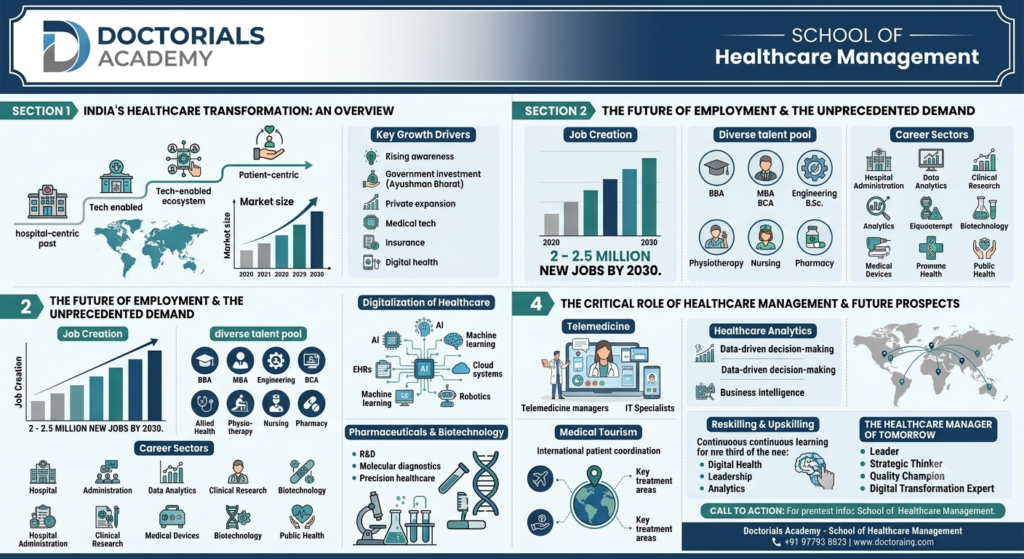
India’s healthcare industry is undergoing one of the most remarkable transformations in its history. What was once viewed as a sector primarily focused on hospitals, doctors, and nurses has now evolved into a dynamic ecosystem powered by technology, innovation, management, research, and patient-centric services. Today, healthcare is not just about treating illnesses—it is about building a sustainable healthcare infrastructure capable of serving over 1.4 billion people while simultaneously creating millions of employment opportunities. As India progresses toward becoming one of the world’s largest healthcare markets, the demand for skilled professionals across every segment of the industry is growing rapidly, making healthcare one of the most promising career sectors for the next decade.
The Indian healthcare industry has witnessed unprecedented growth over the past few years due to rising healthcare awareness, increased government investment, expansion of private hospitals, advancements in medical technology, health insurance penetration, and digital healthcare solutions. The COVID-19 pandemic further highlighted the importance of a resilient healthcare system and accelerated investments in hospitals, diagnostics, pharmaceuticals, telemedicine, healthcare technology, and public health infrastructure. Today, healthcare is recognized as one of the strongest pillars supporting India’s economic growth while improving the quality of life for millions of citizens.
Industry experts estimate that India’s healthcare sector will create between 2 and 2.5 million new jobs by 2030, making it one of the country’s largest employment generators. This growth is not limited to doctors, nurses, or pharmacists. Instead, it extends across a wide range of disciplines, including hospital administration, healthcare management, healthcare information technology, clinical research, biotechnology, diagnostics, medical devices, healthcare consulting, health insurance, and digital health services. As hospitals continue to expand and healthcare services become increasingly organized and technology-driven, the industry requires professionals who can efficiently manage operations, improve patient experiences, ensure regulatory compliance, and support sustainable healthcare delivery.
One of the most significant drivers of this transformation is the rapid digitalization of healthcare. Hospitals across India are adopting Electronic Health Records (EHRs), Artificial Intelligence (AI), Machine Learning, cloud-based hospital management systems, robotics, remote patient monitoring, and telemedicine platforms to improve patient care and operational efficiency. These technologies are fundamentally changing how healthcare organizations function, creating new career opportunities for professionals with expertise in healthcare management, data analytics, digital transformation, and healthcare informatics. The healthcare workforce of the future will require a combination of clinical understanding, technological proficiency, leadership skills, and business management capabilities.
The expansion of healthcare infrastructure is another major factor contributing to employment growth. India continues to witness the establishment of multi-specialty hospitals, super-specialty medical centers, diagnostic laboratories, rehabilitation facilities, day-care centers, and specialized clinics in both metropolitan and emerging cities. Government initiatives such as Ayushman Bharat, increased public healthcare investments, and greater participation from private healthcare providers are significantly expanding access to quality healthcare services. As new hospitals are established, the need for skilled administrators, operations managers, quality managers, human resource professionals, finance executives, procurement specialists, patient relationship managers, and healthcare consultants continues to rise.
Healthcare management has emerged as one of the most critical components of modern healthcare systems. Running a hospital today requires far more than medical expertise alone. Hospitals are complex organizations that must efficiently manage thousands of patients, hundreds of healthcare professionals, advanced medical equipment, financial resources, regulatory requirements, insurance claims, accreditation standards, and patient satisfaction initiatives. Healthcare managers ensure that these diverse operations function seamlessly while maintaining the highest standards of quality and patient safety. Their role directly impacts the efficiency, profitability, and reputation of healthcare organizations.
Another area witnessing exceptional growth is digital health and telemedicine. The increasing availability of smartphones, internet connectivity, wearable health devices, and virtual consultation platforms has transformed the delivery of healthcare services across India. Patients can now consult doctors remotely, access digital prescriptions, monitor chronic conditions through connected devices, and receive healthcare support without visiting hospitals. This shift has created demand for telehealth coordinators, digital health managers, healthcare IT specialists, cybersecurity professionals, and clinical informatics experts who can bridge the gap between healthcare delivery and technology.
The pharmaceutical and biotechnology industries also continue to expand rapidly, positioning India as one of the world’s leading manufacturers of medicines and vaccines. Pharmaceutical companies are investing heavily in research and development, clinical trials, regulatory affairs, pharmacovigilance, and drug safety. Biotechnology firms are driving innovation in genomics, personalized medicine, vaccine development, molecular diagnostics, and precision healthcare. These industries require a highly skilled workforce capable of supporting scientific research, product development, quality assurance, and regulatory compliance.
Medical tourism has become another powerful contributor to India’s healthcare economy. Every year, thousands of international patients travel to India seeking high-quality medical treatment at affordable costs. India has established itself as a preferred destination for complex surgeries, organ transplantation, cardiac care, orthopedics, oncology, fertility treatments, cosmetic surgery, and advanced diagnostics. This growing sector has created opportunities not only for healthcare providers but also for professionals specializing in international patient coordination, hospital marketing, healthcare hospitality, travel management, and multilingual patient services.
Healthcare analytics has emerged as a game-changing field within the industry. Modern hospitals generate enormous volumes of patient data, operational metrics, financial records, and clinical outcomes every day. Organizations increasingly rely on data analytics to improve patient care, optimize hospital operations, predict disease patterns, reduce healthcare costs, and support strategic decision-making. As a result, healthcare organizations are actively recruiting professionals with expertise in healthcare analytics, business intelligence, health informatics, and data-driven decision-making.
One of the most encouraging aspects of the healthcare industry’s growth is that career opportunities are no longer limited to medical graduates alone. Today, hospitals and healthcare organizations actively recruit graduates from diverse educational backgrounds, including BBA, B.Com, BA, B.Sc., BCA, MBA, Engineering, Life Sciences, Biotechnology, Pharmacy, Nursing, Allied Health Sciences, Public Health, Microbiology, Physiotherapy, and many other disciplines. This diversity reflects the evolving nature of healthcare, where clinical excellence must be supported by strong business operations, financial management, technology, marketing, logistics, supply chain management, and human resource development.
As healthcare organizations become increasingly technology-driven, industry experts also predict that nearly one-third of the existing healthcare workforce will require reskilling and upskilling over the coming years. Professionals who continuously enhance their knowledge in digital health, healthcare management, quality systems, artificial intelligence, healthcare regulations, and leadership will enjoy significantly better career prospects than those relying solely on traditional qualifications. Continuous learning is becoming an essential requirement rather than an optional advantage in the healthcare industry.
The demand for qualified healthcare professionals is also expanding beyond India’s borders. Countries across the Middle East, Europe, Australia, Canada, Southeast Asia, and the United Kingdom continue to seek skilled Indian healthcare professionals due to their strong educational background, adaptability, and clinical competence. As global healthcare systems face workforce shortages, Indian professionals with specialized management and administrative skills will find increasing opportunities in international healthcare organizations.
Looking ahead, healthcare management is expected to become one of the most attractive career choices for graduates who aspire to combine leadership, business strategy, and healthcare services. The healthcare manager of tomorrow will not only supervise hospital operations but will also lead digital transformation initiatives, implement quality improvement programs, manage healthcare finances, oversee regulatory compliance, improve patient experiences, and contribute to organizational growth. These responsibilities make healthcare management one of the most influential and rewarding professions within the healthcare ecosystem.
Recognizing this growing industry demand, Doctorials Academy offers the Post Graduate Diploma in Healthcare Management (PGDHM), a comprehensive one-year program designed to prepare graduates for leadership roles in hospitals and healthcare organizations. The curriculum has been carefully developed to align with current industry requirements and covers essential subjects such as hospital administration, healthcare operations, healthcare quality management, NABH accreditation, healthcare laws and ethics, health insurance, digital health, telemedicine, healthcare marketing, finance, human resource management, leadership, communication, and strategic hospital management. Available in both online and offline modes, the program emphasizes practical knowledge, industry exposure, and placement assistance to help students transition successfully into healthcare careers.
Doctorials Academy believes that the future of healthcare depends not only on excellent doctors and nurses but also on visionary healthcare managers who can build efficient, patient-centered, and technology-enabled healthcare systems. Through its industry-oriented curriculum, experienced faculty, practical learning approach, and career support, the academy empowers graduates from both medical and non-medical backgrounds to become future healthcare leaders.
In conclusion, India’s healthcare industry is entering a golden era of growth, innovation, and employment. With millions of new jobs expected by 2030, increasing investments in healthcare infrastructure, rapid technological advancements, expanding medical tourism, and growing demand for professional healthcare management, the sector offers exceptional opportunities for aspiring professionals. For graduates seeking a stable, respected, and future-proof career, healthcare management represents one of the smartest choices they can make. By acquiring industry-relevant skills through specialized programs like the PGDHM offered by Doctorials Academy, students can position themselves at the forefront of one of the world’s fastest-growing and most impactful industries, contributing not only to their own professional success but also to the advancement of India’s healthcare system.
Sources & References
The information presented in this article has been compiled and adapted from reputable healthcare industry reports and educational resources to provide readers with insights into the future of India’s healthcare sector.
- The Indian Practitioner – India’s Healthcare Industry to Create Up to 2.5 Million Jobs by 2030
https://theindianpractitioner.com/indias-healthcare-industry-to-create-up-to-2-5-million-jobs-by-2030/ - SHA (School of Health Administration) – Emerging Healthcare Careers in India
https://sha.edu.in/emerging-healthcare-careers-india/
Additional Industry References
- Invest India – Healthcare Sector Overview
https://www.investindia.gov.in/sector/healthcare - National Health Authority (NHA) – Ayushman Bharat Digital Mission
https://abdm.gov.in/ - Ministry of Health & Family Welfare (Government of India)
https://www.mohfw.gov.in/ - NITI Aayog – Health and Healthcare Reports
https://www.niti.gov.in/ - IBEF (India Brand Equity Foundation) – Indian Healthcare Industry Report
https://www.ibef.org/industry/healthcare-india - National Accreditation Board for Hospitals & Healthcare Providers (NABH)
https://nabh.co/ - World Health Organization (WHO) – India Health Profile
https://www.who.int/india - Healthcare Sector Skill Council (HSSC), India
https://www.healthcare-ssc.in/ - National Skill Development Corporation (NSDC)
https://nsdcindia.org/ - All India Management Association (AIMA) – Healthcare Management Resources
https://www.aima.in/
Citation Note:
This article is an educational and career guidance resource. Industry statistics, employment projections, and healthcare trends have been referenced from publicly available reports and official sources. Readers are encouraged to visit the above websites for the latest updates, reports, and detailed information.

